






































Science and Culture Today Discovering Design in Nature
cats-2
Latest

“For He Purrs in Thankfulness”

Categories
Intelligent Design
Share
Facebook
Twitter/X
LinkedIn
Flipboard
Print
Email

One of my favorite poems (actually, a famous extract from the longer work Jubilate Agno) is Christopher Smart’s “To My Cat Jeoffrey” (1759-63). Smart was confined for insanity in the Bedlam asylum, but his description of Jeoffrey is the sanest and most accurate verbal painting of a cat in English literature. This line, about the daily presence of a cat — “For every house is incomplete without him and a blessing is lacking in the spirit” — is truth itself. 

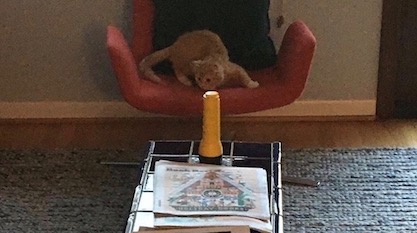
So…my wife and I took the plunge yesterday, and adopted Newton (pictured above, butterscotch tabby, stalking his brother from the orange chair) and Einstein (mostly black, on the carpet, just realizing he is being stalked). Two 12-week-old mischief makers, and our house is no longer incomplete.

One more favorite line, from Smart’s poem: “For he purrs in thankfulness, when God tells him he’s a good Cat.” Amen.

Paul Nelson

Senior Fellow, Center for Science and Culture
Paul A. Nelson is currently a Senior Fellow of Discovery Institute’s Center for Science and Culture and Adjunct Professor in the Master of Arts Program in Science & Religion at Biola University. He is a philosopher of biology who has been involved in the intelligent design debate internationally for three decades. His grandfather, Byron C. Nelson (1893-1972), a theologian and author, was an influential mid-20th century dissenter from Darwinian evolution. After Paul received his BA in philosophy with a minor in evolutionary biology from the University of Pittsburgh, he entered the University of Chicago, where he received his PhD (1998) in the philosophy of biology and evolutionary theory.
Benefiting from Science & Culture Today?
Support the Center for Science and Culture and ensure that we can continue to publish counter-cultural commentary and original reporting and analysis on scientific research, evolution, neuroscience, bioethics, and intelligent design.

© Discovery Institute