






































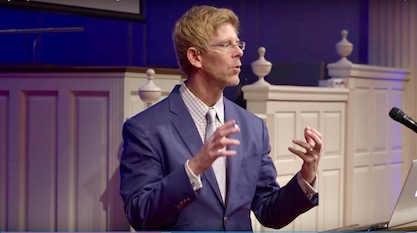
Discovery Institute Senior Fellow and Privileged Planet co-author Jay Richards was among the speakers at our Science and Faith Conference in Dallas. His presentation is now online for you:
Richards spectacularly develops a theme that materialists shy from confronting: in cosmology, it is the eerie overlap between the ultra-precisely defined parameters needed for life, and the precisely defined requirements for scientific discovery. In other words, as Dr. Richards summarizes, “If the universe is set up and fine-tuned not only for complex life, but to make discovery possible — so those rare places where life exists are also the best places for doing science, for discovering the universe around us — that suggests the universe is not just fine-tuned for life.” Instead, “The universe is fine-tuned so that environments habitable to observers will provide the best overall conditions for observation and discovery.”
That’s something quite different, suggesting a designer with an interest in having his design, from the level of an atom to that of a galaxy, recognized. But more than that: recognized not just as a feeling, an intuition, or a lesson from the Bible — but as scientific reality. You can see why science atheists, joined by some defensive theists, are most comfortable dismissing this argument with a wave of the hand and a casual slur — “creationism.”
The Meaning of a Beginning
On that last point, the beloved slur, Jay also makes a great additional observation. As you know, everything the leading book authors on intelligent design have to say about the age of the universe presumes an age in the billions not thousands of years. Yet imagine a scenario where you don’t know the ancient age of the cosmos, but rather, only that it has an age, whatever that might be. In other words, you know that the universe is finite, it has a beginning. Before that there was no universe, no physical existence at all. Unless the universe generated itself from nonexistence, an impossibility, it must have a cause outside nature.
Many scientists fought that conclusion, bitterly, because of its theistic implications. Now, having conceded a start to the cosmos, they are forced back on self-defeating speculations (that form one part of the subject of Stephen Meyer’s next book). The best science marches on and sweeps materialism before it.