






































Complete with a maddening background accompaniment on drums, here’s a brief video from the BBC purporting to explain the transition from ape ancestor to modern human. It’s part of a series claiming to answer “Big Questions.” They promise, “These are the simple steps that made us human,” 15 in all. Simple?? Only 15?? The subhead reads:
Over the course of several million years, apes gradually transformed into humans. This video shows you the key changes along the way.
More accurately, it should say:
Over the course of several million years, apes gradually transformed into humans, so it is said. This video shows you
the key changessome speculations that are currently popular in the media, but disputed in the scientific literature, about how it might have happened.
Somehow that doesn’t have quite the same punch, but they can keep the drums if they want.
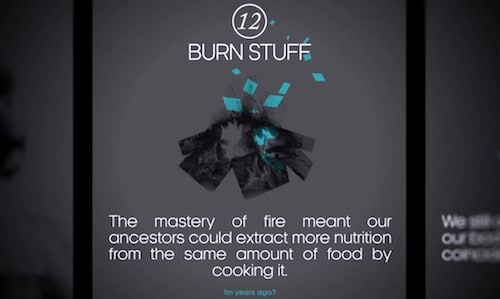
For a sense of how simplistic the presentation really is, note slide 12, above. Burn stuff? Yes, the acquisition of fire was certainly key to the rise of human civilization, as Michael Denton explains in the new video documentary from Discovery Institute, Fire-Maker: How Humans Were Designed to Harness Fire and Transform Our Planet, which goes on sale May 18.
See the trailer here:
But as Denton makes clear, the use of fire by humans was a development prepared for in the very fabrication of the cosmos — the result of extraordinary fine-tuning at many levels that could be no accident. If anything remotely similar is true of those other 14 steps, what conclusion would you draw about the advent of man? Now that’s a Big Question.