






































Yes, there are butterflies in space! Not living ones, of course, but BINOs (butterflies in name only).
When encountering the unknown, our minds try to project the familiar onto the unfamiliar. There are at least four objects in the heavens that have been named after butterflies: Three planetary nebulae and a loose cluster of stars.
M6-A is a cluster in the constellation Scorpius that shows faint bilateral symmetry (credit: Ole Nielsen, via Wikimedia Commons).


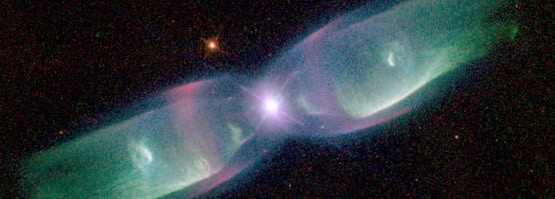
The Hubble Space Telescope has taken photographs of the three planetary nebulae named after butterflies. M6-9 has narrow, long “wings” emerging from its central star.
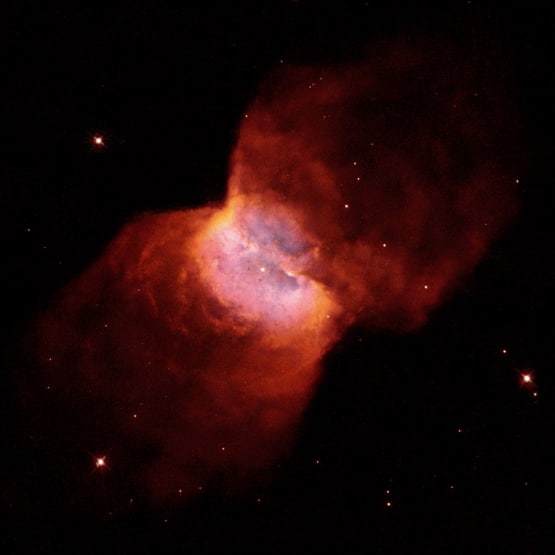
NGC 2346 resembles one of the brilliant red Heliconius butterflies of Peru, but is not nearly as intricate.
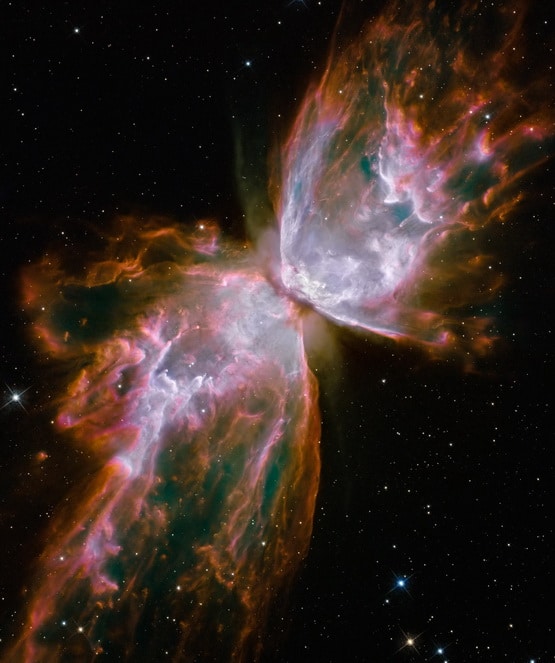
To appreciate the most beautiful of the four, see this stunning photo of NGC 6309, the Butterfly Nebula, taken by the upgraded Hubble Space Telescope. This one, with its dazzling multicolored “wings,” is aptly named.
You might say that planetary nebulae go through a kind of metamorphosis, too — beginning as compact stars, like eggs, then, through little-understood processes, transforming their insides into something totally different — something large and beautiful. But we cannot and will not extend the analogy further, because “space butterflies” do not show the irreducible complexity apparent in living ones. Though they may show intelligent design in terms of following finely-tuned laws of nature, they do not give evidence of the information-rich programming characteristic of biological systems.
Still, they, too, are beautiful.
To learn more about butterflies and the evidence they reveal for intelligent design, visit Metamorphosisthefilm.com, where you can watch the trailer and order this outstanding film from Illustra Media, now available in both DVD and Blu-Ray formats. While there, be sure to download the free companion e-book, Metamorphosis: The Case for Intelligent Design in a Chrysalis, edited by David Klinghoffer — a beautiful and informative resource to enhance your appreciation of butterflies.
To compare and contrast intelligent design evidences in astronomy and in life, be sure to see The Privileged Planet, also from Illustra Media, after watching Metamorphosis. You can watch this outstanding film on Illustra’s YouTube site and order it at ThePrivilegedPlanet.com.