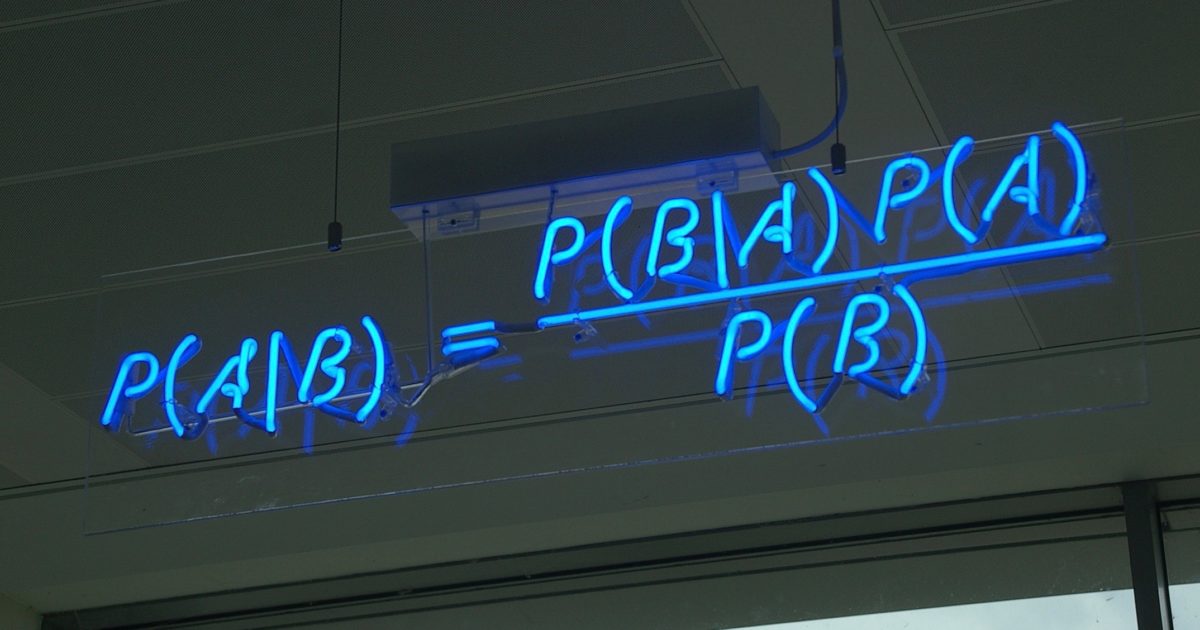
Bayes' Theorem Type post Author Andrew McDiarmid Date November 21, 2023 CategoriesBiologyEvolutionFine-tuningIntelligent Design Tagged , Bayes’s theorem, Bayesian reasoning, Big Bang, biological information, biosphere, cells, environmental fitness, evolution, ID the Future, information, information processing, intelligent design, Irreducible Complexity, Jonathan McLatchie, likelihood, Lydia McGrew, nature, Thomas Bayes Bayesian Probability and Intelligent Design: A Beginner’s Guide Andrew McDiarmid November 21, 2023 Biology, Evolution, Fine-tuning, Intelligent Design 3 If the phrase “Bayesian calculus” makes you want to run for the hills, you’re not alone! Bayesian logic can sound intimidating at first. Read More ›
COVID-19 Type post Author Cornelius Hunter Date March 16, 2022 CategoriesBiologyIntelligent DesignMedicine Tagged , Bayes’ Theorem, COVID-19, design detection, evolution, intelligent design, natural processes, Nature Medicine, New York Times, Nicholas Wade, pandemic, peer review, SARS-CoV-2, Thomas Bayes, viruses COVID-19 Meets Intelligent Design Cornelius Hunter March 16, 2022 Biology, Intelligent Design, Medicine 9 To summarize, the authors use a terrible design hypothesis, and make ever-escalating claims of certainty from two weak observations. Read More ›
Bayes'-Theorem Type post Author Jonathan McLatchie Date July 14, 2020 CategoriesEpistemologyFine-tuningIntelligent Design Tagged , Bayes’ Theorem, Big Bang, biological design, cosmic fine-tuning, evidence, helium, hydrogen, intelligent design, life, likelihood, Luke Barnes, Lydia McGrew, Stephen Meyer, Thomas Bayes, William A. Dembski, William Lane Craig A Bayesian Approach to Intelligent Design Jonathan McLatchie July 14, 2020 Epistemology, Fine-tuning, Intelligent Design 5 I have come to think of evidence in Bayesian terms and this has in turn impacted the way I think about the biological arguments for ID. Read More ›
Tree_of_Life_rear Type post Date July 23, 2018 CategoriesBiologyEngineeringEvolutionIntelligent DesignMathematics Tagged , __k-review, Bayesian reasoning, BIO-Complexity, Brian Miller, calculations, Charles Darwin, complexity, Cornelius Hunter, creationism, data, dependency graph, entropy, evolution, fundamentalism, genes, genome, intelligent design, National Center for Biotechnology Information, parsimony, software, Thomas Bayes, Tree of Life, Winston Ewert The Dependency Graph Hypothesis — How It Is Inferred Science and Culture July 23, 2018 Biology, Engineering, Evolution, Intelligent Design, Mathematics 13 Ewert proposes that life is best explained not by Darwin’s hypothesis of an ancestry tree, but by a modern design-inspired hypothesis. Read More ›