Science and Culture Today Discovering Design in Nature
Topic

__k-review

Ideas, Matter, and Faith
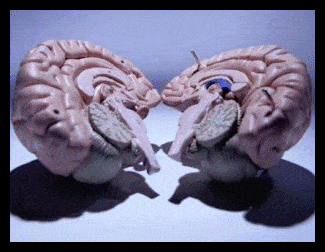
P.Z. Myers’ reply to my observation that ideas like altruism have no physical properties, like location, leaves a thoughtful observer to wonder: why do materialists have so much difficulty with this basic philosophical principle? It’s clear that ideas share no properties with matter. Ideas have no mass, or length, or temperature, or location. They’re immaterial. Clearly, under ordinary circumstances the brain is necessary for our ideas to exist, but, because matter and ideas share no properties, it’s hard to see how the brain is sufficient for ideas to exist.

Yet Myers insists that altruism is located in the brain. He’s had some trouble with my previous thought experiments, so I’ll try another:

Read More ›
The Nature Editorial: Either Intelligent Design is Science, or Senator Brownback Got it RIght

In a remarkable editorial, the editors of Nature recently responded to Senator Sam Brownback’s essay What I Think about Evolution in the New York Times. Senator Brownback wrote:

The question of evolution goes to the heart of this issue. If belief in evolution means simply assenting to microevolution, small changes over time within a species, I am happy to say, as I have in the past, that I believe it to be true. If, on the other hand, it means assenting to an exclusively materialistic, deterministic vision of the world that holds no place for a guiding intelligence, then I reject it….

Referring to materialistic evolutionary theories for the emergence of the human mind, Senator Brownback notes:

…Aspects of these theories that undermine [the] truth, however, should be firmly rejected as an atheistic theology posing as science.

Natures’ editors took Brownback to task for ‘crossing lines’:

Read More ›

Intelligent Design and the Death of the “Junk-DNA” Neo-Darwinian Paradigm

Two recent news articles are discussing the death of the junk-DNA icon of Neo-Darwinism. Wired Magazine has an article pejoratively titled “One Scientist’s Junk Is a Creationist’s Treasure” that emphasizes the positive point that intelligent design has made successful predictions on the question of “junk-DNA.” The article reports: [A] surprising group is embracing the results: intelligent-design advocates. Since the early ’70s, many scientists have believed that a large amount of many organisms’ DNA is useless junk. But recently, genome researchers are finding that these “noncoding” genome regions are responsible for important biological functions. The Wired Magazine article then quotes Discovery Institute’s Stephen Meyer explaining that this is a prediction of intelligent design that was largely unexpected under neo-Darwinian thought: “It Read More ›

‘Verizon Deniers’ Find a Cellphone

Is the brain alone necessary and sufficient to cause the mind? Here’s a thought experiment:
Imagine scientists living on an isolated island who have developed sophisticated science and culture, with one exception: they deny that telecommunication is possible. For assorted reasons, they deny that the human voice can be transmitted through space, except as vibrations in air. We’ll call this civilization the ‘Verizon Deniers.
One day, they find a cell phone (it dropped from a plane or something). They turn it on, and they hear things. They hear hissing, cracking, and what sounds like voices!

Read More ›

Plain Talk About Mike Behe’s New Book, The Edge of Evolution

The folllowing is from a sympathetic academic observer:

Having watched the spectacle of the Panda’s Thumb feeding frenzy, not to mention the Sean Carroll and Jerry Coyne reviews (and more are coming), I wanted to pass on a bit of plain talk about Mike Behe’s new book, The Edge of Evolution (EE).

  1. Don’t expect the sort of reviews that met Darwin’s Black Box (DBB) — but not because EE is inferior to DBB. Far from it.
    Read More ›

    Chronicle of Higher Education Promotes Misinformation about Guillermo Gonzalez’s Publication Rate

    Let the rewriting of history begin. The Chronicle of Higher Education‘s blog recently carried a post claiming that Guillermo Gonzalez was denied tenure by Iowa State University (ISU) largely because “Mr. Gonzalez’s publication record has dropped off considerably since he was hired at Iowa State.” But this statement is a gross distortion of Dr. Gonzalez’s real publication record. A simple decrease in publications is meaningless without reference to expected standards of publication for teaching faculty, departmental publication standards, or the publication rates of similarly situated faculty. A fair assessment would ask how Gonzalez compared to other astronomers in his department since the year he joined ISU (2001), especially compared to those astronomers that have already been granted tenure. And the Read More ›

    Recent Comments on Flock of Dodos at Telic Thoughts

    Links with more Information:Hoax of Dodos, a response to inaccuracies in Flock of DodosHaeckel’s Bogus Embryo Drawings (Clip on YouTube) There is a thread at Telic Thoughts discussing the Flock of Dodos [FOD] film where I posted a comment last week. I posted the comment after a commenter named “Randy” asked a question about Discovery Institute’s responses to the film. I repost the comment below because it clearly explains my position regarding the film, and also provides various useful links for interested readers to visit for more information:

    Evolution and Dissent: CSC Senior Fellow DeWolf in the Boston Globe

    This opinion piece by David K. DeWolf ran in the Boston Globe, yesterday.

    IT’S THE QUESTION that won’t go away. Twice during the Republican presidential debates and once at a forum for Democratic candidates, candidates were asked about evolution. For example, in the California debate all the candidates were asked to respond to the question of whether they believed in evolution. In the New Hampshire debate, follow-up questions were asked of former Arkansas governor Mike Huckabee and Kansas Senator Sam Brownback. At the Sojourners Forum debate, John Edwards was asked, “Do you believe in evolution or do you believe in creationism?”

    Read More ›

    Would Dr. Arno Penzias, Nobel Laureate in Physics, Be Blacklisted at Iowa State?

    Guillermo Gonzalez is the outstanding astronomer who was blacklisted from tenure at Iowa State University because of his support for intelligent design. As my colleagues here on ENV have pointed out, Dr. Gonzalez’ academic record is superb. Since his arrival in 2001, Dr. Gonzalez has been the most productive astronomer in his department, judged by the impact factor of his publications.

    It’s clear that Dr. Gonzalez was denied tenure for only one reason: he stated publicly that he believes there is evidence for design in the universe. As I observed in a previous post about Georges Lemaître, the Catholic priest who is the father of the Big Bang theory, many of the most prominent astronomers in history have shared Dr. Gonzalez’s opinion about the evidence for design in the universe. Nowadays, it is very dangerous to state such beliefs in science departments of many universities, including Iowa State University.

    Who else, besides Dr. Gonzalez and Dr. Lemaître, would qualify for Iowa State’s blacklist? Nobel laureate Dr. Arno Penzias (photo) meets Iowa State’s implicit criteria for denial of tenure. He has discussed his opinions regarding the philosophical ramifications of his discovery quite openly, and, in many ways, has done so in a way that was more explicitly religious than Dr. Gonzalez.

    Read More ›

    New Law Review Articles Discuss Teaching Evolution: Darwinist Law Professor Supports Censorship of ID Ideas

    In a recent law review article in Rutgers Journal of Law and Religion, Stephen A. Newman, law professor at New York Law School, provides a wonderful example of how prevalent among some academics is the idea that it is acceptable and appropriate to censor intelligent design ideas. Newman writes: Consider the experience of two librarians who received copies of two intelligent design books, Darwin’s Black Box by Michael Behe and Darwin on Trial by Philip [sic] Johnson, as donations to their high school collections. When the librarians refused to put the books on the school library shelves, they were accused of censorship. In fact, exercising their professional judgment, they concluded that these books had “little or no value to our Read More ›

    © Discovery Institute