Science and Culture Today Discovering Design in Nature
Category

Science

Chronicle of Higher Education Promotes Misinformation about Guillermo Gonzalez’s Publication Rate

Let the rewriting of history begin. The Chronicle of Higher Education‘s blog recently carried a post claiming that Guillermo Gonzalez was denied tenure by Iowa State University (ISU) largely because “Mr. Gonzalez’s publication record has dropped off considerably since he was hired at Iowa State.” But this statement is a gross distortion of Dr. Gonzalez’s real publication record. A simple decrease in publications is meaningless without reference to expected standards of publication for teaching faculty, departmental publication standards, or the publication rates of similarly situated faculty. A fair assessment would ask how Gonzalez compared to other astronomers in his department since the year he joined ISU (2001), especially compared to those astronomers that have already been granted tenure. And the Read More ›

Evolution and Dissent: CSC Senior Fellow DeWolf in the Boston Globe

This opinion piece by David K. DeWolf ran in the Boston Globe, yesterday.

IT’S THE QUESTION that won’t go away. Twice during the Republican presidential debates and once at a forum for Democratic candidates, candidates were asked about evolution. For example, in the California debate all the candidates were asked to respond to the question of whether they believed in evolution. In the New Hampshire debate, follow-up questions were asked of former Arkansas governor Mike Huckabee and Kansas Senator Sam Brownback. At the Sojourners Forum debate, John Edwards was asked, “Do you believe in evolution or do you believe in creationism?”

Read More ›

Would Dr. Arno Penzias, Nobel Laureate in Physics, Be Blacklisted at Iowa State?

Guillermo Gonzalez is the outstanding astronomer who was blacklisted from tenure at Iowa State University because of his support for intelligent design. As my colleagues here on ENV have pointed out, Dr. Gonzalez’ academic record is superb. Since his arrival in 2001, Dr. Gonzalez has been the most productive astronomer in his department, judged by the impact factor of his publications.

It’s clear that Dr. Gonzalez was denied tenure for only one reason: he stated publicly that he believes there is evidence for design in the universe. As I observed in a previous post about Georges Lemaître, the Catholic priest who is the father of the Big Bang theory, many of the most prominent astronomers in history have shared Dr. Gonzalez’s opinion about the evidence for design in the universe. Nowadays, it is very dangerous to state such beliefs in science departments of many universities, including Iowa State University.

Who else, besides Dr. Gonzalez and Dr. Lemaître, would qualify for Iowa State’s blacklist? Nobel laureate Dr. Arno Penzias (photo) meets Iowa State’s implicit criteria for denial of tenure. He has discussed his opinions regarding the philosophical ramifications of his discovery quite openly, and, in many ways, has done so in a way that was more explicitly religious than Dr. Gonzalez.

Read More ›

New Law Review Articles Discuss Teaching Evolution: Darwinist Law Professor Supports Censorship of ID Ideas

In a recent law review article in Rutgers Journal of Law and Religion, Stephen A. Newman, law professor at New York Law School, provides a wonderful example of how prevalent among some academics is the idea that it is acceptable and appropriate to censor intelligent design ideas. Newman writes: Consider the experience of two librarians who received copies of two intelligent design books, Darwin’s Black Box by Michael Behe and Darwin on Trial by Philip [sic] Johnson, as donations to their high school collections. When the librarians refused to put the books on the school library shelves, they were accused of censorship. In fact, exercising their professional judgment, they concluded that these books had “little or no value to our Read More ›

Gonzalez Co-Author Says “Tenure Denial Springs From Ignorance of Design Theory and Scientific Hubris”

The Des Moines Register has today published a letter by CSC Senior Fellow, Dr. Jay Richards, defending his and Dr. Guillermo Gonzalez’s work in their book The Privileged Planet. Below you will find the complete text of Dr. Richard’s letter.
There were additional letters published today in support of Gonzalez following the president of Iowa State University’s decision last week to uphold his denial of tenure. Two challenge Dr. John Hauptman’s op-ed from last week. Amazingly, Hauptman admitted his complete disregard for academic freedom and said that he denied tenure to Gonzalez, who he said was “very creative, intelligent and knowledgeable, highly productive scientifically and an excellent teacher,” because Gonzalez was a proponent of intelligent design. One letter pointed out:

Coincidentally, on the same day that Hauptman’s lengthy defense of his “no” vote appeared in the Register, another article in the paper noted that ISU president Gregory Geoffroy “said that, Gonzalez’s advocacy of the ‘intelligent design’ concept was not a factor in the decision to turn down his request for tenure.”

Read More ›

Michael Behe Featured on Michael Medved

Michael Behe was featured on the Michael Medved Show this week to talk about his new book, Edge of Evolution: The Search for the Limits of Darwinism, and the audio is now available here.

Bringing up the way evolution has been popping up in the presidential debates, Michael Medved had the fortunate insight to note that this isn’t an issue about evolution per se. Behe was able to respond by clarifying the debate with the right question to ask: is life the result of purpose or an accident?

Read More ›

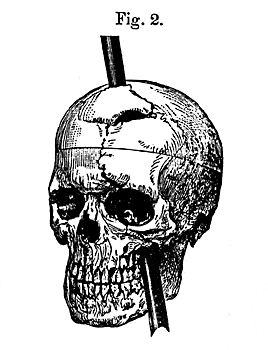
Materialist Neuroscience and an Iron Spike through the Brain

P.Z. Myers over at Pharyngula has responded to my recent post in which I criticized strict materialist explanations for the human mind. I have argued that the mind is not completely caused by the brain. By that, I mean that there are properties of the mind, such as ideas, that are not caused by brain matter alone. Brain matter cannot be the complete cause for ideas because matter and ideas share no properties. Cause and effect can’t be ‘linked’ between substances that have no properties in common. I pointed out that the materialist view that matter alone causes ideas is substantially the same as the view that ideas alone move matter, which is the pseudoscience of ‘telekinesis’.

I believe that materialism is incapable of providing an adequate explanation for the mind. Clearly ideas can influence the movement of matter (via the brain), and vice-versa, but materialism alone is inadequate to explain the link. The link between the mind and the brain must involve agency that has such non-material properties as purpose and judgment, and, as such, an adequate explanation for the mind must necessarily be open to immaterial causes.

Read More ›

Does The Panda’s Black Box “mov[e] beyond mere name-calling and finger-pointing” or continue the Darwinian trend?

Does Panda’s Black Box really contribute something new or is it just more Darwinist “name-calling and fingerpointing”? A book has come out about intelligent design, published by Johns Hopkins University Press and titled The Panda’s Black Box, that promises on its dust-jacket that it “moves beyond mere name-calling and fingerpointing.” Does it live up to its promise? Let’s look at some of the statements in the book to find out. We’ll start with my favorite quote, by bioethicist Jane Maienschein: “There is no doubt, there is no evidence against evolution, and there is no controversy about the science of evolution.” Just keep repeating that to yourself over and over again until you believe it. Other examples include Scott F. Gilbert’s Read More ›

New Textbook Seeks to Improve Teaching of Evolution by Promoting Inquiry-Based Approach

Explore Evolution: The Arguments For and Against Neo-Darwinism (Hill House Publishers Ltd., Melbourne and London, 2007) is the first biology textbook to present the scientific evidence both for and against key aspects of Darwinian evolution. “Sadly, the majority of biology textbooks in use today are ‘dumbed-down’ and do a poor job explaining evolution,” said Dr. John West of Discovery Institute, the book’s United States distributor. “Explore Evolution will improve the teaching of evolution by providing teachers and students with more information about evolution than they are likely to find in any other textbook written at the same level.” West is Associate Director of the Institute’s Center for Science and Culture. Explore Evolution promotes inquiry-based learning, encouraging students to participate in Read More ›

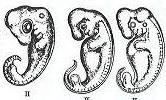
Lessons Learned from Haeckel and His Drawings: We Shouldn’t Always Believe What the “Leading Experts” Tell Us about Evolution

Links of Interest:

Hoax of Dodos, a response to inaccuracies in Flock of Dodos
Haeckel’s Bogus Embryo Drawings (Clip on YouTube)

The late Stephen Jay Gould was one of the most prominent and enthusiastic cheerleaders of biological evolution during the later decades of the Twentieth Century. As a Harvard professor who published many scholarly articles and books and taught biology, geology and the history of science, Gould was often viewed as a spokesperson for science and one of the most prestigious scientists in the world. As a frequent essayist in the popular press, Gould was also well known to the general public.

To the consternation of fellow Darwinists, Gould often told the truth about Darwin’s theory of natural selection and how it measured up against the real world. In 2000, he published an article, entitled “Abscheulich (Atrocious!): Haeckel’s distortions did not help Darwin” (Natural History, March, 2000), that gave a frank assessment of Ernst Haeckel’s infamous embryo drawings and the ethics of using them to sell Darwin’s theory to students and the public.

Read More ›

© Discovery Institute