






































Science and Culture Today Discovering Design in Nature
Category

Science

Questions and Answers from Mike Behe About The Edge of Evolution

On Mike Behe’s Amazon author’s page there is an enlightening 13 part Q&A in which he clarifies his position on a number of issues related to the debate over evolution and intelligent design. It is well worth reading, as is the new book. Here is a just a taste of the types of questions that are posed to the author: In Edge of Evolution you indicate that some of the evidence supporting common ancestry is pretty persuasive. Yet a number of scientists have questioned some of the evidence for common ancestry. Do you think it is beyond the pale for them to do so? In your mind is it scientific to question common ancestry? In my view it is certainly Read More ›
Ideas, Matter, and Faith

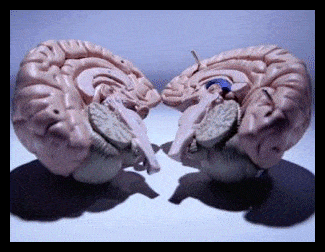
P.Z. Myers’ reply to my observation that ideas like altruism have no physical properties, like location, leaves a thoughtful observer to wonder: why do materialists have so much difficulty with this basic philosophical principle? It’s clear that ideas share no properties with matter. Ideas have no mass, or length, or temperature, or location. They’re immaterial. Clearly, under ordinary circumstances the brain is necessary for our ideas to exist, but, because matter and ideas share no properties, it’s hard to see how the brain is sufficient for ideas to exist.

Yet Myers insists that altruism is located in the brain. He’s had some trouble with my previous thought experiments, so I’ll try another:

Read More ›

The Nature Editorial: Either Intelligent Design is Science, or Senator Brownback Got it RIght

In a remarkable editorial, the editors of Nature recently responded to Senator Sam Brownback’s essay What I Think about Evolution in the New York Times. Senator Brownback wrote:

The question of evolution goes to the heart of this issue. If belief in evolution means simply assenting to microevolution, small changes over time within a species, I am happy to say, as I have in the past, that I believe it to be true. If, on the other hand, it means assenting to an exclusively materialistic, deterministic vision of the world that holds no place for a guiding intelligence, then I reject it….

Referring to materialistic evolutionary theories for the emergence of the human mind, Senator Brownback notes:

…Aspects of these theories that undermine [the] truth, however, should be firmly rejected as an atheistic theology posing as science.

Natures’ editors took Brownback to task for ‘crossing lines’:

Read More ›

Dual-Coding Genes “Nearly Impossible by Chance” — How Would Francisco Ayala Respond?

We mortals are easily impressed by palindromes — words or phrases that have the same spelling forwards and backwards. But try writing a sentence which has two different meanings: One meaning is gained when you start with one letter of the first word, and then an entirely different meaning is understood when you start reading with the second letter of the first word. Such a sentence would be most impressive, but what if such “sentences” existed in our DNA? Leading evolutionary biologist Francisco Ayala recently wrote in Proceedings for the National Academy of Sciences (PNAS) that “Chance is an integral part of the evolutionary process.” Ayala then explained why he thinks Darwinian evolution is right and ID is wrong: “Biological Read More ›

Public Schools Still Using PBS’s Evolution

Many public schools in the U.S. are still showing biology students the 2001 PBS Evolution series. This 8-hour propaganda extravaganza — like most modern biology textbooks — distorts and exaggerates the evidence to convince people that Darwinism is true. When the series was first released, Discovery Institute published a detailed 150-page Viewer’s Guide exposing the distortions and exaggerations. The Guide includes extensive references to the scientific and popular literature, as well as eight activities that teachers and students will find helpful in critically analyzing this work of pro-Darwin propaganda.

Here is an excerpt from the Introduction to Getting the Facts Straight: A Viewer’s Guide to PBS’s Evolution:

Read More ›

Intelligent Design and the Death of the “Junk-DNA” Neo-Darwinian Paradigm

Two recent news articles are discussing the death of the junk-DNA icon of Neo-Darwinism. Wired Magazine has an article pejoratively titled “One Scientist’s Junk Is a Creationist’s Treasure” that emphasizes the positive point that intelligent design has made successful predictions on the question of “junk-DNA.” The article reports: [A] surprising group is embracing the results: intelligent-design advocates. Since the early ’70s, many scientists have believed that a large amount of many organisms’ DNA is useless junk. But recently, genome researchers are finding that these “noncoding” genome regions are responsible for important biological functions. The Wired Magazine article then quotes Discovery Institute’s Stephen Meyer explaining that this is a prediction of intelligent design that was largely unexpected under neo-Darwinian thought: “It Read More ›

Science Historian Sees Behe’s Edge of Evolution as a Cultural Earthquake

Will the summer of 2007 be remembered for largest Darwin-related cultural earthquake to date? Dr. Thomas Woodward, author of Darwin Strikes Back, thinks it just might. Beyondthenews.com today published Woodward’s review of Behe’s The Edge of Evolution. Woodward says the book “is shaping up as a major turning point in the growing controversy between Darwinian evolution and the movement known as Intelligent Design.” Behe’s first ID book, Darwin’s Black Box, broke new ground in the debate over natural selection, and Woodward sees Edge of Evolution doing the same in regards to random mutations. For example, Behe asks, where can we draw the line between what random mutations can do in biology and what they cannot do? To his own surprise, Read More ›

‘Verizon Deniers’ Find a Cellphone

Is the brain alone necessary and sufficient to cause the mind? Here’s a thought experiment:
Imagine scientists living on an isolated island who have developed sophisticated science and culture, with one exception: they deny that telecommunication is possible. For assorted reasons, they deny that the human voice can be transmitted through space, except as vibrations in air. We’ll call this civilization the ‘Verizon Deniers.
One day, they find a cell phone (it dropped from a plane or something). They turn it on, and they hear things. They hear hissing, cracking, and what sounds like voices!

Read More ›

Plain Talk About Mike Behe’s New Book, The Edge of Evolution

The folllowing is from a sympathetic academic observer:

Having watched the spectacle of the Panda’s Thumb feeding frenzy, not to mention the Sean Carroll and Jerry Coyne reviews (and more are coming), I wanted to pass on a bit of plain talk about Mike Behe’s new book, The Edge of Evolution (EE).

  1. Don’t expect the sort of reviews that met Darwin’s Black Box (DBB) — but not because EE is inferior to DBB. Far from it.
    Read More ›

    Please Help P.Z. Myers Find Altruism!

    P.Z. Myers, materialistic neuroscientist and blogger at Pharyngula, is looking for altruism. Responding to my observation that ideas like altruism can’t be caused entirely by neurochemistry because ideas don’t share properties (like location) with matter, Myers asserted: …altruism does have a location. It’s the product of activity in [the] brain. Where else would it be, floating in the air, in [the] left foot, or nonexistent? Let’s take a closer look at Myers’ idea — that altruism, an immaterial idea, is located in the brain. What does it mean to say that altruism is located in the brain? If altruism is located in the brain, then some changes in location of the brain must, to use a mathematical term, ‘map’ to Read More ›

    © Discovery Institute