






































Science and Culture Today Discovering Design in Nature
Category

Life Sciences

Truth or Dare: A Lecture Guide to the Anti-Intelligent Design Claims by Dr. Kenneth Miller

Download the Complete “Truth or Dare” with Dr. Ken Miller Lecture GuidePermission Granted to Copy and Distribute for Educational Use. Links to our 7-Part Series Responding to Ken Miller: • Part 1: Science and Religion: Is Evolution “Random and Undirected”?• Part 2: Misrepresenting the Definition of Intelligent Design• Part 3: Confusing Evidence for Common Ancestry With Evidence for Darwinian Evolution• Part 4: The Name-Dropping Approach to Transitional Fossils• Part 5: Spinning Tales About the Bacterial Flagellum• Part 6: Misrepresenting Michael Behe’s Arguments for Irreducible Complexity of the Blood Clotting Cascade• Part 7: Ken Miller and the Evolution of the Immune System: “Not Good Enough”? Over the past few months, we’ve posted excerpts of a lecture guide to the claims of Read More ›

Ken Miller and the Evolution of the Immune System: “Not Good Enough”?

Download the Complete “Truth or Dare” with Dr. Ken Miller Lecture GuidePermission Granted to Copy and Distribute for Educational Use. Links to our 7-Part Series Responding to Ken Miller: • Part 1: Science and Religion: Is Evolution “Random and Undirected”?• Part 2: Misrepresenting the Definition of Intelligent Design• Part 3: Confusing Evidence for Common Ancestry With Evidence for Darwinian Evolution• Part 4: The Name-Dropping Approach to Transitional Fossils• Part 5: Spinning Tales About the Bacterial Flagellum• Part 6: Misrepresenting Michael Behe’s Arguments for Irreducible Complexity of the Blood Clotting Cascade• Part 7 (This Article): Ken Miller and the Evolution of the Immune System: “Not Good Enough”? Brown University biologist Ken Miller often attacks ID proponent Michael Behe, and in doing Read More ›

Stephen Meyer Responds to Darrel Falk at Biologos

Stephen Meyer’s Signature in the Cell is stirring up a thoughtful debate over at Biologos’ blog, Science and the Sacred, where Darrel Falk and Francisco Ayala both reviewed Meyer’s book. Today, Meyer’s response to Falk is posted: In 1985, I attended a conference that brought a fascinating problem in origin-of-life biology to my attention–the problem of explaining how the information necessary to produce the first living cell arose. At the time, I was working as a geophysicist doing digital signal processing, a form of information analysis and technology. A year later, I enrolled in graduate school at the University of Cambridge, where I eventually completed a Ph.D. in the philosophy of science after doing interdisciplinary research on the scientific and Read More ›

Misrepresenting Michael Behe’s Arguments for Irreducible Complexity of the Blood Clotting Cascade

Download the Complete “Truth or Dare” with Dr. Ken Miller Lecture GuidePermission Granted to Copy and Distribute for Educational Use. Links to our 7-Part Series Responding to Ken Miller: • Part 1: Science and Religion: Is Evolution “Random and Undirected”?• Part 2: Misrepresenting the Definition of Intelligent Design• Part 3: Confusing Evidence for Common Ancestry With Evidence for Darwinian Evolution• Part 4: The Name-Dropping Approach to Transitional Fossils• Part 5: Spinning Tales About the Bacterial Flagellum• Part 6 (This Article): Misrepresenting Michael Behe’s Arguments for Irreducible Complexity of the Blood Clotting Cascade• Part 7: Ken Miller and the Evolution of the Immune System: “Not Good Enough”? Another area where Ken Miller misrepresents irreducible complexity is the blood clotting cascade. With Read More ›

Spinning Tales About the Bacterial Flagellum

Download the Complete “Truth or Dare” with Dr. Ken Miller Lecture GuidePermission Granted to Copy and Distribute for Educational Use. Links to our 7-Part Series Responding to Ken Miller: • Part 1: Science and Religion: Is Evolution “Random and Undirected”?• Part 2: Misrepresenting the Definition of Intelligent Design• Part 3: Confusing Evidence for Common Ancestry With Evidence for Darwinian Evolution• Part 4: The Name-Dropping Approach to Transitional Fossils• Part 5 (This Article): Spinning Tales About the Bacterial Flagellum• Part 6: Misrepresenting Michael Behe’s Arguments for Irreducible Complexity of the Blood Clotting Cascade• Part 7: Ken Miller and the Evolution of the Immune System: “Not Good Enough”? Ken Miller has been making the same objections about irreducible complexity and the bacterial Read More ›

Does “Lifeless” Prion Evolution Demonstrate Anything Significant?

I was recently asked by an e-mailer to comment on a new study about evolution of prions based via a process like Darwinian selection. Prions are misfolded proteins (or misfolded protein complexes). They aren’t alive. They can’t replicate on their own. They require their host’s cellular machinery for producing new proteins they can “misfold” in order to propagate. Prions can be dangerous because they propagate themselves by misfolding other properly folded proteins produced in the cell. The misfolded proteins don’t always function property, and this can disrupt activity in the cell. As the BBC article states, “Prions are associated with 20 different brain diseases in humans and animals.” The new research just shows that prions don’t always make perfect copies Read More ›

digital-contents-concept-social-networking-service-streaming-479151610-stockpack-adobestock
Digital contents concept. Social networking service. Streaming video. communication network.
Image Credit: metamorworks - Adobe Stock

PBS: Pushing Bad Science

The U. S. "Public" Broadcasting System (PBS) has a long history of promoting materialistic philosophy disguised as empirical science. Read More ›

New Peer-Reviewed Paper Demolishes Fallacious Objection: “Aren’t There Vast Eons of Time for Evolution?”

When debating intelligent design (ID), there are countless times I’ve heard the old objection, “But aren’t there millions of years for Darwinian evolution?” Perhaps there are, but that doesn’t mean the Darwinian mechanism has sufficient opportunities to produce the observed complexity found in life. Darwin put forward a falsifiable theory, stating that his mechanism must work by “numerous successive slight modifications.” Michael Behe took Darwin at his word, and argued in Darwin’s Black Box that irreducible complexity refuted Darwinian evolution because there exist complex structures that cannot be built in such a stepwise manner. Darwin’s latter day defenders responded to Behe by effectively putting Darwinism into an unfalsifiable position: they put forth wildly speculative and unlikely appeals to indirect evolution. Read More ›

The Name-Dropping Approach to Transitional Fossils

Download the Complete “Truth or Dare” with Dr. Ken Miller Lecture GuidePermission Granted to Copy and Distribute for Educational Use. Links to our 7-Part Series Responding to Ken Miller: • Part 1: Science and Religion: Is Evolution “Random and Undirected”?• Part 2: Misrepresenting the Definition of Intelligent Design• Part 3: Confusing Evidence for Common Ancestry With Evidence for Darwinian Evolution• Part 4 (This Article): The Name-Dropping Approach to Transitional Fossils• Part 5: Spinning Tales About the Bacterial Flagellum• Part 6: Misrepresenting Michael Behe’s Arguments for Irreducible Complexity of the Blood Clotting Cascade• Part 7: Ken Miller and the Evolution of the Immune System: “Not Good Enough”? Dr. Ken Miller not only conflates evidence for common descent with evidence for Darwinian Read More ›

a-darwin-finch-eating-the-shading-skin-from-a-marine-iguana-326710988-stockpack-adobestock
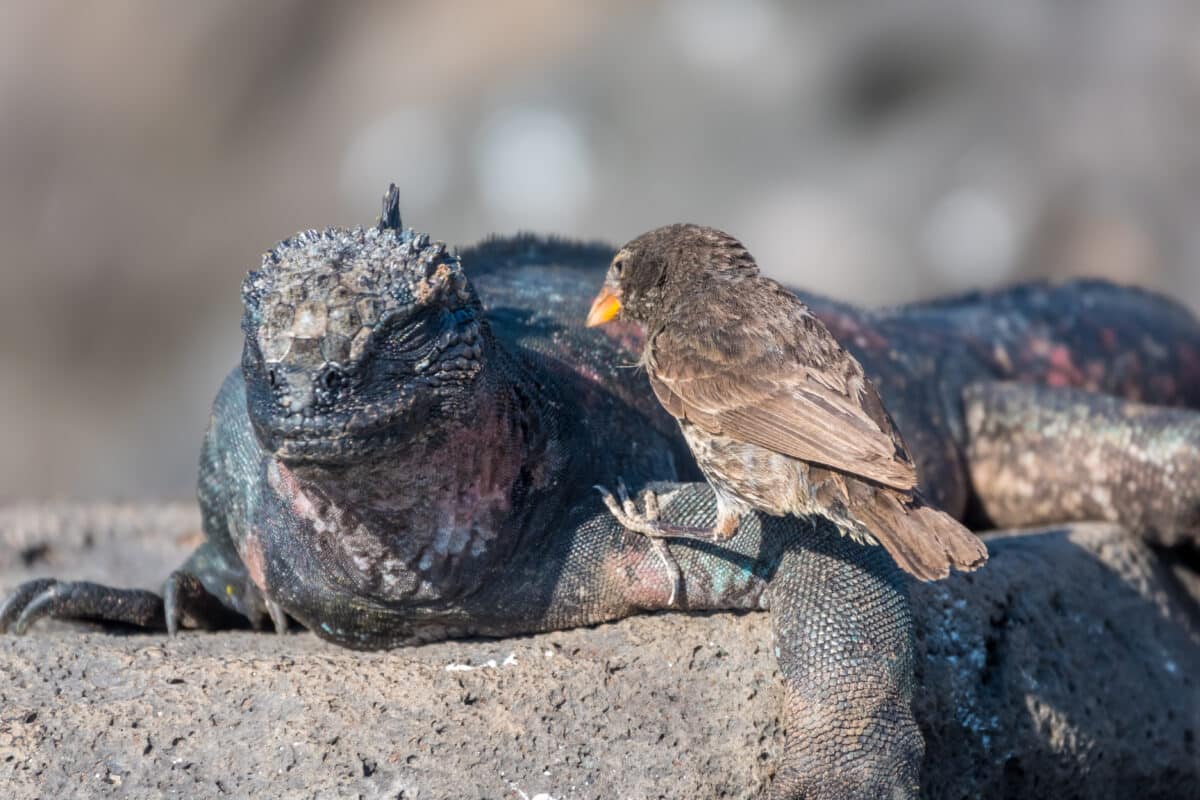
A Darwin finch eating the shading skin from a marine iguana on Espanola Island, Galapagos Islands, Ecuador
Image Credit: Luis - Adobe Stock

Wired Science: One Long Bluff

According to a recent online report from Wired Science, “On one of the Galápagos islands whose finches shaped the theories of a young Charles Darwin, biologists have witnessed that elusive moment when a single species splits in two.” If it were true, this would be very important news. Evolutionary biologists have long recognized that Charles Darwin (despite the title of his most famous book) failed to solve what he called “the mystery of mysteries,” — the origin of species. Darwin argued that it happens by natural selection acting on small variations, but no one has ever observed the origin of a new species (“speciation”) by this process. Evolutionary biologist Keith Stewart Thomson wrote in 1997 that “a matter of unfinished Read More ›

© Discovery Institute