Science and Culture Today Discovering Design in Nature
Author

Michael Egnor

It’s Not Easy Being a Materialist

P.Z. Myers and I have been discussing this question for a while: is the brain sufficient for the mind? It’s clearly necessary for the mind, in everyday experience. Strokes and ethanol affect the brain and alter the mind. But necessity is not sufficiency. Is the brain alone — just matter — entirely sufficient for the mind? I think the mind needs an immaterial cause, like the soul. Myers doesn’t.

How, from a scientific standpoint, could we resolve our disagreement? We would have to show, empirically, whether matter alone could, under the right circumstances, give rise to a mind. This is an experimental question, and it turns on the ability to create artificial intelligence (A.I.). If we could build machines that have first-person ontogeny, which is self-awareness, we could show conclusively that matter alone is sufficient to cause the mind. A conscious computer would have a mind that emerged from matter, and Myers would be vindicated. If we can’t create A.I., my viewpoint would seem more credible.

How would we know that a computer had a conscious mind?

Read More ›


Evolutionary Science: Deconstructing (Other Peoples’) Religious Beliefs

A recent study in American Scientist should ignite a blaze of research in evolutionary psychology. In Evolution, Religion, and Free Will, Gregory Graffin and William Provine report their survey of the religious beliefs of eminent evolutionary scientists. The results are striking. Evolutionary scientists hold views about God and religious belief that are radically at odds with those of most Americans. To evolutionary scientists such extreme variance from the mainstream views would normally raise fascinating questions about selection factors associated with atheist adaptation. Graffin and Provine’s study should give rise to scores of papers about the evolutionary origins of atheism.
But it won’t.

Read More ›

The End of Stories: the Evolutionary Psychology of Evolutionary Psychology

The journal Nature published an editorial recently in which the editors criticized Senator Sam Brownback’s New York Times essay What I Think About Evolution. Senator Brownback wrote:

Man was not an accident and reflects an image and likeness unique in the created order. Those aspects of evolutionary theory compatible with this truth are a welcome addition to human knowledge. Aspects of these theories that undermine this truth, however, should be firmly rejected as atheistic theology posing as science.

In reply to Brownback, the editors at Nature made some stunning assertions:

Read More ›

Ideas, Matter, and Faith

P.Z. Myers’ reply to my observation that ideas like altruism have no physical properties, like location, leaves a thoughtful observer to wonder: why do materialists have so much difficulty with this basic philosophical principle? It’s clear that ideas share no properties with matter. Ideas have no mass, or length, or temperature, or location. They’re immaterial. Clearly, under ordinary circumstances the brain is necessary for our ideas to exist, but, because matter and ideas share no properties, it’s hard to see how the brain is sufficient for ideas to exist.

Yet Myers insists that altruism is located in the brain. He’s had some trouble with my previous thought experiments, so I’ll try another:

Read More ›

The Nature Editorial: Either Intelligent Design is Science, or Senator Brownback Got it RIght

In a remarkable editorial, the editors of Nature recently responded to Senator Sam Brownback’s essay What I Think about Evolution in the New York Times. Senator Brownback wrote:

The question of evolution goes to the heart of this issue. If belief in evolution means simply assenting to microevolution, small changes over time within a species, I am happy to say, as I have in the past, that I believe it to be true. If, on the other hand, it means assenting to an exclusively materialistic, deterministic vision of the world that holds no place for a guiding intelligence, then I reject it….

Referring to materialistic evolutionary theories for the emergence of the human mind, Senator Brownback notes:

…Aspects of these theories that undermine [the] truth, however, should be firmly rejected as an atheistic theology posing as science.

Natures’ editors took Brownback to task for ‘crossing lines’:

Read More ›

‘Verizon Deniers’ Find a Cellphone

Is the brain alone necessary and sufficient to cause the mind? Here’s a thought experiment:
Imagine scientists living on an isolated island who have developed sophisticated science and culture, with one exception: they deny that telecommunication is possible. For assorted reasons, they deny that the human voice can be transmitted through space, except as vibrations in air. We’ll call this civilization the ‘Verizon Deniers.
One day, they find a cell phone (it dropped from a plane or something). They turn it on, and they hear things. They hear hissing, cracking, and what sounds like voices!

Read More ›

Please Help P.Z. Myers Find Altruism!

P.Z. Myers, materialistic neuroscientist and blogger at Pharyngula, is looking for altruism. Responding to my observation that ideas like altruism can’t be caused entirely by neurochemistry because ideas don’t share properties (like location) with matter, Myers asserted: …altruism does have a location. It’s the product of activity in [the] brain. Where else would it be, floating in the air, in [the] left foot, or nonexistent? Let’s take a closer look at Myers’ idea — that altruism, an immaterial idea, is located in the brain. What does it mean to say that altruism is located in the brain? If altruism is located in the brain, then some changes in location of the brain must, to use a mathematical term, ‘map’ to Read More ›

Would Dr. Arno Penzias, Nobel Laureate in Physics, Be Blacklisted at Iowa State?

Guillermo Gonzalez is the outstanding astronomer who was blacklisted from tenure at Iowa State University because of his support for intelligent design. As my colleagues here on ENV have pointed out, Dr. Gonzalez’ academic record is superb. Since his arrival in 2001, Dr. Gonzalez has been the most productive astronomer in his department, judged by the impact factor of his publications.

It’s clear that Dr. Gonzalez was denied tenure for only one reason: he stated publicly that he believes there is evidence for design in the universe. As I observed in a previous post about Georges Lemaître, the Catholic priest who is the father of the Big Bang theory, many of the most prominent astronomers in history have shared Dr. Gonzalez’s opinion about the evidence for design in the universe. Nowadays, it is very dangerous to state such beliefs in science departments of many universities, including Iowa State University.

Who else, besides Dr. Gonzalez and Dr. Lemaître, would qualify for Iowa State’s blacklist? Nobel laureate Dr. Arno Penzias (photo) meets Iowa State’s implicit criteria for denial of tenure. He has discussed his opinions regarding the philosophical ramifications of his discovery quite openly, and, in many ways, has done so in a way that was more explicitly religious than Dr. Gonzalez.

Read More ›

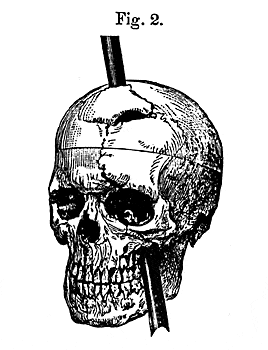
Materialist Neuroscience and an Iron Spike through the Brain

P.Z. Myers over at Pharyngula has responded to my recent post in which I criticized strict materialist explanations for the human mind. I have argued that the mind is not completely caused by the brain. By that, I mean that there are properties of the mind, such as ideas, that are not caused by brain matter alone. Brain matter cannot be the complete cause for ideas because matter and ideas share no properties. Cause and effect can’t be ‘linked’ between substances that have no properties in common. I pointed out that the materialist view that matter alone causes ideas is substantially the same as the view that ideas alone move matter, which is the pseudoscience of ‘telekinesis’.

I believe that materialism is incapable of providing an adequate explanation for the mind. Clearly ideas can influence the movement of matter (via the brain), and vice-versa, but materialism alone is inadequate to explain the link. The link between the mind and the brain must involve agency that has such non-material properties as purpose and judgment, and, as such, an adequate explanation for the mind must necessarily be open to immaterial causes.

Read More ›

‘Waiter, My Steak Isn’t Altruistic Enough!’

Is altruism merely a matter of brain physiology- just the happy result of eons of evolution? Is the brain–an elegant piece of meat– the sufficient cause of the mind and of the ideas that the mind generates? Does the brain secrete altruism, just like the liver secretes bile?

Many neuroscientists believe that it does. In a recent Washington Post article entitled If It Feels Good to Be Good, It Might Be Only Natural, reporter Shankar Vedantam reveals some recent scientific studies of the relationship between the brain and altruism. Vedantam writes:

Read More ›

© Discovery Institute