Science and Culture Today Discovering Design in Nature
Author

Michael Egnor

About That Question, Dr. Shallit…

jeffrey.gifDarwinist Dr. Jeffery Shallit posted an odd response to my comments on his ridicule of Tom Bethell. Mr. Bethell had reiterated the differences between intelligent design and creationism, and he pointed out that the inference to design was valid for some kinds of scientific research. Dr. Shallit, in his post entitled “Bethell the Baffoon”, offered little meaningful refutation of Mr. Bethell’s observations. Instead, Dr. Shallit called Mr. Bethell, explicitly or by clear implication, a “blathering buffoon”, a ‘liar’, ‘gullible’, ‘dishonest’, and ”simply stupid”. He categorized Mr. Bethell’s views as “Idiocy”.

Keep in mind that Dr. Shallit is a full professor of computer science at the University of Waterloo, editor in chief of Journal of Integer Sequences, author of scores of research papers, several textbooks and fifteen book reviews. He graduated cum laude from Princeton. He is professionally, though not rhetorically, distinguished.

Dr. Shallit takes issue with my observation that he called Mr. Bethell a liar:

Read More ›

Jeff Shallit, Blueprints, and the Genetic Code

jeffrey.gif
Dr. Jeffrey Shallit, a professor of computer science at the University of Waterloo and a Darwinist, has a few unkind words for Tom Bethell on his blog Recursivity. Mr. Bethell’s sin, it seems, is that he pointed out the rather obvious differences between creationism and intelligent design. Creationism is the belief that the Book of Genesis is literally, scientifically true — that the earth was created in six days, etc. Intelligent design is the opinion that some aspects of biology, such as the genetic code and the molecular nanotechnology inside cells, are most reasonably explained as the product of intelligent agency. The difference between these viewpoints continues to elude Dr. Shallit. Consequently, Dr. Shallit calls Mr. Bethell a “blathering buffoon.”

Read More ›

‘Constructing Our Outlook on the Origin of Life by Embracing Non-Terracentric Astrobiology’

The National Research Council’s reportThe Limits of Organic Life in Planetary Systems — is a must read. Not for the science — what there is of it can be summed up simply: we have no clue how life began. No, the report is a must read for the insight it offers into the current state of origin of life research:

Read More ›

Questioning Darwin’s Theory in Your Child’s School: You Have the Right to Remain Silent…

We’ve gotten a couple of e-mails challenging my observation in a recent post that questioning Darwin’s theory in a public school is a federal crime. The reader implied that, because there is no federal statute explicitly censoring criticism of Darwin’s theory in public schools, it wasn’t a federal crime to do so. The issue of censorship in science classes in public schools is worth examining more closely.

Is it a federal crime to question Darwin’s theory in a public school? In some public schools it certainly is. It’s a federal crime to violate a federal court ruling, such as the ruling by federal judge John E. Jones banning criticism of Darwin’s theory in the curriculum of biology classes in Dover, Pennsylvania public schools. Disobeying Judge Jones’ ruling would be a violation of U.S. Code Title 18, Part1, Chapter 21, section 401, which reads:

Read More ›

Dunford, Darwinism, and the Paranoid Style

The voices in Mike Dunford’s head have been awfully worried lately. Dunford, a zoology graduate student from Hawaii who ‘”studies evolution,” put up a bizarre post on Panda’s Thumb recently. Dunford is convinced that there are conspiracies going on.

He began his post with lucidity, sensibly acknowledging the truth of Denyse O’Leary’s observation that intelligent design theory is not creationism. Intelligent design is the theory that some aspects of living things are more reasonably explained as the product of intelligent design rather than as the product of random variation. It’s a scientific inference, open to evidence, and it might be right or wrong. Creationism is the belief in the literal truth of the Bible, particularly in the Book of Genesis. It’s a religious inference, and creationists believe it cannot be wrong. Dunford acknowledges the honesty of creationists (as if that were in dispute), but then denies the honesty of those of us who support intelligent design theory. Dunford writes:

Read More ›

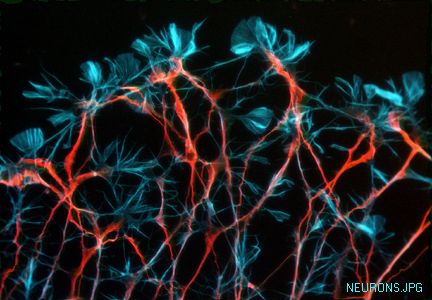
P.Z. Myers’ Neurons Give Talk to Minnesota Atheists on Non-Existence of the Soul

Materialist neuroscientist and blogger P.Z. Myers gave a talk Sunday to the Minnesota Atheists entitled: “There Are No Ghosts in Your Brain: Materialist Explanations for the Mind and Religious Belief”. I wish I could have been there! Hopefully P.Z. will post a transcript, or put up the Powerpoint file. The program looks like it was a treat. Quoting Myers:

Read More ›

An Uncivic Biology

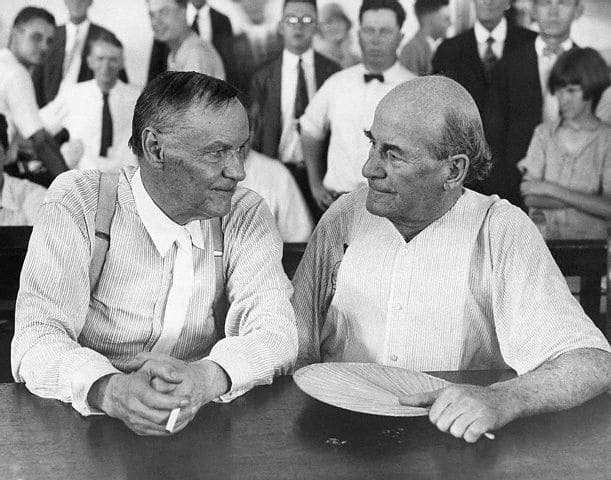
Clarence Darrow, a famous Chicago lawyer, and William Jennings Bryan, defender of Fundamentalism, have a friendly chat in a courtroom during the Scopes evolution trial. Darrow defended John T. Scopes, a biology teacher, who decided to test the new Tenessee law banning the teaching of evolution. Bryan took the stand for the prosecution as a bible expert. The trial in 1925 ended in conviction of Scopes. ca. 1925 Dayton, Tennessee, USA

The Scopes trial is often depicted as an apocalyptic struggle between the forces of light (scientific Darwinists) and the forces of darkness (benighted citizens of Tennessee who didn’t want Darwinism taught to their children). Jerome Lawrence and Robert Edwin Lee’s 1950s play “Inherit the Wind,” a fictionalized account of the Scopes trail, portrays the trial as a struggle between scientific enlightenment and ignorant fundamentalism and has become a staple of high school English classes. Yet the Scopes trial wasn’t, as a matter of law, just about teaching Darwinism in an abstract sense. Scopes violated the Tennessee law by teaching from a textbook — George William Hunter’s A Civic Biology: Presented in Problems (1914).

In a recent essay in the weekly standard, A Book for No Seasons: the forgotten aspects of John Scopes’ famous biology textbook, Garin Hovannisian recounts the truth about the biology textbook that was at the center of the Scopes trial.
Hovannisian observes:

George William Hunter’s A Civic Biology: Presented in Problems (1914) was the book that sparked the controversy. Condemned as heretical in 1925, today it would seem to be a manual for enlightenment’s battle against religion’s perceived mysticism. Yet if John Scopes were to teach the very same Civic Biology in a modern classroom, he would probably be put on trial again. Because buried under the dust of history is the fact that this progressive, pro-evolution text was also quite racist.

Hovannisian quotes from page 196 of Hunter’s textbook:

Read More ›

Is Darwin’s Theory Essential to . . . Mathematical Statistics?

My Darwinist interlocutor Orac, the surgical oncologist who blogs anonymously to hide his professional identity, but who takes umbrage at my observation that his posts are sometimes unprofessional, repeated his claim recently that Darwin’s theory is essential to medicine. That’s an odd assertion, even at first glance, given that Darwin’s theory isn’t taught in medical school and there are no specific requirements that pre-medical students have any grounding in the theory. There are lots of things that medical school admissions and curriculum committees recognize as indispensable to medical practice and research–calculus, physics, chemistry, organic chemistry, physiology, anatomy, pharmacology and pathophysiology, to name a few–but Darwin’s fundamental assertion — that all natural functional biological complexity arose by non-teleological variation and natural selection — isn’t a part of the required curriculum. How can Darwin’s actual theory of the non-purposeful origin of all life be indispensable to medicine, but not taught as a part of medical education, nor even required as a part of pre-medical education?

Yet Darwinists have insisted that Darwin’s theory is indispensable to medicine in three ways:

Read More ›

Pat Sullivan and Marketing Darwin

On June 18th, blogger Pat Sullivan posted his thoughts on the difficulties that Darwinists are having with the public acceptance of their theory. Pat is an entrepreneur and a marketing expert who is the creator of ACT! and SalesLogix, software programs that help businesses with marketing and customer relations. When it comes to marketing, he knows what he’s talking about. He observes:

What interests me as a marketing observer is this; after tens of thousands of exposures to the Darwin marketing “message” only some 34% of people buy the message. And with almost NO exposures to the contrary message except in Sunday school and mom and dad, 66% of people believe we were created by a designer. Personally, I believe the main reason this is the case is the ease with which people look at the world and readily conclude it looks designed. The arguments to the contrary just are really hard to follow.

Pat notes that I.D. makes a lot more sense to people:

Read More ›

Jack Russell Terriers and Cockroaches: A Challenge to Richard Dawkins

Richard Dawkins reviewed Mike Behe’s new book The Edge of Evolution in the June 30 New York Times Book Review. Dawkins offered no surprises. Much of the review was simply a sneer:

I had expected to be as irritated by Michael Behe’s second book as by the first. I had not expected to feel sorry for him…[this] is the book of a man who has given up. Trapped along a false path of his own rather unintelligent design, Behe has left himself no escape. Poster boy of creationists everywhere, he has cut himself off from the world of real science.

Nothing new here. Dawkins uses the standard Darwinist ad-hominem attacks. What’s remarkable about the review is Dawkins’ lack of substantial scientific criticism of Behe’s point in Edge of Evolution. Behe makes the observation that there are limits to the amount of specified complexity that random mutation and natural selection can generate, and that there is reason, based on evidence such as the biochemistry of drug resistance of the malaria parasite, to infer that random mutation and natural selection may be adequate to explain some, but not all, observed biological complexity. It’s a fair and obvious question: how much functional biological complexity can random mutation and natural selection actually generate? Can it account for all of the biological complexity that we actually observe?

Read More ›

© Discovery Institute