Science and Culture Today Discovering Design in Nature
Author

Jonathan Witt

Darwinism Against Design: Warning — The Science You Exclude May Be Your Own

From “The Scientific Status of Intelligent Design“
By Stephen Meyer

Unobservables and Testability

[A frequent argument against intelligent design] that appears frequently both in conversation and in print finds expression as follows: “Miracles are unscientific because they can not be studied empirically. Design invokes miraculous events; therefore design is unscientific. Moreover, since miraculous events can’t be studied empirically, they can’t be tested. Since scientific theories must be testable, design is, again, not scientific.” Molecular biologist Fred Grinnell has argued, for example, that intelligent design can’t be a scientific concept because if something “can’t be measured, or counted, or photographed, it can’t be science.”

Gerald Skoog amplifies this concern: “The claim that life is the result of a design created by an intelligent cause can not be tested and is not within the realm of science.” This reasoning was recently invoked at San Francisco State University as a justification for removing Professor Dean Kenyon from his classroom. Kenyon is a biophysicist who has embraced intelligent design after years of work on chemical evolution. Some of his critics at SFSU argued that his theory fails to qualify as scientific because it refers to an unseen Designer that cannot be tested.

Read More ›

Derbyshire VI: Behe’s Bacterial Flagellum — Still Stirring Up Trouble for Darwin’s Defenders

John Derbyshire is on The Corner arguing that we can never safely infer that certain biological structures were designed. To a reader who asserted that organizational complexity cannot arise from impersonal processes, Derbyshire replies, “How do you know it can’t? It is true that the genesis of organizational complexity is not currently well understood; but to leap from that to telling me we shall NEVER be able to find a natural-law explanation for it is just dogma.”

Derbyshire’s argument is worth confronting because it represents the opinion of leading Darwinists. Biologist Kenneth Miller, for instance, routinely makes just such an argument. Design theorist William Dembski responds thus:

Miller claims that the problem with anti-evolutionists like Michael Behe and me is a failure of imagination — that we personally cannot “imagine how evolutionary mechanisms might have produced a certain species, organ, or structure.” He then emphasizes that such claims are “personal,” merely pointing up the limitations of those who make them. Let’s get real. The problem is not that we in the intelligent design community, whom Miller incorrectly calls “anti-evolutionists,” just can’t imagine how those systems arose.

The problem is that Ken Miller and the entire biological community haven’t figured out how those systems arose. It’s not a question of personal incredulity but of global disciplinary failure (the discipline here being biology) and gross theoretical inadequacy (the theory here being Darwin’s).

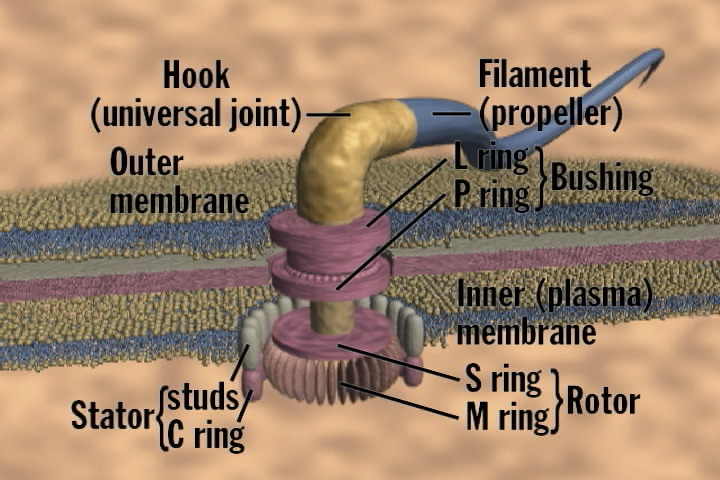
The particular mechanism Miller has in view here is the bacterial flagellum. Click here and scroll down for a good, brief description and animation of the bacterial flagellum, and here for an enlarged view with its parts labeled. Biochemist Michael Behe made this little engine that could famous by showing that it was irreducibly complex, like a mouse trap: “If any one of the components of the mousetrap (the base, hammer, spring, catch, or holding bar) is removed, then the trap does not function.” With even four of these parts, it’s utterly useless. The mousetrap is irreducibly complex.

Read More ›

One of These Things is not Like the Other

BY KEITH PENNOCK Some school boards seem to have confused their role with that of the FDA, placing warning labels on textbooks as though they were a package of cigarettes that should be kept out of the hands of minors. Fortunately, there’s a better way. Rather than noting the scientific controversy over Darwinism by placing stickers on textbooks, we advise that school boards attempt to teach the controversy by augmenting their curriculum using supplemental materials. Ohio and Minnesota followed this approach, and now students there can learn both the strengths and weaknesses in Darwin’s theory. And neither state has been drawn into a legal flap. Smart.

Darwin, Derbyshire and the Dogma of the Gaps

John Derbyshire of The Corner, and Darwinists on every street corner, insist that we should never cram God into the gaps of our scientific knowledge.

As if detecting design meant cramming the designer into the work itself: Imagine Leonardo da Vinci trapped inside the Mona Lisa.

Derbyshire proceeds apace: “History shows that these puzzles always get resolved sooner or later in a natural way, … sending the ‘God of the Gaps’ traipsing off to find a new place where he can hang his starry cloak for a while.”

Bracket off for the moment that this particular history of modern science is an urban legend.

Derbyshire’s argument falls apart all by itself, apart from the historical record. Because more and more things have been explained with reference to impersonal causes, Derbyshire argues, we can never assume that something in nature cannot be explained thus.

That simply doesn’t follow. Consider an analogy.

Read More ›

Darwinists Prove Computers Work!

In a recent post at The Corner, John Derbyshire wrote that “we are actually quite close to a point where we CAN do evolution in the lab.” To make his point, Derbyshire cited an article by Carl Zimmer in the February, 2005, issue of *Discover* Magazine: “Testing Darwin: Scientists at Michigan State University Prove Evolution Works.”

We don’t buy it. Discovery fellow (and Ph.D. biologist) Jonathan Wells found the claims in Zimmer’s article laughable, and he was moved to write a satirical review that we are posting here. Although the tone is tongue-in-cheek, the quotes from Zimmer’s article are real, as is the force of Wells’ argument.


Darwinists at Michigan State University Prove Computers Work by Jonathan Wells

For centuries breeders have been modifying existing species by selecting desirable variations, yet this procedure has never produced a new species. Still less has it produced new organs or body plans. In 1859, however, Charles Darwin wrote that variation and selection explain the origin of species and all of life’s diversity, and his faithful followers are still looking for evidence that he was right.

Read More ›

Derbyshire III: Soft Bodies a Femme Fatale for Darwinism

As we saw in Derbyshire II, the pattern of the fossil record doesn’t fit the Darwinian prediction of a gradually branching tree of life, even where punctuated equilibrium is invoked to shoehorn the transitional intermediates into those gaps John Derbyshire puts such faith in.

The problem gets even uglier when Darwinists try to explain away the fossil record leading up to the Cambrian Explosion. What story do these strata tell? Animals didn’t exist; and then they did — not just dozens of species but dozen of phyla. If you want some idea of how large a category phyla is, consider that sharks, mice, humans and otters are all members of the same phylum.

If natural selection working on random genetic mutation built this menagerie of animals, it had to do it one extraordinarily tiny, functional improvement at a time, one generation at a time, over tens and even hundreds of millions of years. If we had even a tiny fraction of a fraction of the Precambrian life forms, we would have so many transitional forms we would be hard-pressed to draw the line between one phylum and another, so thoroughly would they bleed one form into the other. But we find no such fossil pattern in the Precambrian.

Derbyshire suggests that the precursors of the many Cambrian phyla were soft-bodied and so never fossilized: “[S]oft body parts hardly ever get fossilized,” he writes. “We are working from a pretty scanty data set here.”

The problem is, many soft-bodied creatures did fossilize, and they tell a different story from the one Darwin told. Consider this passage in which Meyer et al., marshall evidence from mainstream evolutionists working in paleobiology:

Read More ›

Derbyshire II: Of Bones and Beads

John Derbyshire recently rebutted a series of objections against Darwinism and, in the process, leveled a series of objections against intelligent design. He dismisses design by ignoring the actual arguments of its theorists and shadowboxing with letter writers instead. He shows, thereby, a lack of seriousness on his own part by trivializing and demeaning scholars whose views he apparently has not really bothered to understand.

One problem is that Derbyshire’s objections against design theory often state the positions of leading design theorists–in other words, he agrees with leading design proponents without even realizing it.

For instance, one of his blog visitors tried to refute Darwinism by asserting, “The fossil record is incomplete.” Derbyshire responded, “Well, duh. Fossilization only happens under extraordinary circumstances.” That’s correct.

He then goes on to assert that the fossil record is nevertheless complete enough to make inferences about the origin and history of species. Still agreed.

Then Derbyshire parts company with leading design theorists. He thinks the gaps in the fossil record protect the theory of common descent by natural selection. But the gaps don’t. The fossil record is a growing problem for neo-Darwinism because attempts to explain away the absence of transitional intermediates between phyla and even lower groups have failed.

Read More ›

Derbyshire Protects Darwinism from Dissent

John Derbyshire keeps reburying the design argument over at The Corner, with evidence he assures us is elsewhere. By assembling a host of misconceptions about design theory into a single, compact essay (generally unencumbered by supporting evidence), Derbyshire has done us a great service, providing us a forum to respond to each misconception in a series of posts over the next several days.

I’ve never met John Derbyshire. I love his name. It makes me think of England and Middle Earth. I imagine him wearing a stylish derby and living in a tasteful shire somewhere, an articulate conservative with strong opinions — but who just might stop and take a second look at a position with a much older pedigree than Darwinism, one that has gotten a boost in recent years from discoveries in molecular biology, big bang cosmology, astrobiology, information theory, and physics.

Derbyshire begins with a rhetorical flourish: “I like a good knock-down argument as much as the next person, but I must say, ID-ers are low-grade opponents, at least if a bulk of my e-mails are any indication.”

Hmmm. If Derbyshire likes a “good knock-down argument,” why is he arguing with his inbox instead of with the best design arguments (of which he appears oblivious)?

I don’t think Derbyshire likes to have his cherished opinions knocked down at all. Most of us don’t. So we have to fight our tendency to guard our pet scientific theories from contrary evidence. We have to put our theories in empirical harm’s way, and see if they continue to stand when assailed with fresh evidence. It’s called “The Scientific Method.”

But for Derbyshire, Darwinism is the damsel and he will not have her virtue besmirched, will not have her dragged into the dock to be cross-examined, will not have her competing for our affections like a common harlot. Intelligent design, he writes, “is, by the way, not a scientific theory, though it may be a metaphysical one.”

Rhetorically punchy, but is it a scientific way to defend a theory–victory by definition?
Derbyshire also informs us, “All the ID arguments have been patiently refuted many times over.” Were they refuted exclusively with metaphysical arguments? No. Leading Darwinists often rebut ID arguments with scientific arguments. Then when a design theorist rebuts the Darwinist’s scientific arguments by pointing to contrary evidence in the natural world, suddenly (according to Derbyshire) it’s no longer a scientific argument.

Such desperate efforts to keep design theory out of the ring should impress no one.

Notice, too, where Derbyshire retreats to the dogma that design theory isn’t science. It’s right after he states, “A good scientific theory fits the data better than a poor theory.” Hear! Hear! But Derbyshire immediately senses the danger. You see, Darwinism does a horrible job of explaining all sorts evidence in biology and paleontology (e.g., irreducibly complex devices like the mammalian eye, the bacterial flagellum, and blood clotting, the sudden appearance of numerous animal phyla in the Cambrian Explosion, the lack of any examples of macroevolution).

On these points, Darwinism is the aging boxer, past his prime. In contrast, the design hypothesis fits these data points nicely. Sensing this, Derbyshire quickly tries to get Darwinism’s strongest contender, intelligent design, out of the ring. “That other guy’s not a boxer. He’s a slugger, a ninja street fighter. I saw him down at the dojo last week! Watch out or he’ll use some of that Kung Fu voodoo on you!”

OK, that isn’t a Derbyshire quotation, but neither have leading design theorists made some of the silly arguments Derbyshire lists to the exclusion of strong design arguments. Consider what philosopher of science Stephen Meyer has to say about the Darwinist habit of defining intelligent design out of the competition:

Read More ›

Calvin Ball at USA Today

Remember Calvin Ball? Calvin and Hobbes played a ball game where the victor was the one who could most nimbly change the rules to assure victory. Well, they’re playing Calvin Ball over at USA Today again. Gerald L. Zelizer writes: Can intelligent design and evolution reside in the same school building? Yes. In the same curriculum? No. Intelligent design belongs in history or social science class. Evolution belongs in science class. If one merely defines the scientific evidence against Darwinism as not-science, then, presto, you’ve cleared the field of all those stubborn, uncooperative facts that are better explained as the product of intelligent cause. Science writer Denyse O’Leary wrote USA Today, commenting thus: Regarding Rabbi Zelizer’s comments (February 6, 2005), Read More ›

Sternberg, Episode 5: The Empire Strikes Back

Recall that Richard Sternberg, former editor of the Proceedings of the Biological Society of Washington, permitted the publication of an essay by Stephen Meyer arguing that intelligent design was the best explanation for the Cambrian Explosion of animal forms. When it appeared, major science journals and media outlets launched a smear campaign against Sternberg, questioning his motives and claiming he violated the journal’s procedures. Sternberg, a man with two Ph.D.s in evolutionary biology and a distinguished record of scientific publication and achievement, eventually felt so much heat that he hired an attorney. Happily, one major media outlet, The Wall Street Journal, broke ranks by publishing an op-ed last week laying out Sternberg’s side of the story. In it, Sternberg’s supervisor, Read More ›

© Discovery Institute