






































Before revolutionaries made everything about sex, parents anticipated a time when their children would ask where babies came from. The latest episode of PBS’s NOVA series Evolution seeks to answer a prior question: “Where did sex come from?”
A Tale of Tales
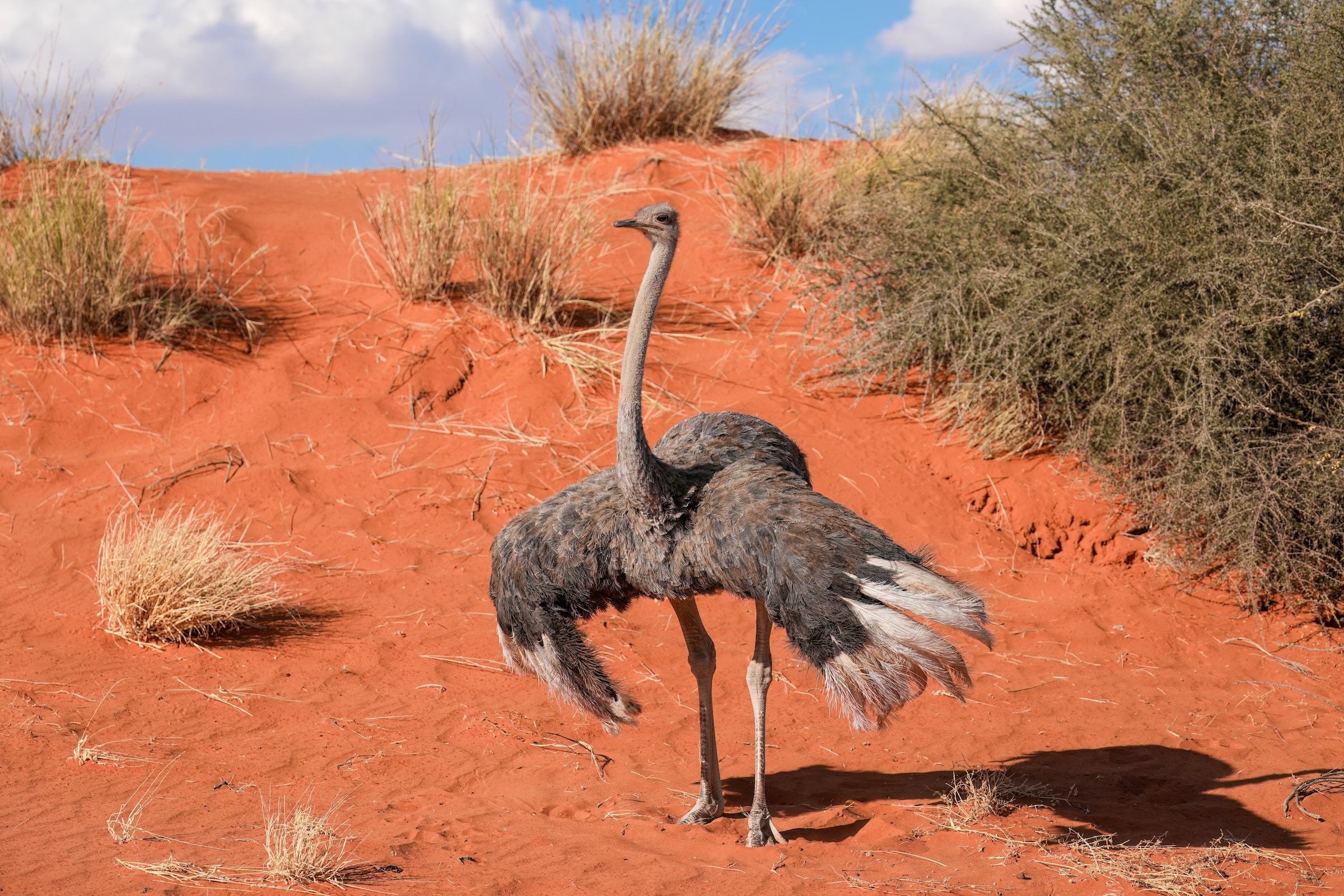
Like a good story often will, “The Mating Game” begins with an image which will serve to embody the narrative to come, in this case an ostrich and its egg. “From its powerful legs to its unique feathers and giant eggs,” begins the narrator, “the ostrich tells the epic story of how sex unleashed the full creative power of evolution.” But the “epic” chain of events laid out over the ensuing 53 minutes rests on more unexplained, random happenings than the Beetles’ bizarre Magical Mystery Tour.
The story goes like this (for brevity, I have omitted the many invocations of the passage of time, such as “countless generations” or “as the ages passed”):
- About four billion years ago, single cells reproduced by cloning themselves.
- Later, a new type of cell emerged. It could reproduce by fusing its membrane with another of its species. This was the earliest form of sex (who knew?), and the mixing of DNA introduced “an enormous amount of variation upon which evolution can work.”
- With the accelerated power of reshuffling genes, some cells “joined forces, building bigger, more complex organisms, made up of thousands, millions, and billions of cells until eventually … the Cambrian seas are teeming with complex life.”
- There was a problem in the Cambrian seas, though, in that complex forms like trilobites could not exchange DNA by fusing themselves (hard shells tend to get in the way of merging). So they evolved by “using specialized cells to do the fusing for them.”
- And so, the earliest gametes “evolved to be separate eggs and sperm.”
“Fish No More”
Having put forth a “plausible” chain of being from self-replicating cells to something resembling sexual dimorphism, the narrator returns briefly to the modern-day ostrich and its jumbo-sized egg. What set it “on its path to greatness”? “Animals continued to evolve,” he says, which does about sum it up. He could have left it at that, but then we would have missed the titillating chapter of the story, which waxes a bit fantastical and then gets flirty.
- In the Devonian period, when it was a “fish-eat-fish world,” a lobe-finned fish shimmied out of the water onto land in search of a safe place to lay her eggs. (An AI visualization shows her scootching herself up onto the mud.)
- “Bones get longer, digits and joints emerge — better for walking on land — until eventually [Voila!] … fins have become limbs. And they are fish no more.”
Here, the animation cuts to something concrete — a paleontologist holding a cast of two fossilized amphibians. Apparently, we are to take this as sufficient evidence of the visually animated fish-to-amphibian transition.
In case we’re tempted to lose sight of the evolutionary connection we share with all living organisms (“every animal, plant, and fungus alive today”), the paleontologist invites us to observe the amphibians’ familiar features. Notice the well-developed hand and five digits, “just like you and me.” “From lizards to elephants to ostriches to us,” the narrator continues, “all land vertebrates trace their heritage back to those first four-legged pioneers.”
“Amphibians No More”
The story continues:
- Amphibians reigned until drier periods threatened their moist spawning grounds. But one of them, Casineria, “managed to hang on” because her eggs were “a tiny bit better at retaining moisture.” It was “a small difference that can mean everything.”
- After Casineria, “the surface of the egg begins to change [pause for dramatic effect as music builds]. It gets tougher [another pause], thicker [pause], and special membranes form to prevent moisture loss [pause]. The egg gets larger and stronger [pause] until … [pause], something extraordinary has emerged [cut to image of eggs with shells, presumably ostrich eggs, lying in sand].
Thanks to an “evolutionary innovation,” “the ancestors of the ostrich were amphibians no more.” “They’d evolved into something new, amniotes.” (Amniotic embryos develop inside eggs, but unlike amphibian eggs, these eggs do not need to stay moist.)
Just-In-Time Delivery Every Time
But how did we get from the amniote to the ostrich? Now we come to the segment that will give rise to snickers and awkward looks in middle-school science classrooms. Shelled eggs posed a problem because they couldn’t be fertilized after they’d been laid outside the mother’s body. So in order to solve that problem, a grinning paleontologist explains, “the first fully terrestrial vertebrates needed to have sex in a brand-new way.”
- “A tiny outgrowth, like an extra limb,” something that will allow for internal fertilization, “begins to grow early in development [on] most reptiles and mammals.”
Amazingly, it appeared just in time, as if it had been ordered up by supply chain management (or DoorDash). Conveniently, this development developed such that the internal egg could be fertilized before the egg acquired a shell. For the next segment, cutesy music accompanies a montage of data on penises and mating practices in the animal kingdom.
But as we all know, our grinning scientist continues, “it takes two to tango. And so the female reproductive anatomy had to coevolve with the evolution of the penis.”
And so, lo and behold, there was coevolution.
“From Fuzz to Flirting to Flight”
After another fossil image break, we come to the segment on the “mating game.” All those unique and brightly colored features we see in many animals evolved because of the males’ “need to get chosen” by an interested female. Coelophysis, for example, an early dinosaur that walked on two legs, is theorized to have attracted his mate by dancing and waving his forearms, which were serendipitously festooned with decorative fuzzy arm fringes. (We’re not told what caused the fringes to evolve in the first place, or what caused the female to be attracted to them, but the comical depiction of this hypothesized mating dance resembles a 1970s Saturday morning cartoon.)
In any event, the theorized fuzzy arm fringes must have worked because,
- “Those fuzzy strands become exaggerated, getting longer [pause for dramatic effect as protrusions emerge like blades of grass in your flower bed] and wider … new colors and patterns emerge, attracting even more attention.” Eventually [as music reaches a crescendo] “they become something new”: feathers.
Another smiling scientist displays a fossil of a feathered dinosaur, Epidexipteryx, which, presumably, we are to take as evidence of the theorized fuzzy-strands-to-feathers metamorphosis.
A Novel “Time Capsule”
The journey to the ostrich and her egg continues:
- Food chains collapsed in the wake of an asteroid impact, so dinosaurs evolved into birds with beaks. The beaks, which enabled them to eat seeds, became their “ticket to surviving.” (Exactly how the beaks appeared just in time to prevent the proto birds from starving we aren’t told.)
- Some birds gave up on flight, and some of their descendants grew bigger. “Their legs got longer. And better for walking.” Eventually, “an iconic animal emerged” — the common ostrich.
And there you have it, folks. Single cells to fusing cells to complex forms with eggs and sperm to fish to amphibians to reptiles to birds to the ostrich and her jumbo-sized egg. Isn’t it all so magical?
“Ostriches are just a fantastic symbol of evolutionary change and innovation,” remarks paleontologist Riley Black. “Every moment, every day, evolution brings us something novel. And I think that’s gorgeous.” Some of the clips of living animals could certainly be called “gorgeous.” But in terms of actual science, “The Mating Game” does not offer any explanation as to where the first cell came from or how any of the many innovations “emerged” from their predecessor(s).
Thus Spake the Darwinists
Ostrich eggs, opines the narrator toward the end, “are time capsules, holding the story of countless generations.”
But no. The tale that has been spun here does not arise from within the egg. The egg in this story is more like one of those gazing balls people place in their gardens; Darwinists look into it and read in reverse the stories they tell themselves. And apparently, they expect us to trust them, “Because science!”
As David Klinghoffer has noted about earlier episodes, a tremendous amount of science has been elided “through judicious deployment of verbs that assert a great deal, in the vaguest terms, without explaining anything.” The same verbal shenanigans drive the story of “The Mating Game.”
The whole retrodicted assemblage of needed novelties could be summed up this way:
Whatever evolution needed to evolve evolved;
And thus, it was so; and thus, it was ever so.