






































As Casey Luskin noted, PBS’s five-episode NOVA series, Evolution, is now complete. Successive episodes have highlighted the brain, feeding and digestion, body building (how some animals grew to be huge), sex, and locomotion (movement). See further Science and Culture discussion here. David Klinghoffer also commented on it at Townhall.
The Template
All the episodes follow a similar pattern. With slight variations here or there, it goes like this:
- Open with stunning clips highlighting the wonder of some feature of modern-day biological life. Ask, “Where did it come from?”
- Begin the story with a simple life form (or forms) on a timeline in a prehistoric sea.
- Fast-forward to a point on the timeline at which a hypothesized life form possesses a hypothesized genetic mutation that affords it an ever-so-slight advantage over its peers. At this point, evolution begins to accelerate.
These opening steps comprise about a quarter of each of the approximately 54-minute episodes. The remainder of the episode narrates a hypothesized stepwise evolutionary journey from the acceleration event to the modern-day feature in view using the following devices:
- AI animation of a hypothesized organism or hypothesized transformation(s) of organisms accompanied by dramatic music. Verbiage narrating the transformation is strategically punctuated with pauses for extra effect.
- Cut to an enthusiastic scientist explaining a fossil related to one of the organisms, as if excited scientists and fossils constitute sufficient evidence of the foregoing transformation(s).
- Repeat (a) and (b) as needed until evolution has evolved the wonderful feature highlighted in the opening.
The final segment of each episode closes the loop with a summary paean to evolution.
“Some Scientists Think”
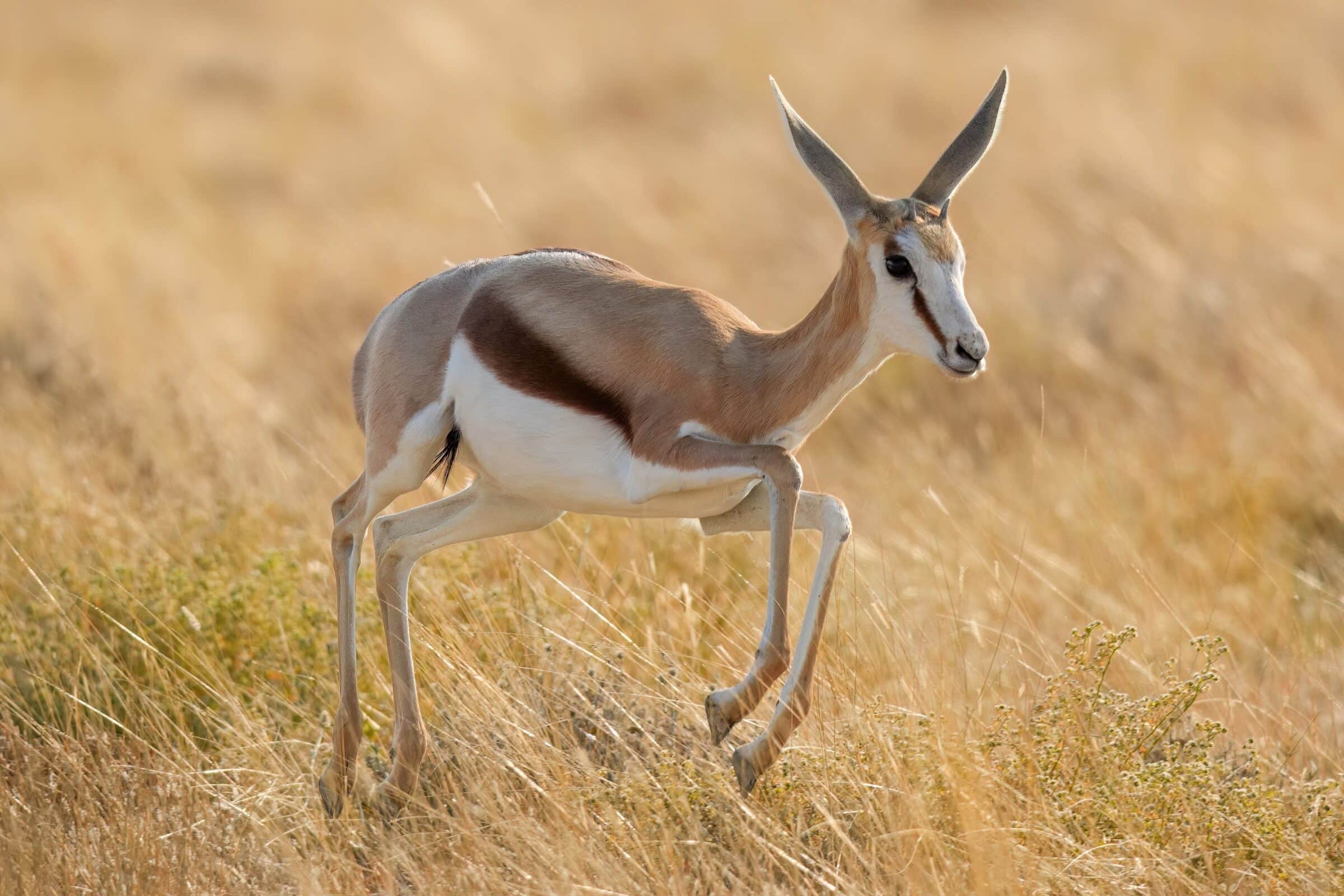
Episode five, “On the Run,” features movement. From swimming to running to flying to climbing to pronking, how did animal movement come about?
The first fossil we see on this feature’s hypothesized evolutionary journey comes from an ancient seabed and is said to have captured “the oldest footstep known to science.” To the scriptwriter’s credit, the narrator begins the story with refreshing epistemic humility:
Some scientists think the story of this fossil went like this…
Here is how “some scientists think the story of this fossil went” (my paraphrase):
While its stationary peers were stuck to the Ediacaran seabed, limited to feeding on particles carried toward them by water currents, one tiny fragile creature was able to use its muscles to create a ripple of contraction throughout its body. When the current changed, rendering its peers vulnerable to starvation, it was able to launch itself forward in search of food.
But while the storytelling begins modestly, the narration soon waxes grandiose. The tiny fragile creature “slowly moves across the sea floor.” It was:
one small shuffle for an anemone-like blob, one giant leap for animal-kind.
The dramatic animation of the shuffling blob then cuts to a scientist exhibiting the fossil of the hypothesized footprint:
This is a trailblazing moment in evolution. You are looking at Neil Armstrong’s footsteps on the moon here, an evolutionary equivalent to that.
So much for epistemic humility.
The rest of the episode follows the template — innovations innovate; developments develop; evolution evolves — with one minor deviation at the end. The concluding segment of the final episode explains that we humans are now directing evolution ourselves through selective breeding. The exemplar is the domesticated horse, and the idea, lest we forget it, is that we are part of the great evolutionary journey.
Fishes ’R Us
In addition to following the same template, the episodes share a few common themes. The most pervasive is that evolution is amazing and wonderful and magical (!!!). For all intents and purposes, it’s omnipotent. But, and this brings us to a second theme, it doesn’t know anything. Evolution has no goal in mind. It has no purpose. And under no circumstance is it directed toward anything. A third theme is the connectedness of all life. In the final episode, biology professor Brooke Flammang veritably enthuses:
The truth is, lobe-finned fishes are everywhere. All of us, you and I, your pet dog, your favorite horse, every terrestrial vertebrate you can think of that walks on land, or flies, or climbs is really a fish, a lobe-finned fish.
So … evolution is amazing, but also mindless, aimless, ignorant, and blind. It produces wonders upon wonders. And all of us are really just fish.
Zombie Science Persists
Biologist-turned-filmmaker Randy Olson has written that scientists should learn from Hollywood how to tell a story. In his first feature-length documentary, Flock of Dodos: The Evolution-Intelligent Design Circus, he spun a whimsical one that included known falsehoods while grossly caricaturing intelligent design and its proponents. And while there are a lot of problems with Olson’s telling of the story (see Hoax of Dodos for a response to the film), at least he acknowledged that there were alternative approaches to the debate.
NOVA’s Evolution series doesn’t even rise to that level. Molecular biologist Jonathan Wells, author of Icons of Evolution: Why Much of What We Teach About Evolution is Wrong and Zombie Science: More Icons of Evolution, wrote that evolution is a “materialistic story,” and this series bears that out. But slick production and smiling scientists do not make philosophical storytelling become science. Long on conjecture and short on empirical substance, NOVA’s Evolution is only the latest exercise in materialistic story-spinning.