






































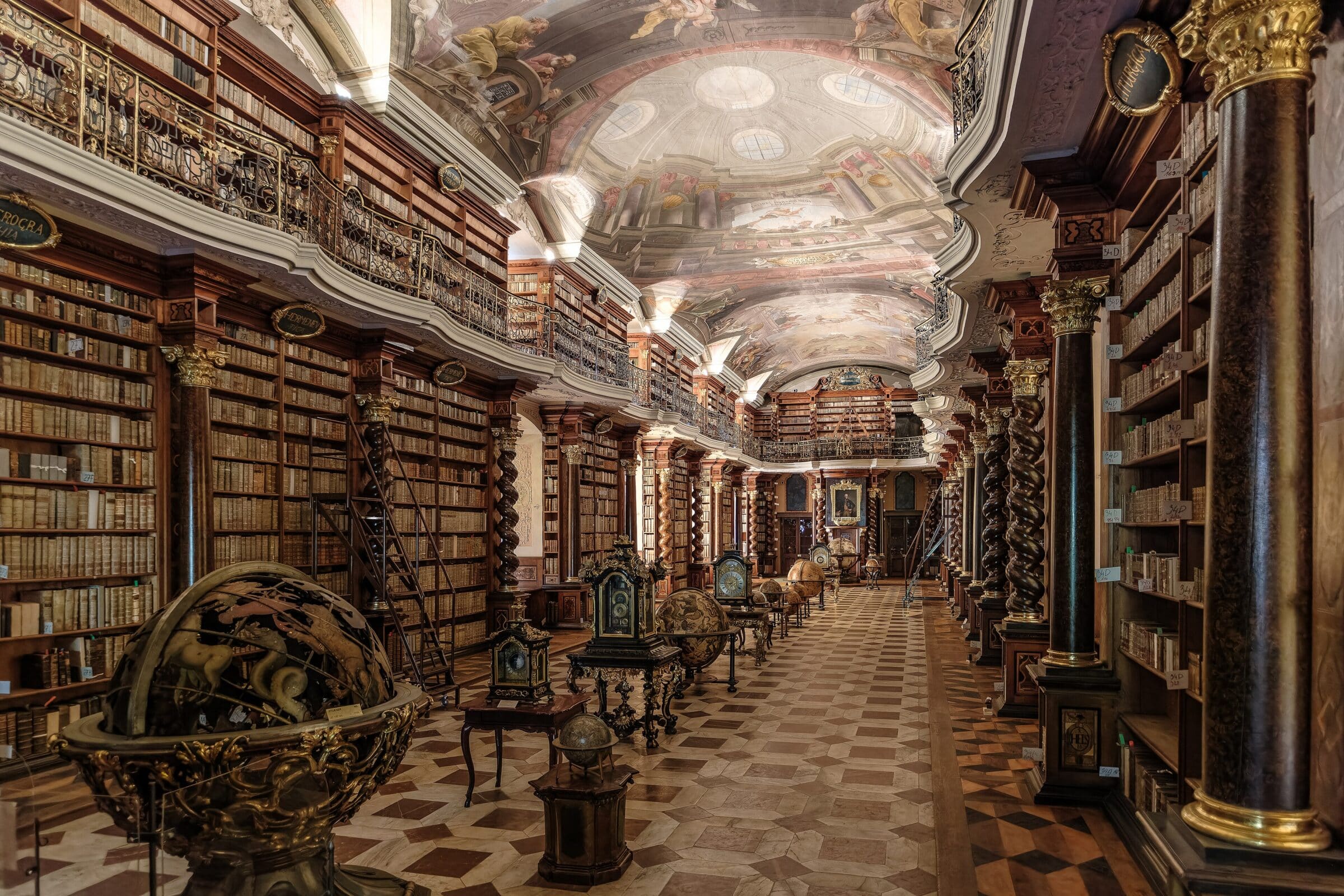
Jorge Luis Borges’s story “The Library of Babel” describes an astronomically large (if not infinite) library. The library is an innumerable collection of hexagonal rooms, each containing floor-to-ceiling bookshelves filled with books. The books themselves are all 410 pages long, with 40 lines per page, and 80 symbols per line. The symbols are 22 characters (as in Hebrew), with a space, period, and comma added for punctuation and word separation. The narrator of the story indicates that all possible combinations of those twenty-five symbols are represented within the library — namely, it contains all possible 410-page books.
Librarians live within the library’s hexagonal rooms. Many of them spend their lives looking for meaning within the collection, trying to find books that will explain what the library is, who constructed it, or what it means. Others search for books that will vindicate their own existence. The narrator claims this quest is futile, since the “chance of a man’s finding his own Vindication, or some perfidious version of his own, can be calculated to be zero.” He is almost correct, in that it is practically indistinguishable from zero. But exactly zero it is not.
What Borges describes is an event of such low probability that we reason it is statistically “impossible,” though not logically impossible. It could happen — it just won’t. It is highly improbable and radically implausible. It lies somewhere between implausible and impossible on a linear scale, but clings much closer to the latter.
I propose we call such events implossible.
Some examples: can a whisked egg be unmixed back into a yolk and whites by stirring? Technically yes. But it is implossible. Will a fair coin land heads up 100 times in a row? Implossible.
We can add to our list. Life spontaneously forming from non-life. Someone winning the state lottery every day for a month. The U.S. Men’s National Team winning the 2026 World Cup.
Finding one’s own Vindication in the Library of Babel is clearly implossible. But so is finding anyone else’s. Borges doesn’t appreciate this fact. His narrator states, “I have seen two [Vindications], which refer to persons in the future, persons perhaps not imaginary”.
No, he has not.
Implossible Vindications
Here is why. Each book in the library contains 1,312,000 characters, which are spaces, punctuation, or letters. There are exactly
possible books of that length. Every combination of symbols is a book, and some almost-zero proportion of them are legible as stories or readable text. Most are gibberish.
If we sample from that collection of possible books uniformly and randomly, what is the probability we’ll find a book that is a Vindication? It is less than the probability that we’ll find a book that is at least readable, which itself is less than the probability of finding a book consisting of all real words. Consisting of actual words is a prerequisite to being readable, which is itself required to be a Vindication. We could quibble that some nonsense “words” should be allowed, but there is some baseline number of real words that must exist to convey meaning. We’ll see that getting any substantial collection of real words by chance is implossible.
Let’s assume the narrator’s language from the story is Hebrew, though surely it is not. We’ll use Hebrew as a proxy anyway. Online word lists for the Hebrew language will help us get a feel for what sort of implossibility we’re up against.
Crunching the Numbers
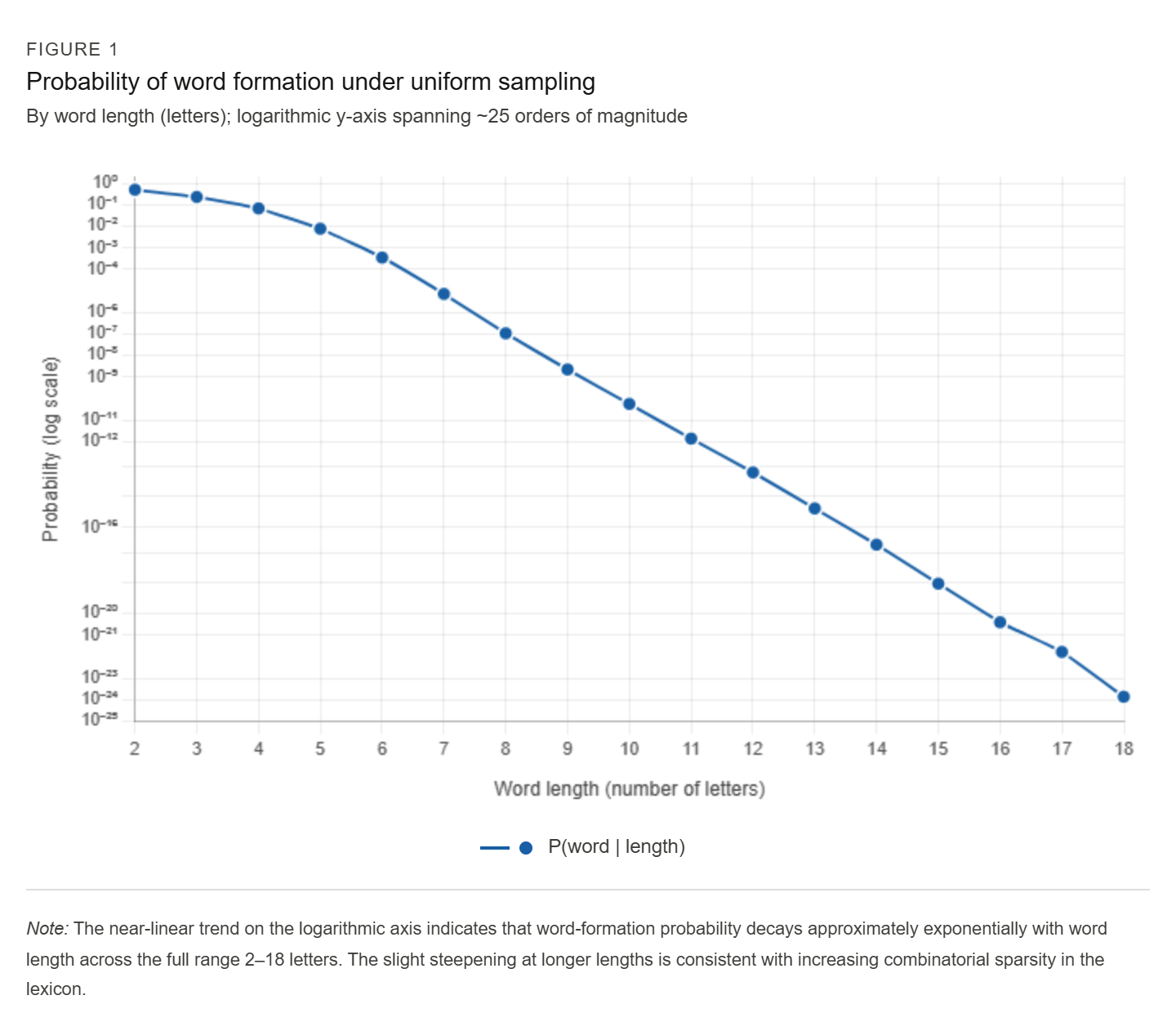
For any string of letters, the shorter the string, the more likely it will be an actual word by chance. This probability is the highest for words of two letters, which have a roughly 50 percent chance of accidentally forming by randomly sampling from the Hebrew alphabet. This probability decays exponentially (that is, really, really) fast as we increase the number of letters in the word, as shown in Figure 1. So let’s take 50 percent as our generously optimistic probability of forming a word, since it only gets worse from there. (Orders of magnitude worse, in fact.)
What is the probability of forming a book with at least one hundred words in a row, if we are sampling from the Hebrew alphabet? Assuming we could tell the story of a Vindication in just one hundred two-letter words, the probability is still on the order of
For comparison, these are the chances of flipping a fair coin one hundred times in a row and coming up heads all one hundred times. It is less than the probability of picking a particular star from all the stars in the known universe, and less than the chance of choosing a marked grain of sand from among all the grains of sand on the earth.
In other words, implossible.
The narrator will never see his own Vindication. Nor has he seen anyone else’s. He has not even come across a book consisting entirely of one hundred or more real words, because to do so would be implossible: logically possible, but outside of the realm of all credibility.
Beyond Borges
The point of this digression isn’t Borges’s fictional world, but our own. If a scientific theory depends on hundreds of lucky coincidences, we can safely jettison it. The implossible is well-beyond implausible. It is ignorable.
We’ve all come across these sorts of claims and situations; sometimes even in peer-reviewed scientific literature. What we’ve lacked is a word or phrase to describe the situation as so unlikely that its improbability amounts to roughly, though not exactly, zero.
We now have one.
Cross-posted from George D. Montañez on Substack.