






































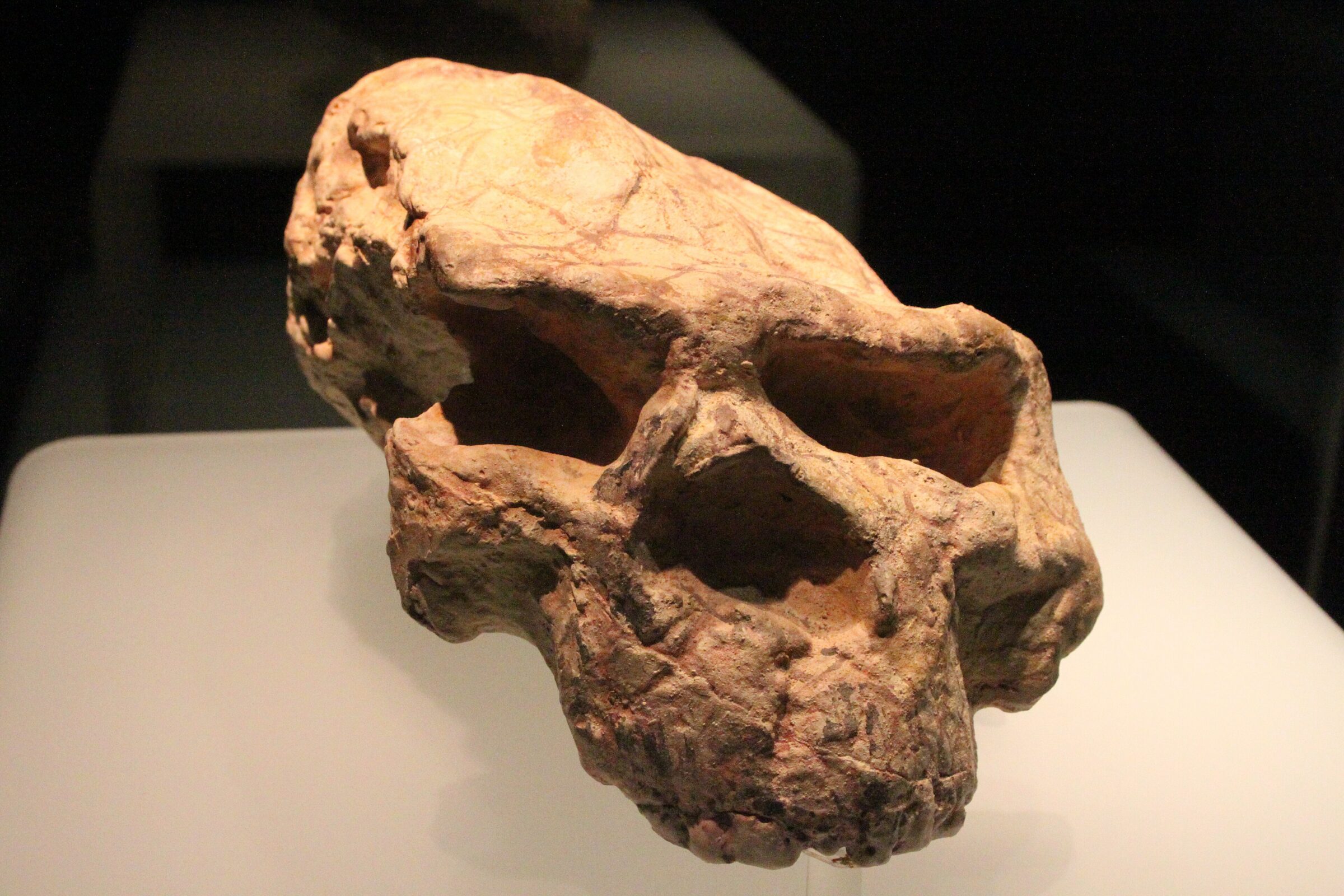
Last year I covered a widely discussed September 2025 paper in Science that analyzed the “Yunxian” skulls, named for the site in China where they were found. The skulls were said to “rewrite” human evolution, because they showed very humanlike characteristics but were from an early age of about 1 million years. As our colleague Günter Bechly used to wryly observe, human evolution is a subject that is constantly being “rewritten,” often accompanied by much media fanfare — yet without scientists acknowledging that the need for perpetual revision may point to the weakness of the overall narrative.
As the BBC reported at the time, the skulls “suggest that our species, Homo sapiens, began to emerge at least half a million years earlier than we thought.” I explained:
The researchers’ argument goes something like this: These Yunxian skulls are dated to about 1 million years … and morphological analysis indicates that the skulls are from a group that is very closely related to Homo sapiens — what the editor’s summary calls a “sister to H. sapiens.”
Therefore, they concluded, if these very humanlike skulls (which they called “Homo longi”) are 1 million years old, then our own species must also date back that far.
A Morphological Analysis
As far as the hard facts go, the claims of the 2025 paper were based upon a detailed morphological analysis of the Yunxian skulls which showed them to be very similar to those of Homo sapiens. That sounded reasonably solid. But the conclusion wasn’t something that researchers were eager to accept, because it did not fit the expected evolutionary timeline. Again, the BBC explains:
When scientists found the skull, named Yunxian 2, they assumed it belonged to an earlier ancestor of ours, Homo erectus, the first large-brained humans. That’s because it dated back about a million years, long before more advanced humans were thought to have emerged.
So basically, at first it was evolutionary reasoning that caused these skulls to be classified as Homo erectus rather than something much closer to Homo sapiens. But after last fall’s Science paper did an extensive morphological analysis, the BBC noted, scientists were willing to rethink that view: “the new analysis of Yunxian 2, which has been reviewed by experts independent of the research team, suggests that it is not Homo erectus” and is instead “an early version of Homo longi, a sister species at similar levels of development to Neanderthals and Homo sapiens.” The implication is:
[I]f Yunxian 2 walked the Earth a million years ago, say the scientists, early versions of Neanderthal and our own species probably did too.
This startling analysis has dramatically shifted the timeline of the evolution of large-brained humans back by at least half a million years, according to Prof Chris Stringer of the Natural History Museum, a co-lead on the research.
He said there are likely to be million year-old fossils of Homo sapiens somewhere on our planet — we just haven’t found them yet.
The point being: Initially the 1-million-year-old age of Yunxian 2 caused scientists to assume it was Homo erectus. But that conclusion was based upon evolutionary reasoning, the view that according to the prevailing evolutionary timeline, Homo sapiens wasn’t around at 1 Ma. But the detailed morphological analysis from last year’s paper in Science was compelling enough that it drove scientists to accept the surprising conclusion that the skull could have belonged to our own species, even if it’s 1 million years old.
That was a good development: it showed that data, not the preference of some evolutionary model, was driving the interpretation. But now, in February 2026, a new paper reports an even earlier age for the Yunxian skulls. It has caused scientists to fall back on evolutionary theory rather than the hard morphological data.
An Older Age Throws Things into Chaos
According to a new paper in Science Advances published just last week, “The oldest in situ Homo erectus crania in eastern Asia: The Yunxian site dates to ~1.77 Ma,” these Yunxian skulls have now been redated. They aren’t ~1 million years old, but more like ~1.77 million years old.
Now remember how all the hoopla I documented was promoted to the public last year about the 2025 morphology-based study? Given that, one would think the implication of this new 2026 study would be to push back the age of our own species to ~1.77 Ma.
But no. That’s not what is happening, because that would definitely not fit the standard evolutionary timeline.
In a striking exposure of how evolutionary reasoning operates, experts are effectively ignoring the results of last year’s study, and reverting to the original view that these skulls represent Homo erectus. An accompanying article in Science tells the story:
Researchers had long assumed the skulls belonged to a distant human ancestor called Homo erectus, which ranged across Asia. In a study published in September 2025, however, other researchers argued that 3D reconstructions of the skulls — known as the Yunxian skulls — linked them to a later group some call H. longi, whose lineage includes the mysterious Denisovans, close cousins of Neanderthals. At the time, the Yunxian skulls were presumed to be about 1 million years old — a strikingly early but not inconceivable date for H. longi. But the new, much older date — if correct — would mean they probably belonged to the older species.
The accompanying article in Science quotes evolutionary scientists who are now apparently ignoring the morphological evidence from the 2025 study. Rick Potts is one example:
“At that time and place, it would make sense [the skulls] were Homo erectus” and not Homo longi,” says Rick Potts, a paleoanthropologist at the Smithsonian Institution’s National Museum of Natural History.
Susan Antón is another:
Susan Antón, a paleoanthropologist at New York University, also leans toward the skulls being H. erectus, adding that Stringer and colleagues’ findings highlight the rich anatomical variation present in that species — not necessarily a connection to Denisovans. “If this is H. erectus at this time and in this part of the world, it’s exactly what we would expect,” she says. “If it’s H. longi, it would be extremely curious.”
Even the second author on this new 2026 paper, Xiaobo Feng — who was also the lead author on the 2025 paper linking these skulls to something very close to Homo sapiens — has changed his tune. Stunningly, the new paper is written almost as if the 2025 paper didn’t exist. The entire 2026 paper speaks as if the Yunxian skulls plainly belong to Homo erectus, and all the evidence and fanfare surrounding the 2025 Science paper just never happened. It’s amazing. The abstract is representative:
With the discovery of three almost complete Homo erectus crania, Yunxian is one of the most important early Pleistocene hominin sites in eastern Asia. Yet, the age of the Yunxian fossils has remained debated because of the lack of reliable numerical dating results. Here, we apply the well-established isochron 26Al/10Be burial dating to quartz gravels from two sediment layers of the site. The age results push the Yunxian crania back to 1.77 ± 0.08 million years ago (±1σ internal error), representing the oldest H. erectus fossils discovered in situ in eastern Asia. A much older age assignment to Yunxian supports the model of rapid dispersal and widespread distribution of early H. erectus and contributes to narrowing the chronological gap between the earliest archaeology and hominin paleontology in eastern Asia.
Erectus, erectus, erectus. That’s all you hear about in the 2026 paper. It’s a prime example of how the preferences of evolutionary theory often take total priority over morphological evidence.
To be clear, the 2026 paper does address the 2025 paper, but consider how it does so. In the 2026 paper, the 2025 paper is reference 35. It’s mentioned only once — very briefly towards the end — and its morphology-based conclusions are basically dismissed without any analysis:
Given the recent phylogenetic study of Yunxian 2 that used the original age of 1.0 Ma to anchor their analysis (35), it would be interesting to see how these updated and much older dates for Yunxian change the phylogenetic analysis and position of these fossils.
They simply say that these older ages should “change the phylogenetic analysis and position of these fossils.” There is no mention of the morphological data and how it challenges the 2026 paper’s repeated assertions that the skulls belong to Homo erectus.
These evolutionary scientists are remarkably quick to dismiss a detailed morphological analysis in a top journal. Why? Because evolutionary theory takes precedence.
Another Way Out?
Another possibility is that the morphological analysis is accurate, but that the 1.77 Ma date on these skulls is wrong. This view is preferred by Chris Stringer, also a co-author on the 2025 paper:
Chris Stringer, a paleoanthropologist at the Natural History Museum in London and co-author of the reconstruction paper, doesn’t buy it. “We don’t think that [the deformed skulls are] H. erectus, and I would respectfully suggest that further work on dating the site is needed.”
[…]
Stringer isn’t backing down. “[The Yunxian skulls are] quite different from the small-brained H. erectus fossils, in cranial shape as well as cranial capacity,” he says. And he questions the new date, noting previous work establishing a probable million-year age for the animal remains at the Yunxian site.
Only more data — notably, a full analysis of the third Yunxian skull — can settle the debate. “I would say, for now, just put a pin in it,” Potts says. “There are a lot of intriguing things going on in China.”
Of course there’s a third possibility: That is that their evolutionary model is wrong and these skulls really were something very similar to Homo sapiens at 1.77 Ga, or whatever age they happen to be.
What Does This Episode Show?
In closing, we can set aside for the moment questions about exactly how old these skulls are or whether they are closer to Homo sapiens (via Homo longi) or closer to Homo erectus. Here’s the main point:
When they think the skulls are at an age they can tolerate for the existence of Homo sapiens, then they accept morphological data which shows the skulls are very humanlike. But when the age is apparently too old for their model, they let evolutionary considerations drive the interpretation and claim they belonged to Homo erectus. The hard morphological data goes out the window.
This episode shows how quickly evolutionary scientists will ignore the hard evidence and completely change their interpretation of a fossil in deference to the evolutionary story they wish to tell. The demands of the evolutionary theory come first. And that observation applies far beyond the context of the Yunxian skulls.
There’s probably another point as well: At the end of the day, the skulls from all the groups under discussion here — Homo erectus, Homo longi, and Homo sapiens — are very similar. So much so that scientists feel they can transfer the assignment of these skulls from one group to another quite freely. As I argued last year, they could well all just be the same species. How many preferred evolutionary narratives are getting in the way of the data which supports that conclusion?