






































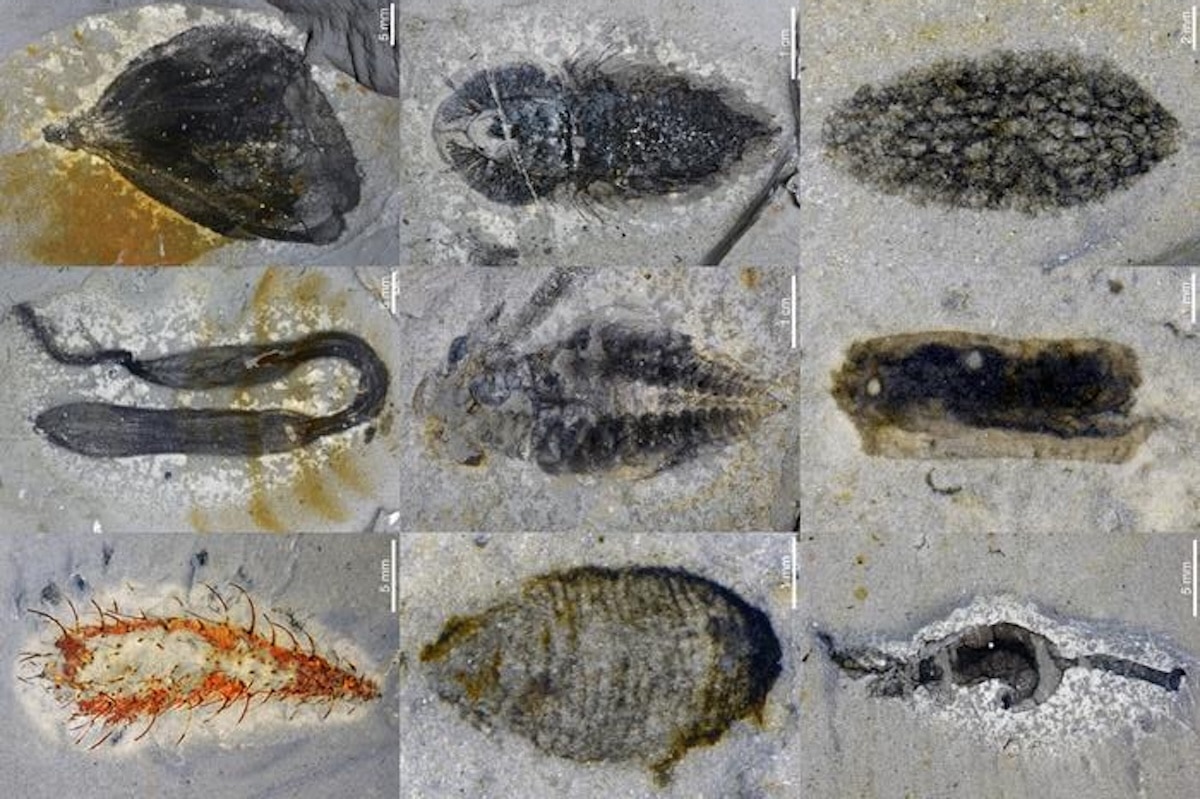
The Burgess Shale in Canada has been famous for over a century. It is the archetype of well-preserved Cambrian fossils. In 1988, the Chengjiang site in China startled paleontologists with its colorful specimens showing exceptional preservation (Lagerstätte). In 2014, another site in British Columbia near the Burgess Shale, Marble Canyon, was discovered with comparable fossils. Several lesser Cambrian sites around the world have been identified as “Burgess Shale Type” fossil beds (BST).
Now, another Cambrian fossil site that rivals the original Burgess Shale has been announced to the world: the Huayuan site in southern China, over 650 miles northeast of the Chengjiang site. The extensive bed contains some surprises as well as “more of the same” to the consternation of some evolutionists.
The Discovery
The Chinese Academy of Sciences boasts that the new site is top-notch among BST fossil beds:
The Huayuan biota boasts an extraordinary abundance and diversity of soft-bodied fossils, exceptional fidelity of soft-tissue preservation, and complex ecosystem structures, establishing it as a top-rank Burgess Shale-type fossil deposit, rivaling China’s Chengjiang biota and Canada’s Burgess Shale biota.
What’s New at Huayuan
The surprises include new species and the reappearance of species from the Burgess Shale, halfway around the world. James Woodford at New Scientist says, “So far, they have analysed 8681 fossils from 153 species, nearly 60 per cent of which are new to science.” The Chinese Academy emphasizes the number collected over those analyzed:
The story of the discovery began in 2020 in Huayuan County, in central China’s Hunan Province, when road construction exposed ancient shale rock layers. Scientists began excavating the area and uncovered an extraordinary site. To date, they have collected over 50,000 fossils. An initial study of thousands of these specimens revealed 153 animal species, with a remarkable 59 percent being completely new to science.
The fossils represent 16 animal phyla. Woodford mentions some examples of animals found:
Most of the fossils found are arthropods, related to today’s insects, spiders and crustaceans. The fossils also include molluscs, shelled creatures called brachiopods and cnidarians — relatives of jellyfish.
Add chordates to the list, the Chinese Academy says. The soft-tissue preservation is also remarkable:
What makes the Huayuan Biota so important is the exceptional way in which the soft tissues have been preserved. These fossils capture delicate animals — early relatives of everything from worms and jellyfish to chordates — in fine detail, showing features like guts, nerves, and gills. This provides an unprecedented snapshot of a complete ancient ecosystem.
The detail in the fossils is remarkable. Woodford suggests why that is:
Zeng says the reason for the exquisite preservation found at the site is that the animals were buried very quickly under a slurry of fine mud. The soft parts of animals are preserved in extraordinary detail, including walking legs, antennae and tentacles, respiratory organs such as gills, the pharynx and guts in many animals and even eyes and neural tissues.
The journal paper also mentions “diverse radiodont predators and abundant pelagic tunicates” were found. (Radiodonts include the large predator Anomalocaris famous from the Burgess Shale.) The artwork of a Huayuan ecosystem includes a predator resembling Anomalocaris, trilobites, and Hallucigenia on the ocean floor, and a number of swimming creatures like Marrella and chordates, some of which resemble fish. Also found are lobopodians, priapulids, poriferans (sponges), cnidarians, comb jellies (ctenophores), and much more. For a site representing “the end of the canonical Cambrian explosion” (in terms of new phyla), this was a rich, diverse community of complex animals.
Huayuan’s Place on the Cambrian Timeline
More from the Chinese Academy of Sciences explains that among the known the BST fossil sites, paleontologists had lacked soft body fossils from a particular extinction called the “Sinsk Event” which is assigned a date of 513 million years ago on the evolutionary timeline.
That changed over the past five years, however, with the discovery of the Huayuan biota — a world-class soft-bodied fossil deposit dating to shortly after the Sinsk Event. The deposit, located in Huayuan County, Hunan Province, was identified by a research team from the Nanjing Institute of Geology and Palaeontology of the Chinese Academy of Sciences (CAS), whose findings were published in Nature on January 28.
The paper calls the Sinsk event a major extinction comparable to the “big 5” mass extinctions. The other news release says the Huayuan site fills an important gap on the evolutionary timeline:
Now, that gap has been spectacularly filled. A team led by researchers from the Nanjing Institute of Geology and Palaeontology at the Chinese Academy of Sciences (NIGPAS) has announced the discovery of the Huayuan Biota, a stunning collection of fossils dating to about 512 million years ago, right on the heels of the Sinsk event.
For comparison, evolutionary paleontologists date the Chengjiang bed at 520 million years old (before the Sinsk Event) and the Burgess Shale at 508 million years old (after the Sinsk Event). The Cambrian Explosion itself goes back to 540 million years ago, the news release says, admitting that it represented abrupt changes over a short time:
Around 540 million years ago, Earth’s biosphere underwent a pivotal transformation, shifting from a microbe-dominated world to one teeming with animal life, as nearly all major animal phyla appeared abruptly in the fossil record over a very short geological time interval. This landmark evolutionary event is known as the Cambrian Explosion.
Not just an event, mind you, but an evolutionary event. Take note of that as we continue.
Evolutionary Surprises
One surprise was finding species from the Burgess Shale on the other side of the planet living comfortably at home here. The researchers marvel at this, because they say Canada was far from China when the fossils were deposited. How did they get there? Woodford offers a suggestion from one of the discoverers, Han Zeng:
Another arthropod, Helmetia, is one of two genera that were previously found only in Canada’s Burgess Shale but have now been found at Huayuan, which was then, as now, “halfway across the world,” says Zeng. “This indicates that early animals were able to spread over a very long distance, which was most likely made by the transportation of animal larvae in ocean currents,” he says.
This question deserves closer consideration. It sounds a bit like the “rafting monkeys” hypothesis. Could tiny larvae survive a trip that far?
Any Transitional Forms?
Since they date the new site between Chengjiang and Burgess Shale, some evolution should have occurred. One of the news releases doesn’t mention evolution. The other one waves a magic wand:
These analyses reveal a fundamental reorganization of global marine communities across the Sinsk Event extinction boundary. The findings further suggest that deep-water outer shelf environments acted as critical refugia for faunal migration, biological survival, and evolutionary innovation during this pivotal post-extinction transition.
Evolutionary innovation? Is that a thing, or just a phrase masking ignorance? Maybe it means mini-explosions within the explosion. Woodford at New Scientist fails to mention evolution. If the fossils supported one or more evolutionary transitional forms, wouldn’t the media be making it the centerpiece of the story?
How about the paper in Nature? It mentions transitions in ecosystems, but no particular creature representing stages of evolutionary ancestry. Figure 4 includes phylogenetic diagrams, and counts of creatures of each phylum at Burgess Shale, Chengjiang, and seven other BST sites, with suggestions that Huayuan sits in the transition between Cambrian ages 3 and 4, but that’s it: mere bean counting. The rest of the evolution-talk is in magical thinking and promissory notes:
The marked differences in taxonomic composition between Cambrian Stage 3 and Stage 4 BST biotas (Fig. 4c and Extended Data Fig. lOc-f) indicate that the global soft-bodied biotas also experienced a notable transition during the Sinsk event. The BST biotas from Cambrian Stage 4, including the Guanshan, Sinsk, Emu Bay Shale and Parker Quarry biotas, indicate that shallow-water biotas recovered relatively quickly from expanded shallow marine anoxia in the Sinsk event.
Oxygen, as usual, is one of the evolutionists’ magic potions to spark innovation:
Meanwhile, the deep-water environment, closer to the oxygen minimum zone, may have been a refugee or an innovative regime where new taxonomic and ecological groups originated, as indicated by the correlation between expanded marine anoxia and evolutionary novelty and innovation in post-extinction recovery. Such an onshore-offshore pattern of fauna I change echoes the observations for the early Palaeozoic and the prediction of heuristic model, providing an excellent platform for future testing of extinction-diversification models in macroevolution.
Translation: we can surmise, by imagination, that nature built a sanctuary in deep water where innovative random processes built legs, guts, and eyes because there was just enough oxygen. Some future day someone could test that idea if they get around to it.
Straining to Fit
This major discovery should excite everyone with its glimpse into a community of complex animals preserved with fine details intact. Intelligent design advocates see the sudden appearance of complex body plans in thriving ecosystems, focusing on the sophisticated body systems like eyes, jointed legs, guts, reproductive systems, and brains. Evolutionists, though, are straining to fit it into a Darwinian narrative, aware that an “explosion” of complex body plans runs contrary to the gradual mutation-selection “mechanism” championed by Darwin.
The Huayuan Biota, like the other Cambrian fossil sites, documents faunal disparity but not ancestry. It’s “more of the same” found all over the world in the Cambrian: the same phyla with clearly recognizable members. What is the source of the information required to build integrated systems displaying hierarchical organization? That was the question in Darwin’s Doubt. None of the sources even tried to address that issue. Design advocates can scientifically predict that evolutionists will continue failing to locate the information required for complex body plans within oxygen molecules.