





































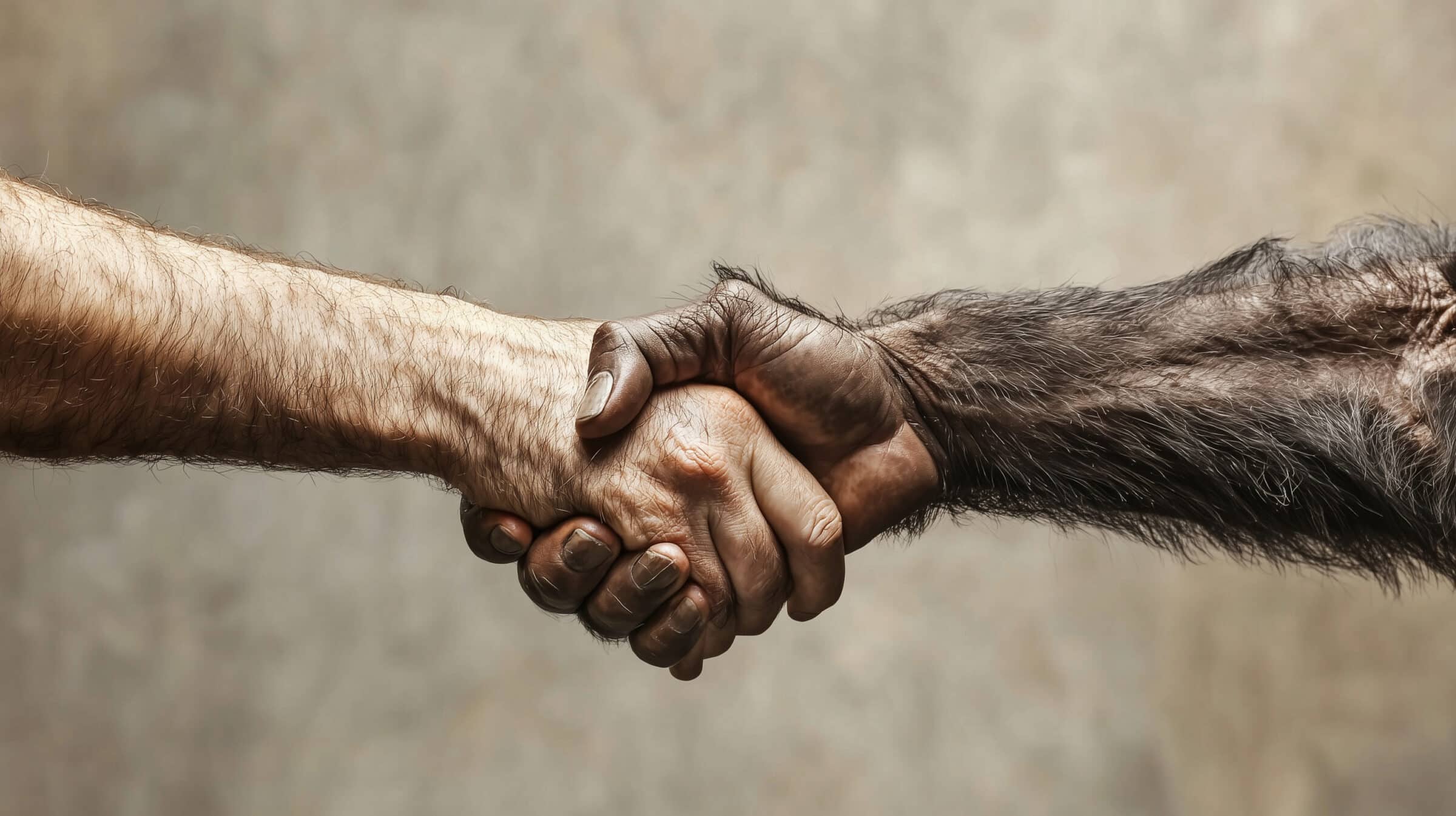
Chimpanzees, we are told, are the closest relatives to human beings. Indeed, for years scientists claimed that there is only about a one percent difference separating the human genome from that of chimps. Some advocates even claimed that means humans are mostly chimps, or that chimps are mostly human, eroding the principle of human exceptionalism.
But research published last year disclosed that the “1 percent difference” was badly off the mark and that the true genetic difference between humans and chimps is about 15 percent. But what does the genetic difference statistic mean scientifically, and whether 1 percent or 15, does it matter morally?
For a new episode of the Humanize podcast, I invited one of Discovery Institute’s premier scholars to discuss these new findings and the meaning of it all. Dr. Casey Luskin is a scientist and attorney with a PhD in geology from the University of Johannesburg and a law degree (JD) from the University of San Diego. He also holds BS and MS degrees in Earth Sciences from the University of California, San Diego, and is a California-licensed attorney. He works at Discovery Institute as Associate Director and Research Director for the Center for Science and Culture, where he directs the ID 3.0 Research Program, and assists and defends scientists, educators, and students who seek to freely study, research, and teach about the scientific debate over Darwinian evolution and intelligent design (ID).
He has co-written, co-edited, and contributed to many books on ID, is a sought-after public speaker and a prolific media commentator. Download the podcast or listen to it here.
Dig Deeper
- “Letter to the Smithsonian,” by Casey Luskin | Science and Culture Today
- “Smithsonian exhibit monkeys around with the scientific evidence on human origins,” by Casey Luskin | New York Post
- “Fact Check: New ‘Complete’ Chimp Genome Shows 14.9 Percent Difference from Human Genome,” by Casey Luskin | Science and Culture Today
- “Complete sequencing of ape genomes,” by Yoo, D., Rhie, A., Hebbar, P. et al. | Nature
- “No, We Are Not Part Chimp!” by Wesley J. Smith | National Review
- “Humans Are Not 98 Percent Genetically Identical to Chimpanzees,” by Wesley J. Smith | National Review