




































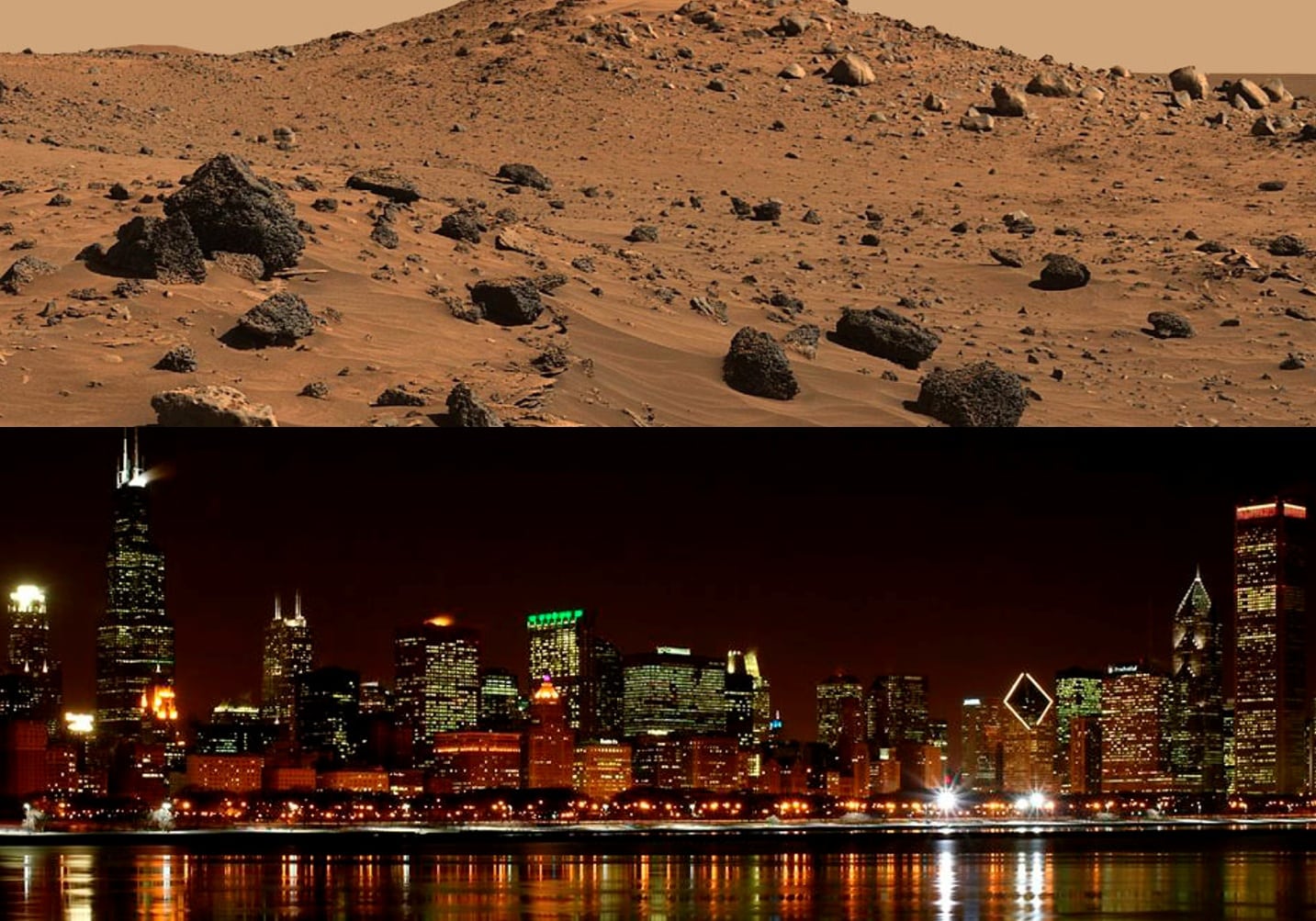
I often show, for example in the video “Evolution Is a Natural Process Running Backward,” a picture of a barren planet and a picture of a modern city today and use this to illustrate that there seems to be something very “unnatural” about what has happened here on Earth. Most lay people, and certainly intelligent design advocates, would agree; but how can we express what is obvious to the layman in more “scientific” terms?
The only widely recognized law of science that the development of civilization on a barren planet could violate is the (generalized) second law of thermodynamics. A typical statement of this law is that “in an isolated system, the direction of spontaneous change is from order to disorder.” The usual counterargument is that “the Earth is not an isolated system, it receives energy from the sun, and entropy (disorder) can decrease in an open system.” Nothing unusual here — happens all the time.
All About Probability
The fact that the usual statements of the second law do not apply to open systems has made it necessary to express the “unnaturalness” of undirected evolution in other ways. A popular and valid way to do this is to talk about the increase in “information” associated with the origin and development of life, and to point out that in our experience only intelligence creates information.
But the second law is all about probability. Why can’t order increase in an isolated system? Because it is extremely improbable. Are the laws of probability suspended when a system is open? No, you just have to take into account what is crossing the boundary in deciding if an increase in order is extremely improbable or not. So, I have frequently offered this tautology:
If an increase in order is extremely improbable when a system is isolated, it is still extremely improbable when the system is open, unless something is entering which makes the increase NOT extremely improbable.
In several publications (see this 2024 Science and Culture article for the references and a more rigorous discussion of the whole topic) I have looked at the equations for entropy change and showed that the entropy associated with any diffusing component X (if X is diffusing heat, this is just the usual thermal entropy) can decrease in an open system, but no faster than it is exported through the boundary. Since this “X-entropy” measures disorder in the distribution of X, we can say that the “X-order” (defined as the negative of X-entropy) can increase in an open system, but no faster than X-order is imported through the boundary. Thus, the very equations upon which the “compensation” argument, used by Isaac Asimov and many others, is based illustrate instead the tautology offered above. (I’m not sure a tautology needs illustrating but this topic is so controversial that maybe it does.)
Computers on a Barren Planet
Then I have applied this tautology to what has happened on Earth and said, the fact that order can increase in an open system does not mean that computers can arise on a barren planet as long as the planet receives energy from the sun. Something must be entering the system which makes the appearance of computers NOT extremely improbable, for example, computers.
In two videos, “Evolution Is a Natural Process Running Backward” and “Why Evolution Is Different” (starting at 4:01), and in several publications, I have further pointed out that since tornados derive their energy from the sun, the compensation argument could equally well be used to claim that a tornado running backward, turning rubble into houses and cars, would not violate the second law.
In a 2013 BIO-Complexity paper, I nevertheless conceded:
Those wanting to claim that the basic principle behind the second law is not violated [by what has happened on Earth] need to argue that, under the right conditions, macroscopically describable things such as the spontaneous rearrangement of atoms into machines capable of mathematical computations…or of interplanetary space travel, are not really astronomically improbable from the microscopic point of view, thanks to the influx of solar energy, and to natural selection or whatever theory they use to explain the evolution of life and of human intelligence.
What Darwinists Believe
A friend recently objected: but that is exactly what Darwinists believe! The implied question was, what does the second law argument really accomplish if Darwinists can still say, “The second law is not violated because it only seems astronomically improbable that unintelligent forces alone could rearrange the basic particles of physics into smartphones. But it really isn’t, and here is our theory as to how it happened…”
I would answer that what it accomplishes is this: it at least shifts the burden of proof. Most scientists now look at what has happened on Earth and say, naturalism has been so successful in explaining other phenomena that if you don’t think an entirely natural, unintelligent explanation is possible for all of this, the burden of proof is on you to prove that it isn’t. But if we saw a tornado running backward, turning rubble into houses and cars, and heard someone claim to have a scientific theory that explains how this could happen, doubters would not feel they need to find the errors in his theory. They would consider doubt to be the default position!
What is the difference between a tornado running backward and civilization arising on a barren planet? Each certainly seems to be extremely improbable, and so each seems to violate at least the underlying principle behind the second law in a spectacular way, whether there is input of solar energy to their systems or not. (And remember that time is the enemy, not the friend, of theories that violate the second law.)
So, in “Why Evolution Is Different,” I concluded (starting at 13:27):
Anyone who claims to have a scientific explanation for how unintelligent agents might be able to turn rubble into houses and cars would be expected to produce some very powerful evidence if they want their theory to be taken seriously. The burden of proof should be equally heavy on those who claim to have a scientific explanation for how a few unintelligent forces of physics alone could rearrange the basic particles of physics into computers and encyclopedias and Apple iPhones — and there is no evidence that natural selection of random mutations can explain anything other than very minor adaptations.