






































It’s a new year and the media is already buzzing with news stories about the latest “missing link in human evolution.” The New York Times has the enticing headline “Moroccan Cave Fossils Yield a Possible Missing Link in Human Evolution.” Reuters has the headline “Fossils found in Moroccan cave may be a close Homo sapiens ancestor.” And other news-sites have headlines like “Early Human Ancestor Found in Morocco Dates Back 700,000 Years May Be Major Missing Link” or “Morocco fossils reveal missing link to human ancestry in Africa.” What’s the big deal and what was actually found?
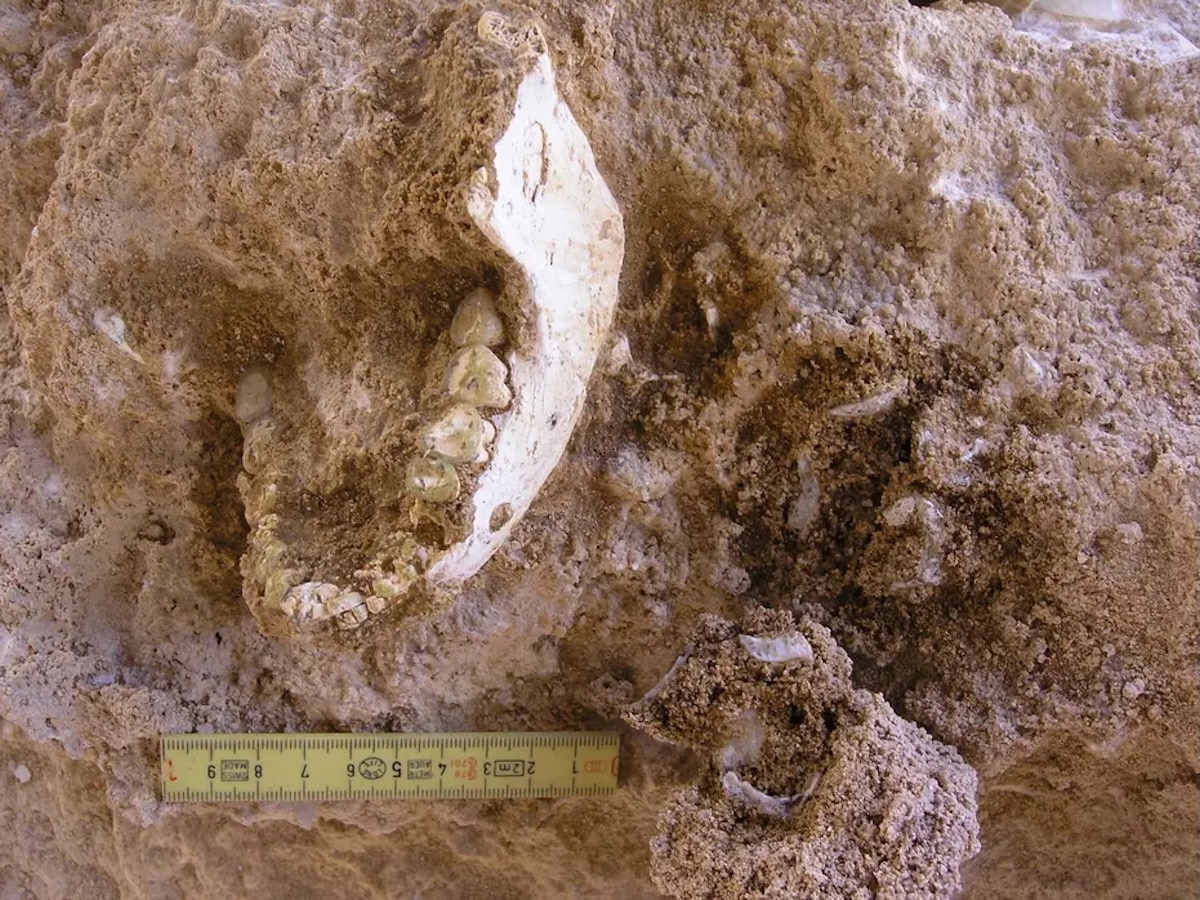
According to the technical paper in Nature, the find is interesting but far from overwhelming. They found three jawbones (one of which is very complete, another of which is a half-mandible, and the third is highly “fragmentary”), some teeth (more than a few but less than a mouthful), and eight vertebrae. There was also a chewed-up femoral shaft found at the back of the cave site a few years back, but according to the technical paper its stratigraphic relationship to the other bones is “uncertain.” Fairly commonplace stone tools are also found in the cave. Again interesting, but not a whole lot to go on.
Paleoanthropologist John Hawks comments that the teeth exhibit an “anatomical mosaic,” and perhaps that’s true. But teeth can be highly plastic, and I’m reminded of past studies which have said things like “tooth morphology is prone to homoplasy [convergence] and is therefore a poor guide to low-level phylogenetic relationships” or “little confidence can be placed in phylogenies generated solely from higher primate craniodental evidence.”
In any case, perhaps the extreme modesty of this find could still warrant the media’s amped rhetoric if the fossils represented some momentous evolutionary transition, such as humans evolving from apelike ancestors or something like that. But no. The very title of the paper is “Early hominins from Morocco basal to the Homo sapiens lineage” (emphasis added), which suggests that at most their evolutionary significance is that they were early members of our own species — or something extremely similar to our species. So we’re talking about fossils that are very humanlike, if not essentially completely human.
One Biological Species
Even John Hawks thinks “these fossils are Homo sapiens.” He continues:
They fall somewhere within that tangle of groups that ultimately gave rise to Neanderthals, Denisovans, and modern people.
That’s very fair, but does it mean they were anything but basically human? Cue Jerry Coyne’s Why Evolution Is True blog, which commented just a few days ago that “Neanderthals are Homo sapiens.” The point was made based upon some refreshingly lucid reasoning from evolutionary biologist David Hills, who similarly wrote on Facebook just a few days ago:
“Joao Zilhão, an archaeologist at the University of Lisbon, noted, with a trace of sarcasm, that the push to classify Neanderthals as a separate species frequently arises from a reluctance, especially among geneticists, to fully accept them as a geographically distinct, but interbreeding, branch of humanity.”
Exactly. Neanderthals were a geographically distinct population of Homo sapiens, rather than a distinct species. The two populations interbred extensively, and many modern people (including me) have both as ancestors.
If pure Neanderthals were around today, no one would call them a different species, which would be considered highly insulting and racist. Why does the fact that we interbred them to extinction (actually intergradation) change that? Given that much of modern humanity carries Neanderthal genes in their genomes, it is time to stop making this misleading distinction.
This is 100 percent right. And if anyone is paying attention, I made largely the same point back in October about some recently published skulls from China:
According to some common definitions of species, if you interbreed in nature, then you should be considered part of the same species. For example, Google reveals that the Oxford language definition of species is “a group of living organisms consisting of similar individuals capable of exchanging genes or interbreeding.” Under such a standard definition, it’s hard to rule out Sapiens, Neanderthals, and Longi [which includes Denisovans] being the same species.
According to the biological species concept — arguably the most commonly accepted definition of a species (that I was taught over and over while studying evolutionary biology in school) — a group of individuals that can interbreed and cannot breed with other groups (i.e., “reproductively isolated”) is considered a biological species. Here’s what all this means: Although these fossil individuals lived 773,000 years ago, we can infer that if (a) these specimens were at the base of modern humans, Neanderthals, Denisovans, and (b) modern humans, Neanderthals, and Denisovans represent an interbreeding population, then we’re all part of the same species. And these fossils therefore belong within the species Homo sapiens — or at the very least are very human-like.
Something New, But It’s Not About Evolution
There is something new about this fossil discovery — but it doesn’t show anything momentous about evolution. The fossils are supposed to be about 773,000 years old, which represents a time period when we previously didn’t have many human fossils from Africa. But what’s really cool, from my perspective as a PhD paleomagnetist, is the magnetostratigraphic dating that was used to date the fossils. They believe these fossils were preserved in sediment deposited precisely during the geomagnetic transition from the Matuyama chron to the Brunhes chron, seeming to capture the Brunhes–Matuyama reversal. If correct, that’s extraordinarily lucky, and it allows them to pinpoint the age of these fossils to an age of about 773 Ka.
And what does this discovery show we find at this poorly known time period around 773 Ka? A “missing link in human evolution,” as the New York Times tells us? No. We find fossils that belong within Homo sapiens, or at the very least are highly human-like. In my opinion that’s interesting and revealing, but it certainly doesn’t warrant the hyped-up headlines we’re seeing.