






































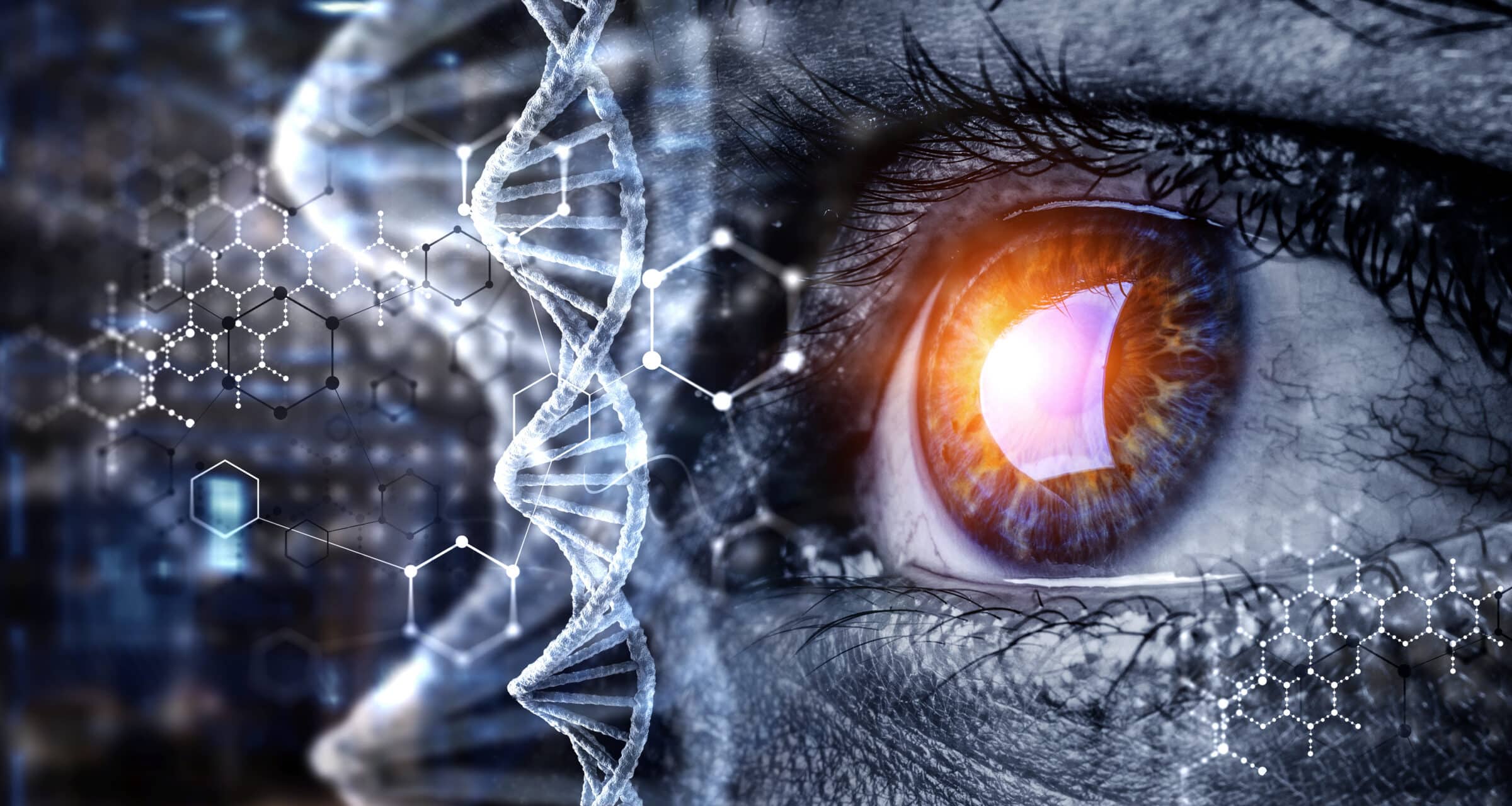
First, we learned that DNA is a molecule: a nucleic acid. Then we learned that it is a double helix. Then we learned that its 2-D sequence of nucleotides is informational: it codes for genes. Then we learned that DNA is not haphazardly stuffed into the nucleus: it’s a 3-D information system — a genome, with a shape related to its function. Then we learned that the genome is accompanied by a plethora of molecular machines and regulators, comprising an interactome. Then we learned that the shape DNA takes on in the nucleus has an architecture: it folds into topological domains and functional compartments. The interactome became a nucleome.
Now, DNA has entered the fourth dimension: it is a dynamic architecture, constantly reconfiguring itself in functional ways with the aid of a multitude of molecular machines in dizzying motions and interactions. A factory in a cathedral could hardly compare. For the final dose of awe, consider that the molecular machines that operate on DNA are coded in DNA! Gone is the Central Dogma. Gone is the myth of Junk DNA.
Seeing Genetics in 4-D
This unprecedented expansion of the concept of the “genome” from sequence to dynamic nucleome has been aided by a series of international research programs like ENCODE and its successors. The latest has been the 4D Nucleome Project funded by the NIH Common Fund. A short video from 2023 explains its goals.
The 4D Nucleome Project (henceforth 4DN) brought together an international consortium of researchers to work on unanswered questions about DNA. They all cooperated in an open-science environment, where data and technologies could be shared through the 4D Nucleome Portal. (See my earlier articles on 4DN from 2017 and 2018.) One might call this an “interactome” of human researchers seeking understanding of the interactome of cellular components.
The 4DN program completed another milestone last month. The findings and techniques perfected so far will continue to bear fruit for years, increasing our understanding of DNA’s dynamic architecture and how diseases result when the architecture breaks down. Feel the excitement of the researchers in this NIH video from summer 2025 describing what they discovered about the nucleome:
From Sequence to Shape
Phase One of the 4DN ended in 2020, focusing on developing new technologies for research. Phase Two (2020-2025) ended with a grand finale: an elaborate map of the nucleome presented in Nature. Ninety authors from eight countries contributed to the paper by lead author Job Dekkar of Howard Hughes Medical Institute and corresponding co-author Feng Yue at Northwestern University, “An integrated view of the structure and function of the human 4D nucleome.” The results are impressive:
We produced and integrated diverse genomic datasets of the 4D nucleome, each contributing unique observations, which enabled us to assemble extensive catalogues of more than 140,000 looping interactions per cell type, to generate detailed classifications and annotations of chromosomal domain types and their subnuclear positions, and to obtain single-cell 3D models of the nuclear environment of all genes including their long-range interactions with distal elements. [Emphasis added.]
The findings were summarized for journalists in this press release from Northwestern. One of the accomplishments of the team was “the use of computational methods to predict genome folding from DNA sequence.” As we have long known, the sequence of amino acids in a polypeptide is critical for its ability to fold into a functional protein. In a similar way, the sequence of DNA letters is involved in its ability to fold into a functional nucleome, but DNA architecture is even more wondrous: it reconfigures itself according to the needs of the cell type and its current health status.
The work underscores a growing recognition that the genome’s function cannot be understood only by reading its sequence and that its shape matters, too. By revealing the connections between DNA folding, chromatin loops, gene activity and cell behavior, the study moves the field closer to a holistic view of how genetic instructions operate inside living cells.
Functional Spaghetti in Motion
Another press release from UMass Chan Medical School features lead author Job Dekker. Consider the plethora of players in the nucleome and the vast extent of their playing field:
The human genome contains more than 20,000 protein-coding genes with an estimated millions of regulatory elements that influence those genes. Scientific studies have catalogued some of these components. However, the mechanisms by which these regulatory elements act on specific genes, especially over long distances of up to hundreds of kilobases and sometime megabases, are still poorly understood.
How the genome is folded, organized and structured in space greatly influences what regulatory elements and genes are in proximity to each other, as well as their location in relation to other molecular bodies in the nucleus. This, in part, explains how elements that are spaced widely apart along the linear genome can interact in three-dimensional space. Like cooked spaghetti gathered in a bowl, folding and looping brings distant elements into proximity to each other so they can interact. What’s more, the structure of the genome can vary from cell to cell and state to state, such as during cell division or when a cell undergoes stress, further influencing gene function.
Let us multiply the complexity even further by considering that each species of plant and animal has its own 4-D nucleome with unique functional needs. Surely there is much more work ahead!
“This is the most detailed view of the living physical genome as it exists inside of cells,” said Dekker. “It’s the foundation for the deep exploration of structure and function of the genome.”
Into the Microcosm of DNA Topology
Molecular machines guide DNA into Topologically Associating Domains (TADs) where genes and proteins interact. (Interestingly, many of the repetitive DNA portions that had been dismissed as “junk” turn out to be key structural components of the TADs.) A domain is like a factory within a factory, where genes and their regulators can interact while being insulated from the noise outside. Cohesin and CTCF protein are key players in TAD formation.
Within a TAD, condensates form via phase separation, bringing functional ingredients into contact with each other. See my article about condensates here that describes what 4DN researchers at Caltech found in 2021: short-order work groups containing polymerases, regulators, cofactors, and thousands of non-coding RNAs that cooperate for specific functions. That was an astonishing discovery that blew away old notions of DNA junk floating around in the nucleus waiting for a polymerase to land somewhere. Everything turns out to be coordinated within a vast floor plan with thousands of workers knowing where to go and what to do. Some of the workers even recruit needed workers!
The new architectural paradigm explains how genes and cofactors on different chromosomes can be brought into contact. Through folding and loop extrusion, distant pieces of DNA can be brought near for interaction. Multi-loop hubs bring enhancers and promoters together. The new picture also sheds light on how a single genome can generate very different cell types in the same body by switching on or off different regulatory operations.
Hierarchical Design
This paragraph from Dekker et al. helps us get a grip on the extensive compartmentalization of DNA inside the nucleus. Compartments large and small contribute to a hierarchical architecture in coordinated motion:
The genome is organized at different scales. At the local scale of the chromatin fibre, nucleosome positioning and histone modifications influence the structure and accessibility of DNA. At the scale of up to hundreds of kilobases, chromatin loops form in a dynamic manner, sometimes enriched near specific cis-elements and in many, but not all, cases such loops are generated through active loop extrusion by cohesin and condensin complexes. The pattern of extrusion along chromosomes is modulated by cis-elements such as enhancers, promoters and insulators. The process of loop extrusion contributes not only to loops between specific cis-elements including CTCF-bound sites, but it also underlies the formation of topologically associating domains (TADs). Loci within TADs interact frequently through cohesin-mediated extrusion. TADs often have CTCF sites at their boundaries that block extrusion, thereby lowering the probability of interactions between loci on either side of the boundary, a phenomenon referred to as insulation. Finally, chromosomal domains that can range in size from several kilobases to megabases cluster together in space to form subnuclear compartments. Such associations can involve functionally distinct subnuclear structures and bodies such as nuclear speckles, nucleoli and the nuclear periphery. Many studies over the past several years have started to describe these phenomena, exploring the mechanisms of their formation and their potential roles in genome regulation.
Mapping all of this architecture, including the 140,000 looping interactions they found, is a mere prerequisite for understanding the operation of this spectacular dynamic architecture. DNA is not a static sequence to read; it is a code that builds and operates its own factory. And to think that it is all duplicated while in operation seems more than human engineers can grasp.
ID on Steroids
Can random mutations conceivably improve this dynamic architecture, let alone originate it? Perish the thought. The authors know that breakdowns in this dynamic architecture lead to diseases like cancer and Alzheimer’s disease. This is no factory to tinker with. Blind watchmakers need not apply. In truth, numerous repair processes try to keep it together, because small mutations can have large, sometimes catastrophic, effects. Remember when Darwinists spoke of random mutations as the seedbed of evolutionary progress? That notion seems quaint today.
It’s been immensely satisfying to watch the case for intelligent design blossom as views inside the cell improve. DNA was a 4-D masterpiece all along. I pity the Darwinists who cling to their outmoded models of blobs of protoplasm. It’s a new day. Happy New Era!