






































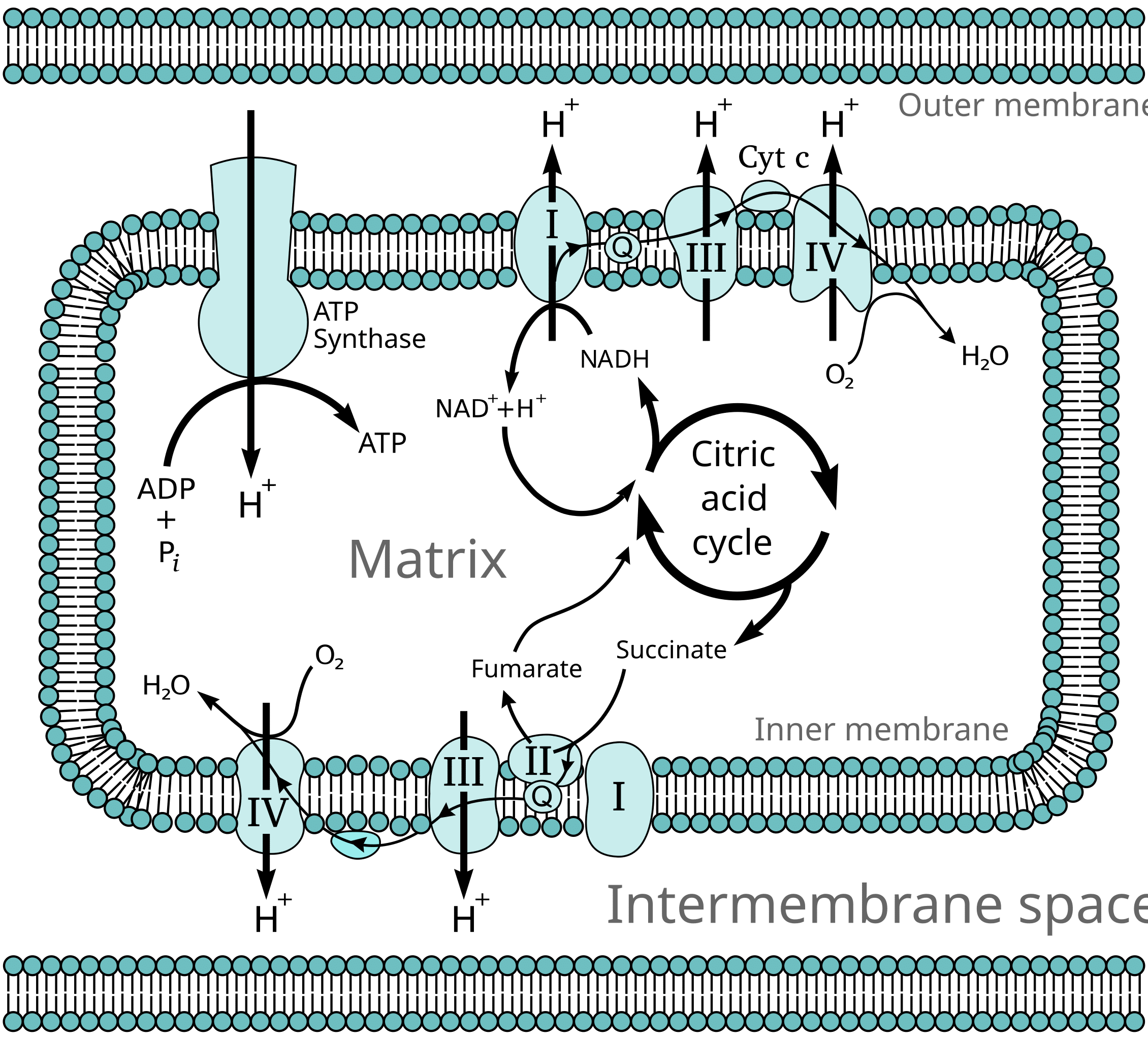
In two previous articles (here and here), I highlighted the incredible design of the glycolytic pathway and Krebs cycle. Here, I will briefly survey the elegant engineering of the electron transport chain.
In short, the electron transport chain involves the flow of electrons through a respiratory chain. Electrons pass through three protein complexes that are embedded in the inner mitochondrial membrane: NADH-Q oxidoreductase (Complex I); Q-cytochrome c oxidoreductase (Complex III); and cytochrome c oxidase (Complex IV). Complex I, a large multi-subunit protein, is the enzyme that catalyzes the transfer of electrons from the reducing agent (electron donor) NADH to coenzyme Q. The electrons are relayed to cytochrome c at Complex III, and Complex IV transfers the electrons to oxygen, which is thus reduced to water. Complexes I, III, and IV serve as proton pumps, using the energy from electron transfer to transport protons from the matrix into the intermembrane space. The complexes utilize the energy given up by the flow of electrons. The inner mitochondrial membrane is impermeable to protons, leading to their accumulation in the intermembrane space.
Like water behind a dam, this build-up of protons stores potential energy. A chemical turbine called ATP synthase then facilitates the flow of protons down their concentration gradient from the inner membrane space to the matrix, using the energy released in the process to create ATP.
To describe the electron transport chain at a high level fails to do justice to the incredible complexity and elegance of this remarkable process. Below is an animation, narrated by Harvard professor Rob Lue, that reveals the intricacies of this incredible phenomenon: