






































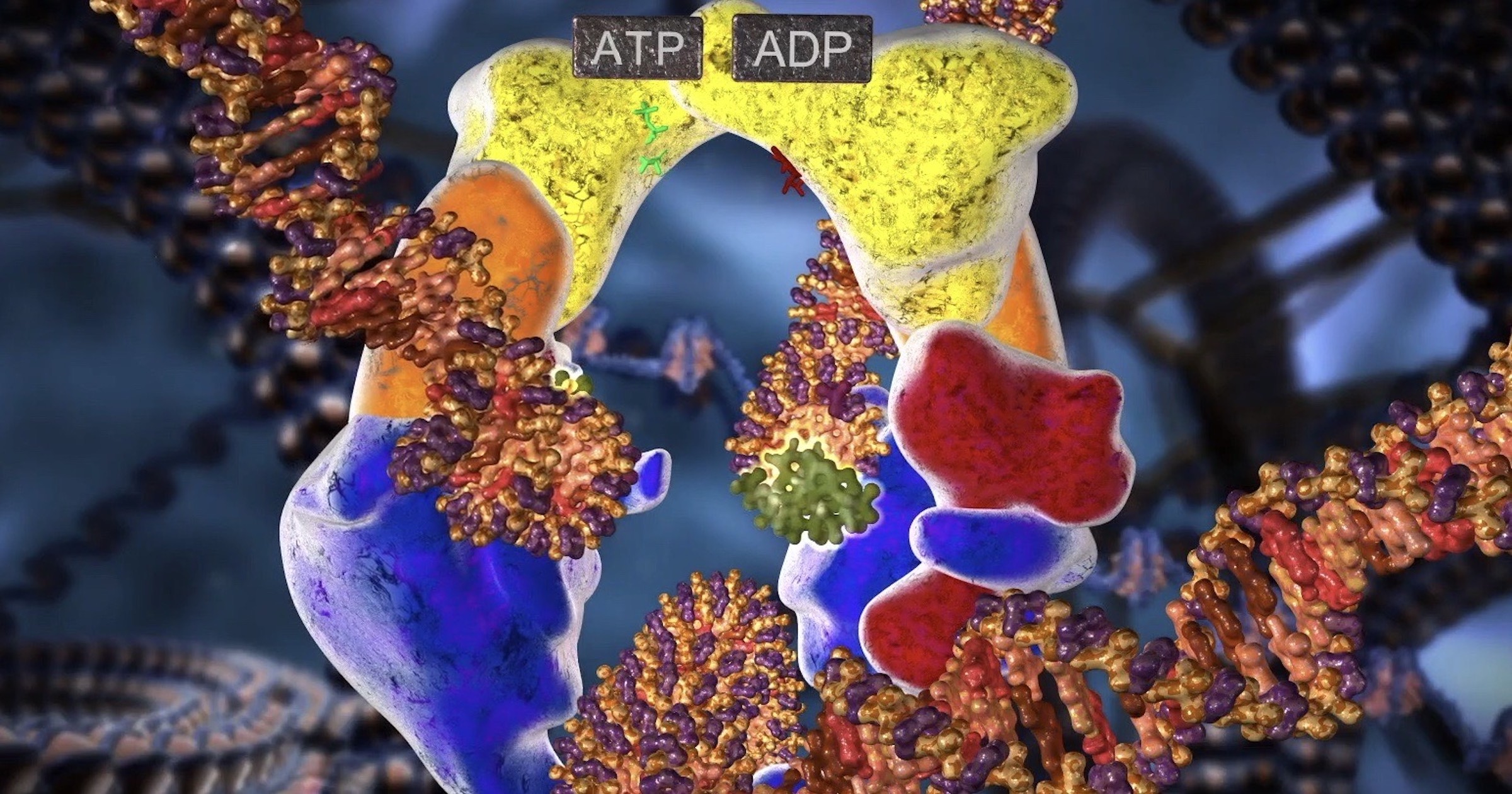
Last Saturday I participated in a webinar with biochemist Joe Deweese, discussing his work on topoisomerases and debuting Discovery Institute’s new animation on the subject, for which he was a consultant. Professor Deweese, who participates in the ID 3.0 research project, is a gifted explainer. I enjoyed his extremely lucid comments about evidence for design in this class of remarkable enzymes. Incidentally, I also enjoyed his bow tie — yes, it really is made of wood, as he acknowledges in response to one curious viewer’s question at the end.
The webinar conversation and subsequent Q&A are up on YouTube now:
You can also see our animation here:
In preparing for the webinar, I watched other videos about topoisomerase enzymes. I did this not just as background research, but also to see how our video stacked up against other topoisomerase animations on the Internet.
Admitting My Bias
Many videos out there do a great job of explaining what topoisomerases do and why they’re important for untangling knots and supercoils in DNA during replication and transcription. But — and I say this while fully admitting my bias — I think our video does the best job of showing the biochemical nuts and bolts of how topoisomerase works. In fact, I think that no other video does as good a job of showing how topoisomerases function. After you watch our video, take a few minutes to explore some others so you can appreciate the bigger picture.
This video has a nice illustration with rope showing how supercoiling arises in DNA:
A student-made video (from my alma mater, UC San Diego!) demonstrates with Play-Doh how topoisomerase relieves supercoiling in DNA.
Another nice explanation of supercoiling and the action of topoisomerases in eukaryotes and prokaryotes:
A video-only illustration shows how topoisomerases relieves supercoiling:
Another video demonstrates how DNA gyrase, a prokaryotic enzyme similar to topoisomerase II, helps relieve supercoiling.
Lastly, if you’re into the lecture format, here’s an explanation from Shomu’s Biology of the different types of topoisomerase enzymes:
Inappropriate “Anthropomorphizing” in Biology?
As I found, these videos all have something in common: they assume that topoisomerase has a function, and it’s to undo supercoils which can cause problems for DNA replication and transcription. Yet leading thinkers in evolutionary biology will tell you we need to stop saying that a given enzyme (or any other biological feature) has a purpose “to” do something. In their view, teleology represents inappropriate “anthropomorphizing” in biology and must be banished from our discourse:
It is about time that we stopped such anthropomorphic terminology and thinking, and confronted the likelihood that — far from being ‘excusable shorthand’ — it is an important contributor to a false impression of evolution among many non-scientists. I feel that much of the ‘excuse’ for using terms that evoke will, direction and strategy in evolutionary processes is a problem of finding the right words; or at least of not falling so easily into the anthropomorphisms that we use in other realms of experience.
A banal example shows how an apparently trivial change in words can radically change perceived meaning: to accomplish metabolic process X, enzyme Y evolved a specificity for Z. In an objective scientific sense, we should phrase this as ‘in accomplishing X, Y concomitantly evolved a specificity for Z’. It is that innocent little word ‘to’ that transforms the meaning, giving enzyme Y the essence of ‘will’ — ‘to’ being short for ‘in order to’, or ‘with the purpose of’. Purpose can only be exercised by a supernatural entity in this situation.
There have even been meetings organized under titles such as ‘Molecular Strategies in Biological Evolution’. This and other examples impose a fallacious sense of direction of causality in evolution, and that is completely consistent with a common misconception of evolution facilitating organisms towards certain aims or goals.
(Andrew Moore, “We need a new language for evolution. . . everywhere,” BioEssays, 33: 237 (2011))
Similarly, a letter in Science states:
If our present understanding of evolution is correct, nothing has evolved to do a specific task. … teleological and anthropomorphic language … is indicative of how widely and unfortunately such inaccurate and misleading language is now used in the scientific literature.
How to Understand Biology
Of course, these authors are correct that standard evolutionary models propose that there is no purpose or direction to evolution. But does this view of life help us understand the real world of biology? If this evolutionary understanding is correct, then it means that topoisomerases did not arise to undo knots and supercoils in DNA during DNA replication. Topoisomerases have no purpose, and we should not talk about them as if they exist to accomplish some particular function in cells.
This perspective stems from a materialistic view of biology, which refuses to acknowledge purpose in nature. Materialists want us to twist our minds and our rhetoric into knots: we’re supposed to describe a world full of purpose, direction, and goals as if it has no purpose, direction, or goals. Thus, we get impossible demands, as seen above, insisting we cannot ever say that a biological feature exists to do something in particular. You can’t talk about purposeful systems without using teleological language.
Solution to a Knotty Problem
Just as topoisomerases were designed to remove knots in DNA, there’s an easy solution to the materialist’s knotty problem. It was identified by Annie Crawford in Communications of the Blyth Institute who writes:
If teleological language is essential to biology, then life must be teleological … since teleological language is essential to a meaningful and coherent explanation of biological phenomena, life must be inherently teleological.
Crawford is right: It’s not for no reason that it’s so hard to describe life without reference to teleology. Discussing biology requires teleological language because biology is full of purpose and intention — all reflecting its design. As Professor Deweese and I discuss in the webinar, topoisomerases not only have a function to untie knots in DNA, they were intelligently designed to perform that very function in cells.