





































The Ninth Circuit Court of Appeals has ruled, following an earlier case, that animals can have standing under the Constitution (Article III) to bring lawsuits. (Article III “standing” requires that the party bringing suit have suffered an actual injury.)
Some readers may remember the ridiculous PETA suit for copyright infringement on behalf of a monkey, for a photo it inadvertently took. (A monkey would not know what a camera is.) PETA tried to be the “friend” of the “incompetent litigant,” and was refused by the court. So far, so good.
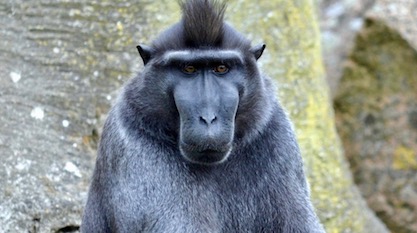
But then the court — unnecessarily, in my view — said that the monkey could assert actual harm anyway, e.g., Article III standing (citing an earlier Ninth Circuit case with which the judges disagreed but felt bound to follow). And the case is in the monkey’s name (Naruto, a crested macaque) given by PETA! From Naruto v. Slater:
Here, the complaint alleges that Naruto is the author and owner of the Monkey Selfies. The complaint further alleges that Naruto has suffered concrete and particularized economic harms as a result of the infringing conduct by the Appellees, harms that can be redressed by a judgment declaring Naruto as the author and owner of the Monkey Selfies. Under Cetacean, the complaint includes facts sufficient to establish Article III standing. Therefore, we must determine whether Naruto has statutory standing to sue for copyright infringement.
The court then ruled that the copyright statute does not give animals standing to sue for breach. So case dismissed.
That result should not make us sanguine. The two Ninth Circuit cases mean that in that jurisdiction, animal “claims” come within the parameters of the Constitution! It means that in the Ninth Circuit, animals can bring federal cases in their own name (as surreal as that sounds). It means, as I have been warning for years, that animal-rights activists are close to breaking the “species barrier” and opening up the courts of this land to lawsuits by animals.
In all fairness: I know Judge Bea, who wrote this decision — and he’s no left-wing radical. So, I think the court is sending a warning. Indeed, in a footnote, the court provided some of reasons why animal standing is bad law and worse policy:
Judge N.R. Smith insightfully identifies a series of issues raised by the prospect of allowing animals to sue. For example, if animals may sue, who may represent their interests? If animals have property rights, do they also have corresponding duties? How do we prevent people (or organizations, like PETA) from using animals to advance their human agendas? In reflecting on these questions, Judge Smith reaches the reasonable conclusion that animals should not be permitted to sue in human courts.
As a pure policy matter, we agree. But we are not a legislature, and this court’s decision in Cetacean limits our options.
So let’s consider this case to be like a flare from the Titanic. It warns that animals bringing lawsuits — and all the harm that would cause — is more than conceivable, and indeed, based on the current state of the law, poised to become a reality.
This case is so important it should be brought to the Supreme Court, where, if it grants a hearing, I am pretty confident the Ninth Circuit decisions will be reversed by a ruling that animals can never — and should never — come under the umbrella of the Constitution. Human exceptionalism and basic sanity demand it.
Photo: A crested macaque, by Tim Strater from Rotterdam, Nederland (Kuifmakaak) [CC BY-SA 2.0], via Wikimedia Commons.
.jpg)
Cross-posted at The Corner.