






































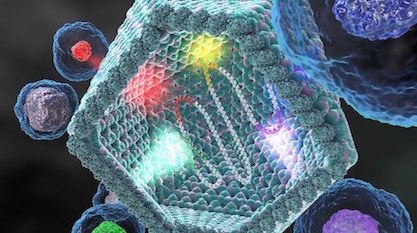

Viruses have long been an enigma to microbiologists. A new paper in the journal Science says that viruses are infecting Darwin’s tree, but not in a healthy way (for Darwinism, that is). Mitch Leslie summarizes:
Researchers used to think that viruses were small and simple, but they’ve identified giant viruses that are larger than many bacteria and carry more genes. Now, scientists report that they’ve uncovered genomes of the most cell-like viruses discovered so far. Compared with previous giant viruses, the new viruses have more of the genes necessary for protein synthesis, including a complete set of genes that code for enzymes that ensure delivery of amino acids to sites of protein synthesis. The researchers’ analysis of the viruses’ gene sequences challenges a controversial hypothesis that giant viruses descended from cells and represent a new domain, or a new branch on the tree of life.
Nature is hedging its bets on what this means for evolution:
Evolutionary biologists have never known what to make of viruses, arguing over their origins for decades. But a newly discovered group of giant viruses, called Klosneuviruses, could be a ‘missing link’ that helps to settle the debate — or provoke even more discord.
It’s clear that anything this complex cannot be a stepping-stone to the first life. But if viruses don’t fit an evolutionary place as a “fourth domain of life” near the root of Darwin’s tree, how did they become “a network of stolen parts” from cells?
One researcher says that the giant virus’s “translation machinery does not match that of any other known organism.” Jordi Paps at The Conversation likens these entities to zombies. “Maybe it would be just easier to consider viruses undead,” he says. “The big question is: where do they come from?” He’s not ready to bet on the Darwin Tree defenders:
The researchers conclude that the giant viruses analysed in this study have evolved multiple times from smaller viruses, rejecting the idea they evolved from cellular lifeforms.
However, the new evidence doesn’t kill viruses completely. New gnarls in the tree of life are discovered every day, and a new finding could still provide a link between cellular and acellular life — or prove the opposite. Until then, we will keep thinking about the nature of life, the relationship between zombies and viruses, and wondering “what the hell is that?”
As we noted yesterday, there are interesting developments for the Darwin Tree support team: even the managers are calling time out because of the shakeup on wiggly field. We call them as we see them.
Image: Giant virus, by Ella Maru studio/Joint Genome Institute.