






































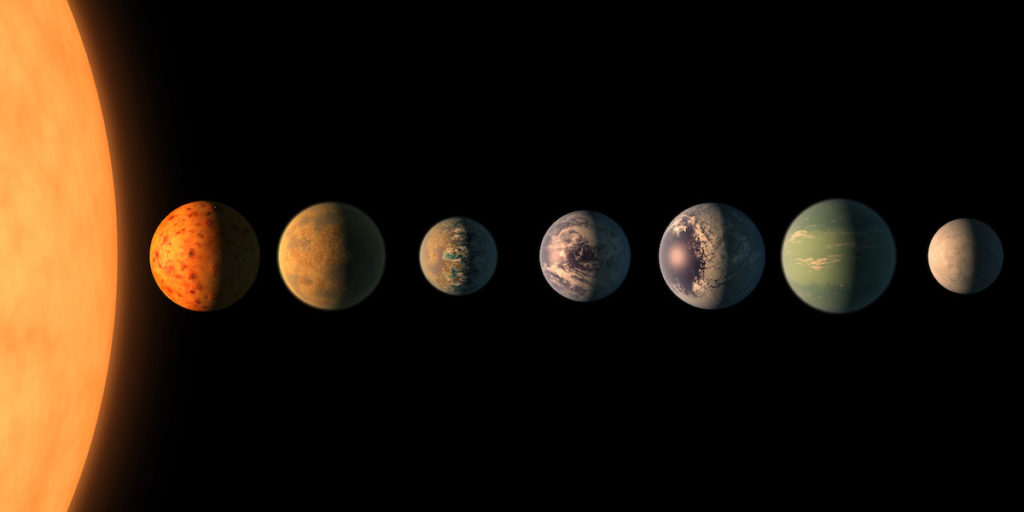
In a BreakPoint broadcast, considering media hype about the recent discovery of seven supposedly Earth-like exo-planets, our friend Eric Metaxas finds a note of poignancy. That is the TRAPPIST-1 system some 40 light years away, which I wrote about a little while back.
Insightfully, Metaxas notes the sense of loneliness for companionship from beyond the stars, notable in the media, in science, and science fiction too. He saw Arrival, which I also recommend:
In the new movie “Arrival,” a group of scientists try to break the language barrier between humanity and an extraterrestrial race that’s landed on Earth. These visitors have not come to make war, but to offer us a gift. I won’t spoil it for you, but I will say that the film is pervaded by a sense of loneliness and a longing for kinship with someone beyond our world.
In this sense, “Arrival” is far from the only alien-related fiction in the news. Last month NASA set off a veritable media shower of conjecture when it announced the discovery of several “earth-like” planets orbiting a nearby star. The kind of breathless speculation journalists churned out about this red dwarf and its seven planets was worthy of a Brothers Grimm fairytale.
The Independent proclaimed, “NASA’s ‘Holy Grail.’ ” National Geographic chimed in, “Seven alien ‘Earths’ found orbiting nearby star.” The Sun declared this new solar system “could be teeming with ‘exotic’ alien lifeforms.” And the Toronto Star offered a more touching angle, writing that “the universe looks less lonely” now.
He kindly cites my comments here at Evolution News, and concludes by observing that there is, in fact, no cause for loneliness. As Eric argued in a provocative Wall Street Journal article, evidence of design in the cosmos indicates that we’re not alone at all.
Distant planets may be devoid of intelligent life — probably are, as far as anyone can tell at the moment. But a designer operating behind or through nature is the accessible object of both scientific and spiritual searching:
The longing for life beyond our planet is obsessive. For decades, we’ve poured resources into the search for celestial neighbors, hoping to establish in real life the kind of contact portrayed in “Arrival.” But the stars, despite our best efforts, have proved silent and barren.
But in another sense, our Sun, Earth, and the TRAPPIST-1 system are anything but silent! They declare a cosmic Intelligence Who’s both infinitely mysterious and intimately knowable.
Christians recognize that our planet was uniquely designed and fine-tuned to support life — and that’s putting it mildly. Our place in the universe is nothing less than a miracle.
We leave others to draw religious conclusions. The scientific evidence, though, is clear and demands a response from objective and open-minded observers.