






































Our friends over at The Stream appear to have read Pope Francis’ encyclical, Laudato Si’, more carefully than some premature pundits. They point out “11 Things You Probably Won’t Hear about Pope Francis’ Encyclical.” Two of those are particularly relevant to our concerns here:
(1) Creation has a Creator, and is more than just “nature-plus-evolution”:
(75) A spirituality which forgets God as all-powerful and Creator is not acceptable. That is how we end up worshipping earthly powers, or ourselves usurping the place of God, even to the point of claiming an unlimited right to trample his creation underfoot. The best way to restore men and women to their rightful place, putting an end to their claim to absolute dominion over the earth, is to speak once more of the figure of a Father who creates and who alone owns the world. Otherwise, human beings will always try to impose their own laws and interests on reality.
(77) “By the word of the Lord the heavens were made” (Ps 33:6). This tells us that the world came about as the result of a decision, not from chaos or chance, and this exalts it all the more. The creating word expresses a free choice. The universe did not emerge as the result of arbitrary omnipotence, a show of force or a desire for self-assertion. Creation is of the order of love. God’s love is the fundamental moving force in all created things: “For you love all things that exist, and detest none of the things that you have made; for you would not have made anything if you had hated it” (Wis 11:24). Every creature is thus the object of the Father’s tenderness, who gives it its place in the world. Even the fleeting life of the least of beings is the object of his love, and in its few seconds of existence, God enfolds it with his affection. Saint Basil the Great described the Creator as “goodness without measure,” while Dante Alighieri spoke of “the love which moves the sun and the stars”. Consequently, we can ascend from created things “to the greatness of God and to his loving mercy.”
And:
(10) The Church does not presume to settle scientific questions, and we need an honest and open debate:
(60) Finally, we need to acknowledge that different approaches and lines of thought have emerged regarding this situation and its possible solutions. At one extreme, we find those who doggedly uphold the myth of progress and tell us that ecological problems will solve themselves simply with the application of new technology and without any need for ethical considerations or deep change. At the other extreme are those who view men and women and all their interventions as no more than a threat, jeopardizing the global ecosystem, and consequently the presence of human beings on the planet should be reduced and all forms of intervention prohibited. Viable future scenarios will have to be generated between these extremes, since there is no one path to a solution. This makes a variety of proposals possible, all capable of entering into dialogue with a view to developing comprehensive solutions.
(188) There are certain environmental issues where it is not easy to achieve a broad consensus. Here I would state once more that the Church does not presume to settle scientific questions or to replace politics. But I am concerned to encourage an honest and open debate so that particular interests or ideologies will not prejudice the common good.
In short, as all the major Western theistic traditions ought to be able to agree, the world has an author who acts freely and deliberate, “not from chaos or chance.” However, whether on that issue or any other, scientific evidence is weighed independently. “Honest and open debate,” not foregone conclusions, is what’s needed.
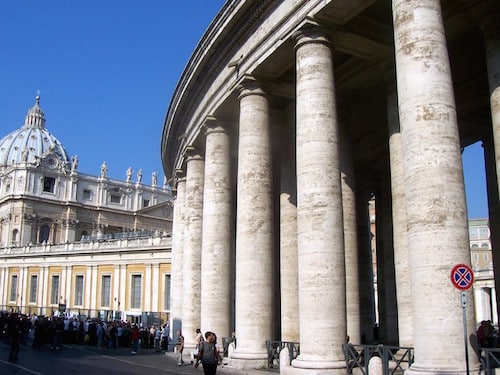
Image: St. Peter’s Square, by MarkusMark (Own work) [CC BY-SA 3.0], via Wikimedia Commons.
