






































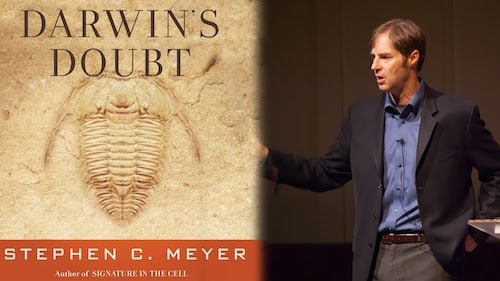
A rough count of 1,500 people — sizeable for a workweek evening — came to a large church auditorium in Santa Ana this past Thursday night to hear Steve Meyer, John Stonestreet, and Dennis Prager discuss “Faith, Science and Culture: Does God Still Matter?” Hugh Hewitt acted as moderator.
The lively discussion covered many topics and none of the panelists was ever at a loss for words. In the broad mix of subjects, ranging from terrorism to classical music, from pornography to the Cambrian explosion, everyone had something interesting to say. Even though belief in God was a prevalent subtext, Meyer was able to explain the scientific evidence underlying the intelligent design position cogently and effectively.
Audience interest even after two hours of the panel was evident from the long line of people at the microphones for the Q&A. One particular answer that got hearty applause from the audience was Meyer’s response on the alleged similarity of genes between chimpanzees and humans. He explained that a great deal more genetic information separates the two than is misrepresented in the often cited 2 percent difference: epigenetic and other forms of information that regulate the expression of genes.
Meyer was asked if he thought there was evidence for a transcendent designer. He recounted the indisputable evidence for design from astrophysics and the fine-tuning of the constants of physics, then used that evidence to support the view that the designer must be beyond the universe. The sudden origin of the universe also argues for a pre-existent designer.
He stressed, however, that the intelligent design argument does not concern the identity of the designer, but only whether intelligent causes can be inferred from the effects, using the well-known uniformitarian principle that causes we see producing effects today can be used to infer the causes at work in the past. Critics of ID, he pointed out, are quick to accuse advocates of religious motivations, but never refute the design argument scientifically. They belittle the messenger instead of responding to the message.
The importance of ID to college students and young people was not lost on any of the panelists. Prager and Stonestreet described the boredom and purposelessness of many young people today, who (unlike previous generations) perceive themselves as consumers rather than producers. They gave examples of young people, taught all their lives that they are nothing but animals evolved from lower life forms, who turned to suicide or terrorism in response to the nihilism of our culture. When asked what was responsible for this cultural decline, Meyer did not hesitate to claim it was Darwinism. The other panelists nodded in agreement.
Staff from Illustra media sold many copies of Meyer’s books, Signature in the Cell and Darwin’s Doubt, along with a number of their DVDs. Meyer commented later that Illustra’s film Darwin’s Dilemma makes a good complement to his book. The books and DVDs flew off the table, keeping the Illustra team very busy.
Steve Meyer was clearly a major draw, as could be seen afterward in the lobby with a long line of visitors wishing to meet him, get their pictures taken with him, and have him sign his book. At the end, if Meyer was tired, he didn’t show it. The lineup continued till the building crew told everyone it was time to leave, then it continued outside for another 45 minutes. Even after that, he spent some quality time with the Illustra staff at dinner discussing their current production.
What will that be? Stay tuned.