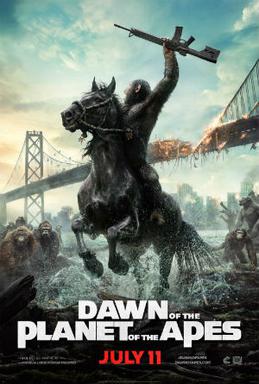
Since mentioning it here last week, I’ve been wondering expectantly what “War on Humans“-related themes will be cashed in when the much-anticipated Dawn of the Planet of the Apes opens on Friday. As early reviewers mention, the series has always specialized in melancholy reflections on issues of the day, going back to the 1968 opener with its shocking climax (the ruined Statue of Liberty) telling of a global nuclear holocaust in Earth’s future.
The new film is an anti-humanist’s pleasant daydream, set after a simian flu virus has decimated the planet’s human population, leaving behind just 1 in 500. Humans now compete with apes, gifted with speech, for survival.
The prestige of the Apes series (which, by the way, I’ve always immensely enjoyed) consists in its notes of high-minded liberal despair. Dawn, touted as a return to the greatness of the best films in the franchise, could not possibly let us down in this regard. Or could it?
Sure enough, we learn that gun control is a theme, as are the “death penalty, isolationism, fundamentalism.” That’s almost the entire progressive catechism right there.
The film takes it as a given that, apes and humans being more or less equals, each community will includes its good guys and its bad guys. On the ape side, the warlike Koba is the leading…well, not villain, but dangerous personality. He can’t be a true villain since we’re evidently supposed to sympathize with him being that he is, says one review, an “animal-testing survivor.”
Whoa, that is telling, on a couple of different levels. First, notice the heavily freighted term, “survivor,” associated with human survivors of everything from the Holocaust to physical and sexual abuse to cancer. That anyone would apply it to an animal, even a highly intelligent animal in a movie, is a remarkable sign of the times.
So too, that the philosophically encumbered Apes series would choose medical experimentation on animals as one of its themes represents, you would think, somewhat of a lightening of the load compared to the series’ previous ruminations about human self-annihilation.
The first Planet of the Apes movie portrayed man’s destruction at our own hand as something to weep over. I have not seen the new film, only read initial reviews, but the latest Apes movie sounds as if it’s more hung up on a relatively trivial matter. However deplorable, mistreatment of lab animals does not, so you would think, weigh much in the scales compared with nuclear annihilation.
But for a significant portion of our culture, the idea of a clean slate for planet Earth, minus humans, has its charms. For that same part of the culture, it becomes increasingly difficult to see human life as uniquely valuable, sacred, worthy of special dignity. From 1968, we’ve come a long way, baby. A long way down.