






































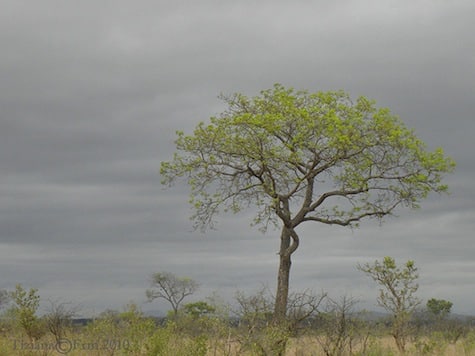
A Darwinian evolutionary bedtime story tells of how proto-man achieved his upright walking status when the forests of his native East Africa turned to savannas. That was 4 to 6 million years ago, and the theory was that our ancestors stood up in order to be able to look around themselves over the sea of grasslands, which would have been irrelevant in the forests of old.
A team of researchers led by USC’s Sarah J. Feakins, writing in the journal Geology, detonate that tidy explanation with their finding that the savannas, going back 12 million years, had already been there more than 6 million years when the wonderful transition to bipedalism took place (“Northeast African vegetation change over 12 m.y.“).
Science Daily summarizes:
The research combines sediment core studies of the waxy molecules from plant leaves with pollen analysis, yielding data of unprecedented scope and detail on what types of vegetation dominated the landscape surrounding the African Rift Valley (including present-day Kenya, Somalia and Ethiopia), where early hominin fossils trace the history of human evolution.
The Economist enjoys this revelation, observing how “A cherished theory about why people walk upright has just bitten the dust”:
Dr Feakins has shown that early humanity’s east African homeland was never heavily forested, so the idea that people were constrained to walk upright by the disappearance of the forests is wrong.
Perhaps it was more pull than push — a pre-existing, but empty ecological niche crying out to be filled by an enterprising species that could make the transition. But perhaps those who seek an ecological explanation of this sort are, as it were, barking up the wrong tree.
Of course there’s much more to the enigma of upright walking than just the question of whether it was a response to grassland encroaching on the forest (that, we now see, wasn’t there in any event). In Science and Human Origins, see Ann Gauger’s discussion of the engineering difficulties in making a transition to the nearly modern anatomy of Homo erectus.