






































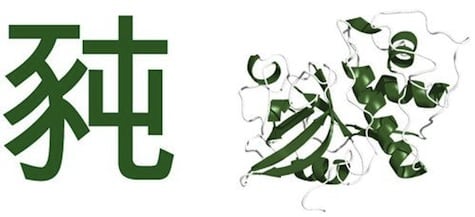
What do Han Chinese characters and proteins have in common? Both can be thought of as two- or three-dimensional functional shapes. Change their shapes significantly and you change what they mean or do.
For proteins the flow of functional information goes like this:protein coding sequence ? 3-D structure ? function
If a code could be devised that specifies Han character traces in vector space, then the Han character set would have a similar information flow:
Han coding sequence ? 2-D structure ? meaning
And suddenly all the parallels between genetic code and language become a rich environment in which to test evolutionary scenarios.
This brilliant analogy between protein structure and Han characters occurred to Dr. Douglas Axe of the Biologic Institute several years ago. He and his collaborators have since devised a vector code analogous to the genetic code (see below) and implemented it in a program called Stylus. A paper describing its initial characteristics and making its source code available was published in the peer-reviewed journal PLoS One.

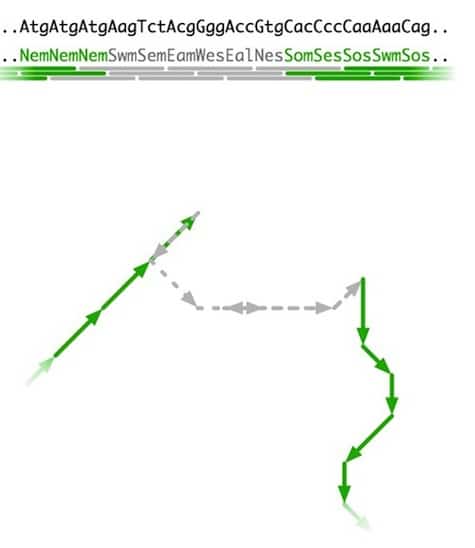
Figures from Stylus: A System for Evolutionary Experimentation Based on a Protein/Proteome Model with Non_Arbitrary Functional Constraints.
Dr. Axe and co-workers have now created a self-referential genome that describes in Han vector code the main elements of the program. Each sentence of the description is a unit of linked genes that specify a particular function, much like the tryptophan operon is a collection of genes that specify how to make tryptophan, all organized into a coordinated group so that their function is coordinated. This work has also been published in a peer-reviewed journal here.
Right now, the program is available as source code for people to experiment with. You can adjust various parameters that determine how much and what kind of genetic change takes place, how many generations you want the evolutionary experiment to run, etc. A web-based platform is the next goal. Let’s find out how much meaning random, undirected processes can create, shall we?
Cross-posted at Biologic Perspectives.