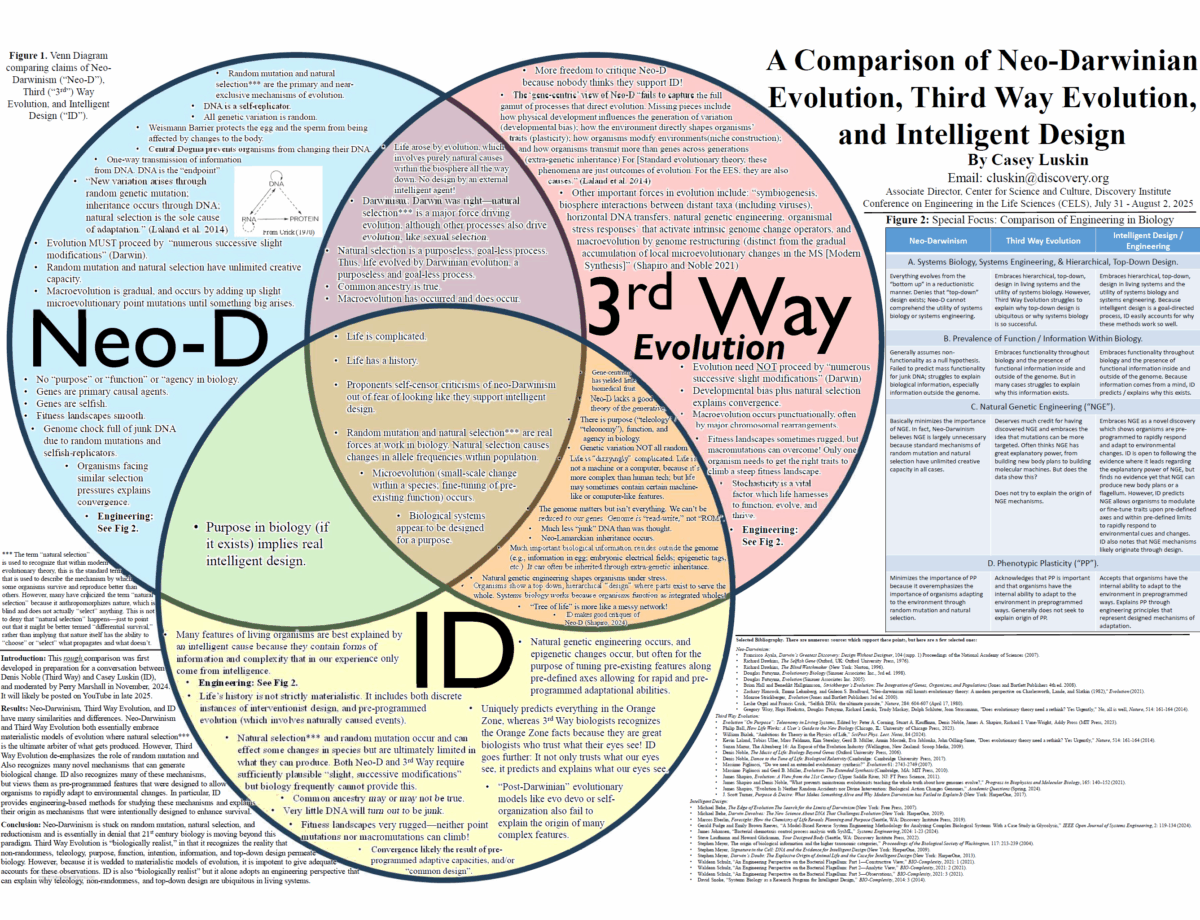
VennDiagramNeo-D-3rdWay-ID Type post Author Casey Luskin Date August 8, 2025 CategoriesEngineeringEvolutionIntelligent Design Tagged , biologists, biology, Casey Luskin, Conference on Engineering in Living Systems, Denis Noble, Discovery Institute, engineering, engineers, function, ID 3.0, information, intelligent design, intention, natural selection, Neo-Darwinism, Perry Marshall, purpose, random mutation, randomness, teleology, Third Way of Evolution, Venn diagram Here’s the Venn Diagram from My Conversation with Denis Noble Casey Luskin August 8, 2025 Engineering, Evolution, Intelligent Design 4 While preparing for the conversation, I created the diagram comparing the similarities and differences among three viewpoints. Read More ›
The Temptation of Adam by Jacopo Tintoretto Type post Author Paul Nelson Date September 2, 2020 CategoriesEvolutionIntelligent Design Tagged , Adam and Eve, agnostics, atheism, Charles Darwin, Christianity, common ancestry, evolution, Homo sapiens, intelligent design, James Tour, Jerry Coyne, mainstream science, Michael Behe, Richard Buggs, Richard Dawkins, S. Joshua Swamidass, Sapientia, Sean McDowell, Stephen Meyer, Templeton Prize, The Genealogical Adam and Eve, Venn diagram, Walter Bradley On the Swamidass Hypothesis — The Cheese Stands Alone Paul Nelson September 2, 2020 Evolution, Intelligent Design 7 We have a lonely hypothesis standing by itself in the center of the room, which no one, including its author, will own as true. Read More ›
Adam and Eve, by Lucas Cranach the Younger Type post Author David Klinghoffer Date August 27, 2020 CategoriesFaith & SciencePhilosophy Tagged , Adam and Eve, baseball, Christianity, chromosomes, common ancestry, Daniel Dennett, faith, first couple, mainstream science, methodological naturalism, Paul Nelson, reality, S. Joshua Swamidass, Sapientia, science, The Genealogical Adam and Eve, theology, Venn diagram Adam and Eve and “Mainstream Science” David Klinghoffer August 27, 2020 Faith & Science, Philosophy 4 “The category ‘mainstream science’ sounds plausibly neutral, capturing the sort of objective knowledge to which any well-educated adult should assent.” Read More ›
Unicorn Type post Author Michael Egnor Date October 11, 2019 CategoriesFaith & ScienceMetaphysicsPhilosophyScientific Reasoning Tagged , __edited, Aristotle, bias, cat, Christianity, dog, essence, existence, faith, kittens, reality, Thomas Aquinas, unicorns, Venn diagram Essence and Existence: The Cornerstone of Thomistic Metaphysics Michael Egnor October 11, 2019 Faith & Science, Metaphysics, Philosophy, Scientific Reasoning 6 I can describe anything you like in whatever detail you like, but you can’t know whether it exists or not merely by its description. Read More ›