origin of humans Type post Author Casey Luskin Date November 13, 2017 CategoriesHuman ExceptionalismHuman Origins and AnthropologyIntelligent DesignLinguisticsReproductive Science Tagged , __k-review, "survival of the fittest", altruism, apes, brain, Darwinism, Discovering Intelligent Design, E.O. Wilson, Fire-Maker, fossil record, Francis Collins, Holocaust, human origins, ID's Top Six, intelligent design, Michael Denton, Michael Ruse, National Academy of Sciences, Philip Skell, Science and Human Origins, Wesley J. Smith ID’s Top Six — The Origin of Humans Casey Luskin November 13, 2017 Human Exceptionalism, Human Origins and Anthropology, Intelligent Design, Linguistics, Reproductive Science 10 There are many aspects of humanity that point to intelligent design. Read More ›
animal Type post Author Casey Luskin Date November 11, 2017 CategoriesIntelligent Design Tagged , __k-review, animals, blueprint, body plans, Cambrian Explosion, computer program, Darwin's Doubt, epigenetics, fossil record, functional information, ID's Top Six, intelligence, mind, Paul Nelson, software, Stephen Meyer ID’s Top Six — The Origin of Animals Casey Luskin November 11, 2017 Intelligent Design 9 In his book Darwin’s Doubt, Stephen Meyer considers the nature of animals and what is required to build an animal. Read More ›
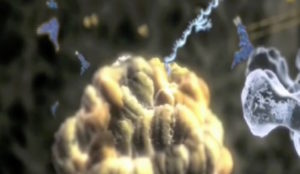
kinesin (1) Type post Author Casey Luskin Date November 10, 2017 CategoriesBiologyIntelligent DesignLife Sciences Tagged , __k-review, ATP synthase, Bruce Alberts, cells, co-option, Craig Venter, Darwin's Black Box, Discovering Intelligent Design, evolution, ID's Top Six, intelligent design, Irreducible Complexity, Jonathan Witt, kinesin, Michael Behe, molecular machines, National Academy of Sciences, ribosomes, William A. Dembski ID’s Top Six — The Origin of Irreducibly Complex Molecular Machines Casey Luskin November 10, 2017 Biology, Intelligent Design, Life Sciences 8 There is no known cause, other than intelligent design, that can produce machine-like structures with multiple interacting parts. Read More ›
origin of information in DNA Type post Author Casey Luskin Date November 9, 2017 CategoriesBiologyIntelligent DesignMathematics Tagged , __k-review, analogy, Bill Gates, biological information, complexity, computer program, David Hume, DNA, functional specificity, ID's Top Six, intelligent design, Signature in the Cell ID’s Top Six — The Origin of Information in DNA and the Origin of Life Casey Luskin November 9, 2017 Biology, Intelligent Design, Mathematics 7 The laws of the universe are necessary for life to exist. But they aren’t sufficient to explain how life arose. Read More ›
Big Bang Type post Author Casey Luskin Date November 8, 2017 CategoriesFine-tuningIntelligent DesignPhysical SciencesPhysics Tagged , __k-review, Big Bang, Charles Townes, Discovering Intelligent Design, electromagnetic force, gravitational constant, gravity, hydrogen, ID's Top Six, initial entropy, intelligent design, nature, Nobel laureate, physical constants, quantum mechanics, stars, universe, weak nuclear force, William Lane Craig ID’s Top Six — The Fine-Tuning of the Universe Casey Luskin November 8, 2017 Fine-tuning, Intelligent Design, Physical Sciences, Physics 5 Some scientists respond, “Well, there must be an enormous number of universes and each one is a little different. This one just happened to turn out right.” Read More ›
Lemaitre Type post Author Casey Luskin Date November 7, 2017 CategoriesAstronomyIntelligent Design Tagged , __k-review, Big Bang, Darwin's Doubt, Darwinian evolution, Discovering Intelligent Design, Doppler effect, Edwin Hubble, First Cause, Georges Lemaître, ID's Top Six, intelligent design, Islam, Kalam cosmological argument, NASA, redshift, Signature in the Cell, Stephen Meyer, universe, William Lane Craig ID’s Top Six — The Origin of the Universe Casey Luskin November 7, 2017 Astronomy, Intelligent Design 5 In 1927, Belgian astronomer Georges Lemaître theorized that the universe began with a single explosion from a densely compacted state. Read More ›