





































Science and Culture Today Discovering Design in Nature
Topic

Borde-Guth-Vilenkin theorem

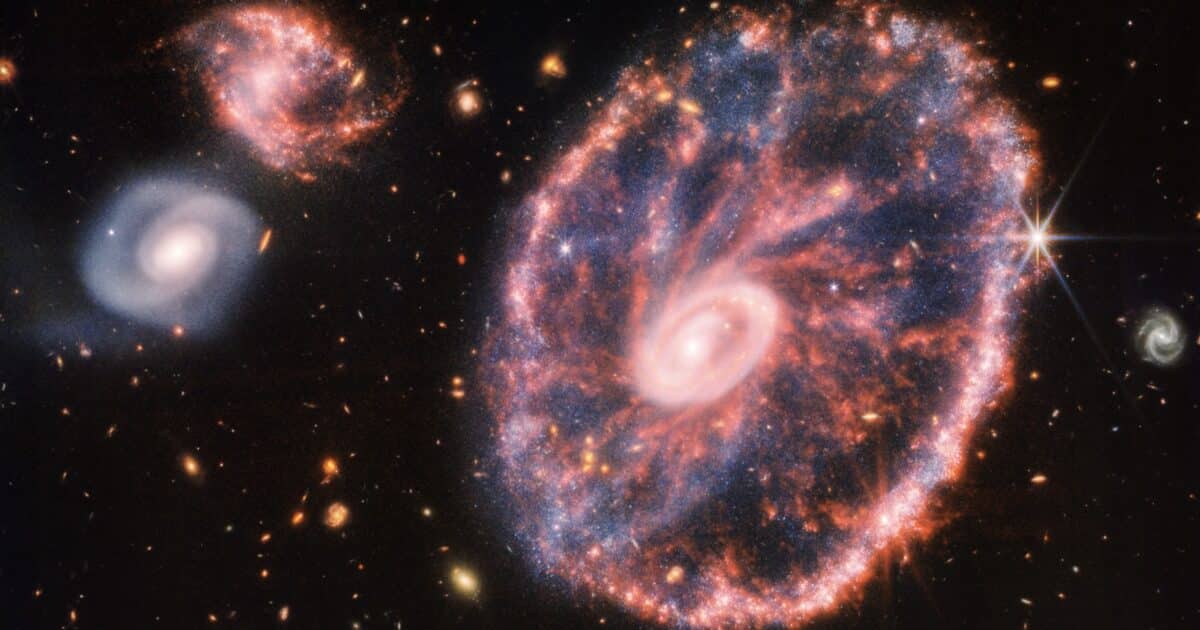
Cartwheel Galaxy
Photo: Cartwheel Galaxy, by James Webb Space Telescope, via NASA, ESA, CSA, STScI.

#4 Story of 2022: Science Journal Reaffirms Universe Had a Beginning

If the universe and everything in it are the result of a mind, then we are not unintended accidents of nature. Read More ›
Cartwheel Galaxy
Photo: Cartwheel Galaxy, by James Webb Space Telescope, via NASA, ESA, CSA, STScI.

Science Journal Reaffirms Universe Had a Beginning, a Key Argument in Meyer’s God Hypothesis

If the universe and everything in it are the result of a mind, then we are not unintended accidents of nature. Read More ›
Hawking zero gravity
Photo credit: Jim Campbell/Aero-News Network [Public domain], via Wikimedia Commons.

Efforts to Resist the Big Bang and Its Implications for Cosmic Design

Unsurprisingly, many academics have attempted to overturn the conclusion of a beginning through the most creative of means. Read More ›
Roger Penrose
Photo: Roger Penrose, by Biswarup Ganguly, CC BY 3.0 <https://creativecommons.org/licenses/by/3.0>, via Wikimedia Commons.

Another Attempt by an Esteemed Cosmologist to Avoid a Cosmic Beginning Collapses on Inspection

Roger Penrose, one of the preeminent physicists of our day, envisions that the universe is eternally expanding. Read More ›
aurora borealis
Photo: Aurora borealis, by NASA/ Bill Dunford.

Astrophysicist Ethan Siegel Again Desperately Attempts to Avoid a Cosmic Beginning

If the model were plausible, the level of fine-tuning would represent even greater evidence of design than it was intended to avoid by removing the beginning. Read More ›
A new composite image of the Crab Nebula features X-rays from Chandra, optical data from Hubble, and infrared data from Spitzer.
A new composite image of the Crab Nebula features X-rays from Chandra (blue and white), optical data from Hubble (purple), and infrared data from Spitzer (pink). Chandra has repeatedly observed the Crab since the telescope was launched into space in 1999. The Crab Nebula is powered by a quickly spinning, highly magnetized neutron star called a pulsar, which was formed when a massive star ran out of its nuclear fuel and collapsed. The combination of rapid rotation and a strong magnetic field in the Crab generates an intense electromagnetic field that creates jets of matter and anti-matter moving away from both the north and south poles of the pulsar, and an intense wind flowing out in the equatorial direction.

Recommended Reading: A Handbook of the Big Bang

Perhaps the publisher, Cambridge University Press, thought the title might help sales with a younger, hipper generation. Read More ›

© Discovery Institute