Science and Culture Today Discovering Design in Nature

Science and Culture Today | Page 500 | Discovering Design in Nature

Secrets of the Cell

Coming on Darwin Day, a New Video Series — Secrets of the Cell with Michael Behe

The cell is what biochemist Michael Behe has called evolution’s “black box,” its spectacularly complex, superbly designed contents unknown to Charles Darwin. Read More ›
forest

A Forest, Not a Tree? Nelson Asks Why Universal Common Descent Needn’t “Pay” for Failures

Maybe life is not a tree but, as biologists are finding to be increasingly likely, a forest or an orchard. But then what are the consequences for strict naturalism? Read More ›
PZ Myers

No, Really? Scientists Find Anti-Christian Prejudice in the Science World

The statement that “scientists call” this group “fundamentalist and/or evangelical” makes it sounds as if that is an objective, scientific label. Read More ›
Quallenforschung im Bonner zoologischen Institut

Carnival of the Animals Delights Scientists
The graceful, pulsating moon jellyfish move in “a very efficient way,” say biologists at the University of Bonn. Read More ›
MOLO

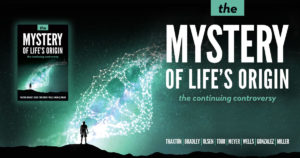
Introducing Walter Bradley: Friend, Hero, and Coauthor of The Mystery of Life’s Origin

Through solid scientific analysis, Mystery showed there was no explanation for the origin of life. But that was 35 years ago. Has it held up? Read More ›
c92-2

Can Science Answer All the “Big” Questions?

Peter Atkins is right that science can answer the biggest question we can ask. His problem is that he doesn’t like the answer science provides. Read More ›
Walter Bradley

Before Natural Selection There Was, and Remains, a Mystery

Bradley and Marks offer an uncommonly clear discussion of the problem of the early Earth’s atmosphere, and why materialist theories stumble on the ancient rocks. Read More ›
Meyer-Dallas

Stars of ID Were Out for the Day: More Photos from the Dallas Science & Faith Conference

At one point a participant in a Q&A asked Douglas Axe, as a “celebrity lookalike,” which movie star he’s most often mistaken for! Read More ›

© Discovery Institute