






































We are surrounded by networks. The internet is a prime example, but there are many others: highway systems, air traffic control networks, power grids, and even social networks. In generic terms, a network is a collection of independent entities that cooperate to transmit and receive information. For instance, automobiles have independent drivers, but millions of people can travel crowded highways safely by following the rules of the road. Someday robots may replace human drivers in freeway networks. New applications in technology are proliferating. Many of us have marveled at the drone shows popular at celebrations where thousands of lighted drones controlled by a computer can create fantastic animations in the sky at night.
In human experience, we learn how to network in many ways with our bodies and minds, such as in sports, social events, and businesses. Orchestras, choirs and marching bands are familiar examples. Musicians may excel individually as soloists, but their collective performances in ensembles often exceed the sum of the parts. For these networks to perform well, the participants must have sensors and know how to follow signaling protocols: good hearing, the ability to read music (symbols on paper), and the know-how to follow a conductor’s signals. During the Covid shutdowns, it was amusing to find ensembles performing their own parts at home that were synchronized remotely by video producers. That required another level of signaling: email instructions with sheet music, tuning checks and timing devices. Human networking is as old as language, civilization, and military operations.
Personal Experience
Networking was a major aspect of my career in IT. Users spent much of their day alone at their workstations, but they were all connected by cables or Wi-Fi to each other. Maintaining networks was not easy. Security policies demanded strict protocols to control access, avoid hackers, and limit access to foreign nationals on a “need to know” basis. This required extra layers of hardware (e.g., routers) with their own operating systems. Routers have their own programming languages and concepts, but with them as onramps to the internet, users at JPL were able to enjoy real-time communication with colleagues across America and in Europe. I administered team workstations in the U.K., Germany, and the Netherlands, along with others in universities across the U.S. It was a complex but rewarding job.
Computer network signals are often “packetized” into chunks that are assembled on the receiving end, because the transmission channels (wired or wireless) share traffic with other networks. To send and receive data privately and accurately, each packet contains a header and footer providing metadata, indicating its source, destination, sequence number, and other information. Since the packets may take different routes through the internet, the receiver at the far end must be able to assemble the packets in order, and to request re-transmission for any lost packets. When a network path was down, the system had to be able to “buffer” the packets and resume transmission when the network was restored.
This method even worked across millions of miles of space. Instructions for the Cassini spacecraft were carefully “sequenced” at the lab by teams of programmers who had to understand the design of instruments on board as well as the limitations of the onboard computer (which had been built years earlier and was obviously incapable of hardware upgrades). The signals could only be beamed toward Cassini when one or two of the three earthbound radio antennas of the Deep Space Network were pointing at it and not busy communicating with other spacecraft.
Since one bad packet could have jeopardized the mission, these sequences were tested carefully in clean rooms at the lab that housed identical copies of the instruments, to ensure everything responded as planned. Once successfully beamed, after about an hour and a half of travel at the speed of light, the sequence would be received by the onboard computer. It would assemble the packets and route the instructions to each appropriate instrument — the camera, the ultraviolet spectrometer, the reaction wheels, or any of a dozen other components. After completing the sequence, the onboard computer would return data in packetized form to Earth, 880 million miles away. We often waited eagerly for the assembled packets to generate new images on conference room screens.
Macro Networks in Biology
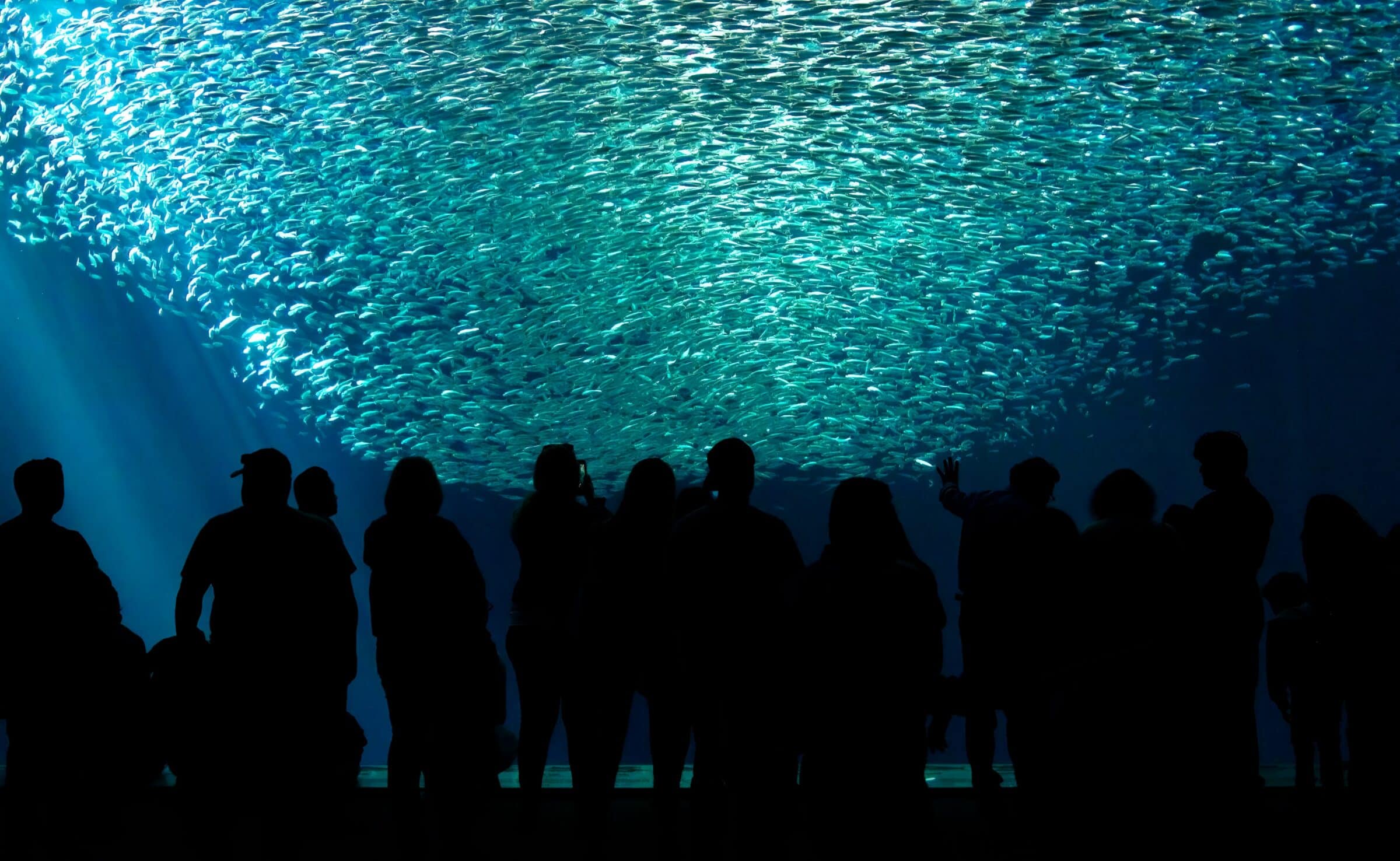
In sum, network technology requires two-way signaling, authentication, error correction, and feedback. Biology has known all of this since the beginning. Consider the wonder of a starling murmuration, where half a million birds coordinate their movements, darkening the skies with ever-changing ballets of motion. The birds may be flying inches apart, but they almost never collide. The Blue Angels or Thunderbirds could only dream of coordinating that many pilots so smoothly. The same goes for schools of fish (like the one pictured at the top), honeybee swarms, singing whales, galloping bison, and hundreds of other living networks. As amazing as these examples are, it is inside of organisms (including us) where network technology really shows off its virtuosity (for instance, see my article about interoception). Living networks operate even at the molecular level in cells.
Micro Networks in Biology
Consider one simple example among thousands. This one was reported by the Whitehead Institute in Cambridge, Massachusetts. “Study reveals ‘two-factor authentication’ system that controls microRNA destruction,” they say. Internet users are increasingly aware of two-factor authentication used by banks and other services to increase security. The user must supply, in addition to a password, a phone number or email address that the bank can access to send a numeric code the user must reproduce to continue. Two-factor authentication increases security by ensuring there is “something you have, and something you know.”
In a similar way, microRNAs (once considered cellular junk) play key roles such as regulating the abundance and lifetimes of proteins and messenger RNAs, but they must “know” which ones to tag for degradation and must “have” the proper authenticating tag. One tag is not enough, this lab understood, but the scientists wondered what other signal was used. “The answer turned out to be surprisingly sophisticated,” the Darwin-free press release says:
Using a combination of biochemistry and cryo-electron microscopy — an imaging technique that reveals molecular structures at near-atomic resolution — the researchers discovered that the degradation system relies on a dual-RNA recognition process. First, Argonaute must carry a specific microRNA. Second, another RNA molecule called a “trigger RNA”must bind to that microRNA in a particular way. [Emphasis added.]
This protocol ensures “exquisite specificity,” the article says. “The degradation machinery activates only when both signals are present.” Lead researcher David Bartel was impressed.
“The vast majority of Argonaute molecules in the cell are doing useful work regulating gene expression,” says Bartel, who is also a professor of biology at MIT and an HHMI Investigator. “You only want to degrade the ones carrying a particular microRNA and bound to the right trigger RNA. Without that specificity, the cell would lose its microRNAs and the essential regulation that they provide.”
Other team members had similar responses: “When we saw the structure, everything clicked,” said one. “It was like opening a treasure chest where every detail revealed something new and mesmerizing,” said another. One co-author added, “Here, the recognition was far more elaborate than expected.” Likely their satisfaction was partly due to their familiarity with two-factor authentication and their surprise at finding it at work inside cells that had been using it since ancient times.
Systems-Level Network Organization
An even greater example of biological finesse is described in Science by Claudio Gomes and Michele Vendruscolo: “Systems-level organization of extracellular proteostasis.” Proteostasis (protein homeostasis) refers to maintenance of the set of proteins for a cell. Extracellular proteostasis refers to maintaining the set of proteins outside the cell, such as those exported to the cell membrane or others drifting in the extracellular matrix.
This evolution-free paper should be examined by ID advocates. It has great diagrams about the hierarchical organization of components that “network” for protein homeostasis. Look at the players in this drama:
One defining feature of complex organisms is the ability to maintain protein homeostasis beyond cellular boundaries. We review how extracellular proteostasis is organized as a hierarchical network spanning pericellular, tissue, and systemic tiers. At each tier, secreted chaperones, proteases, vesicles, receptors, immune sentinels, and clearance organs cooperate to recognize, buffer, and eliminate misfolded proteins. Feedback through immune signaling, stress-induced protein secretion, and glymphatic and lymphatic transport adjusts capacity to proteotoxic load.… Viewing extracellular proteostasis as an integrated systems-level network reveals opportunities for combinatorial and preventive therapies.
Gomes and Vendruscolo use the word “network” 20 times, often with adjectives like “hierarchical network,” “multilayered network,” or “systems-level network.” Especially notable is how the network components span many orders of magnitude, from molecules to the whole body. These “tiers” all cooperate in the important task of identifying and fixing misfolded proteins and maintaining the extracellular proteome in good working order.
Biology Does it Better
The capstone article defending our title comes from the University of New Mexico: “UNM-led study finds that when it comes to networks, nature has an edge.”
Networks exist in both nature — such as biological systems like food webs and gene regulatory networks — and in engineered systems as seen in power grids. Though natural and engineered systems share an overarching goal — providing a mechanism for interacting components to transmit information — one system appears have a clear advantage, according to findings published recently by a University of New Mexico-led team.
In this case, the team found that nature does [it] best when it comes to networks.
Their paper “The frequency response of networks as open systems,” published in Nature Communications, contains a great deal of sophisticated mathematics to establish a key point about nature’s superiority at networking:
We analyze a diverse set of empirical networks and find that many naturally occurring systems, such as food webs, signaling pathways, and gene regulatory circuits, are structurally organized to enhance the passing of signals; in contrast, the structure of engineered systems like power grids appears to be intentionally designed to suppress signal propagation.
Nature is doing something right that human technology can’t match. More signal gets through biological networks than artificial ones. Perhaps human network engineers can improve throughput by imitating life’s methods. The paper ends with questions needing further research.
Several key questions about how complex systems respond to perturbations remain open. For instance, time-varying coupling-arising from failures or from the intrinsic evolution of the underlying network-may strongly affect signal transmission, and the impact of control actions triggered by propagating perturbations is still poorly understood. Furthermore, mounting evidence points to the pivotal role of higher-order (beyond pairwise) interactions in networked systems, raising the question of how such multi-body couplings modulate their response and resilience to perturbations. Addressing these issues represents an important direction for future work.
Here’s a career choice for ID advocates. Intelligent design provides the methodological resources to understand “higher-order interactions” in networked systems. With a design-based approach, who knows what improvements could be made to the technological networks on which modern civilization depends?