







































Editor’s note: We are delighted to welcome the new book by award-winning British engineer and designer Stuart Burgess, Ultimate Engineering: An Engineer Investigates the Biomechanics of the Human Body (Discovery Institute Press), with an excerpt from Chapter 1.
There is a running debate about which culture in antiquity invented and perfected the block-style arch that came to be known as the Roman arch. But none of those cultures can claim the olive wreath, for the designer of the human foot got there long before.
Figure 1.9 below compares a Roman arch to the arch of the human foot. The staples and tie in the Roman arch are equivalent to the ligaments in the human foot. Both arches have blocks and a keystone at the top. However, the human foot is more sophisticated than a typical human-made arch because the foot has three integrated arches and three keystones. In addition, the human foot is a dynamic structure that deforms to absorb shock and store energy.
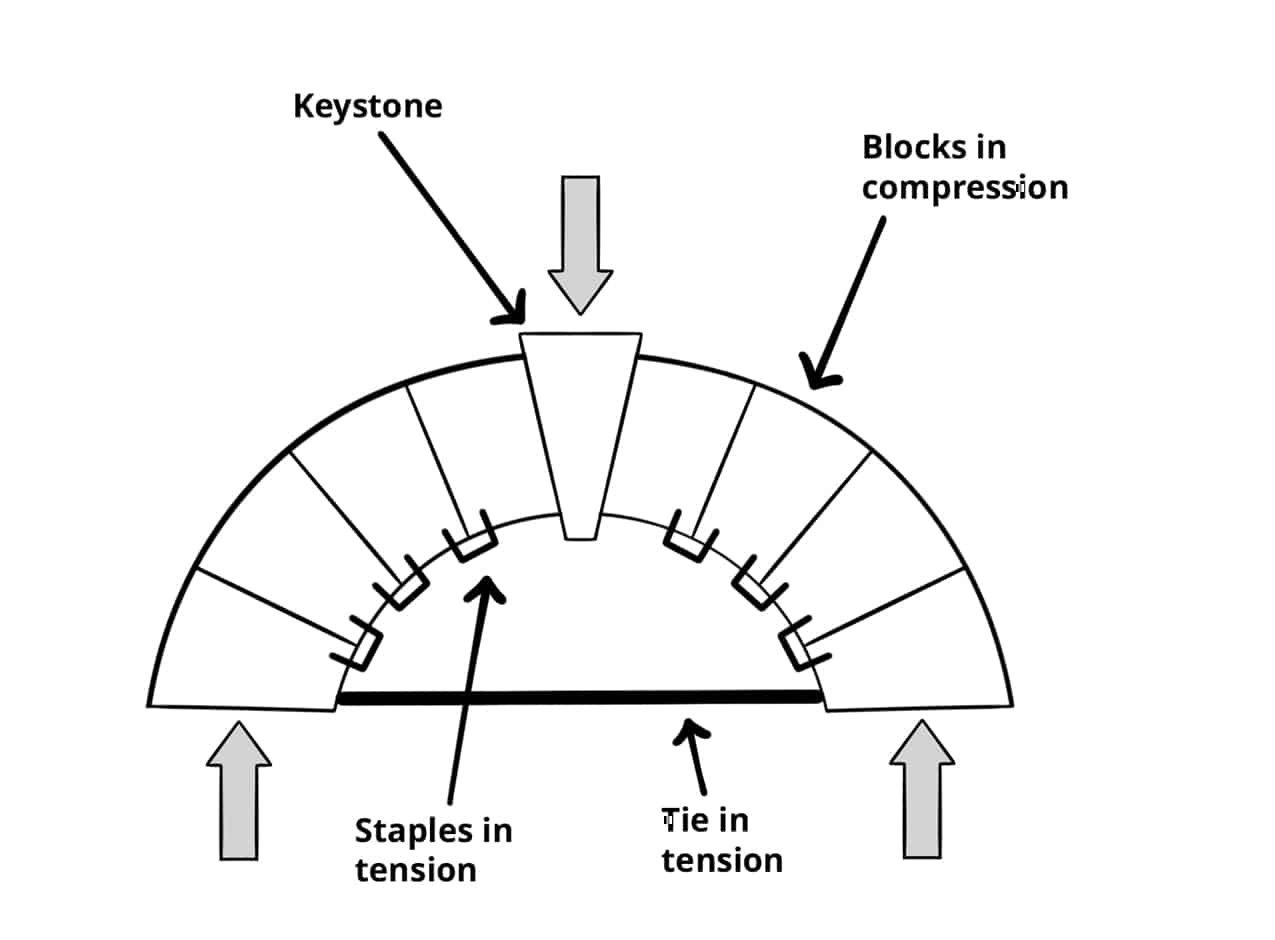
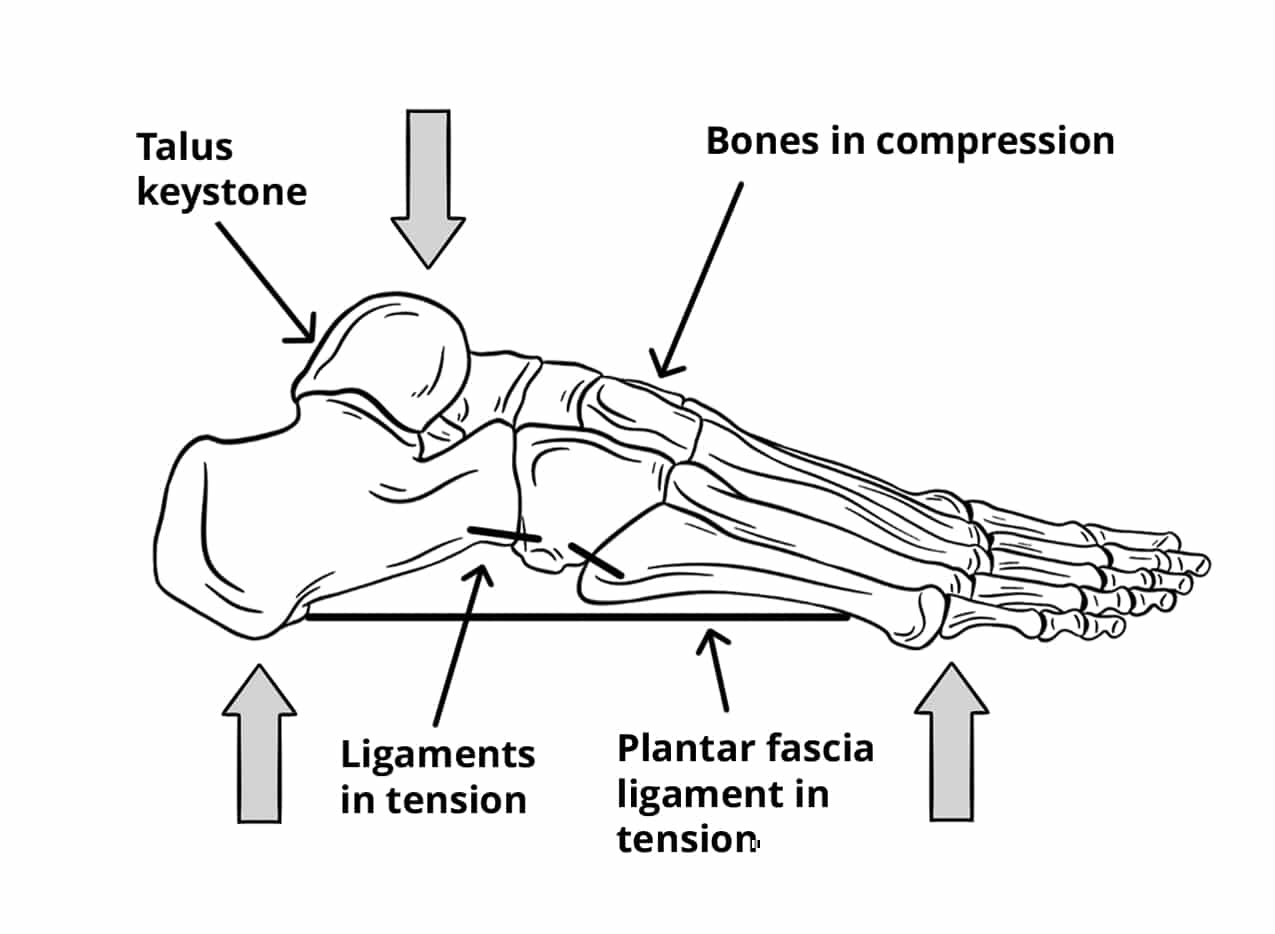
The triple-arched structure of the human foot, an engineering marvel, is unique among mammals and a serious challenge to evolutionary theory. In the fossil record there are no transitional forms between the arched feet of humans and the flat feet of apes. This should not be surprising, because the arches of the foot are irreducibly complex structures that could not evolve step by tiny step. This is because the evolving foot would have to move through a series of intermediates far less functional than either ape feet or human feet, much less functional intermediates that natural selection would readily weed out.
A block-style Roman arch consists of separate wedge-shaped blocks that, under gravity, lock the arch together. A Roman arch is a very efficient form of arched structure because loads are transferred by compression forces rather than bending forces. The design is especially well suited for materials like stone that are stronger in compression than tension. Bone is also stronger in compression than tension, another reason a block-style arch is a good engineering solution for the feet.
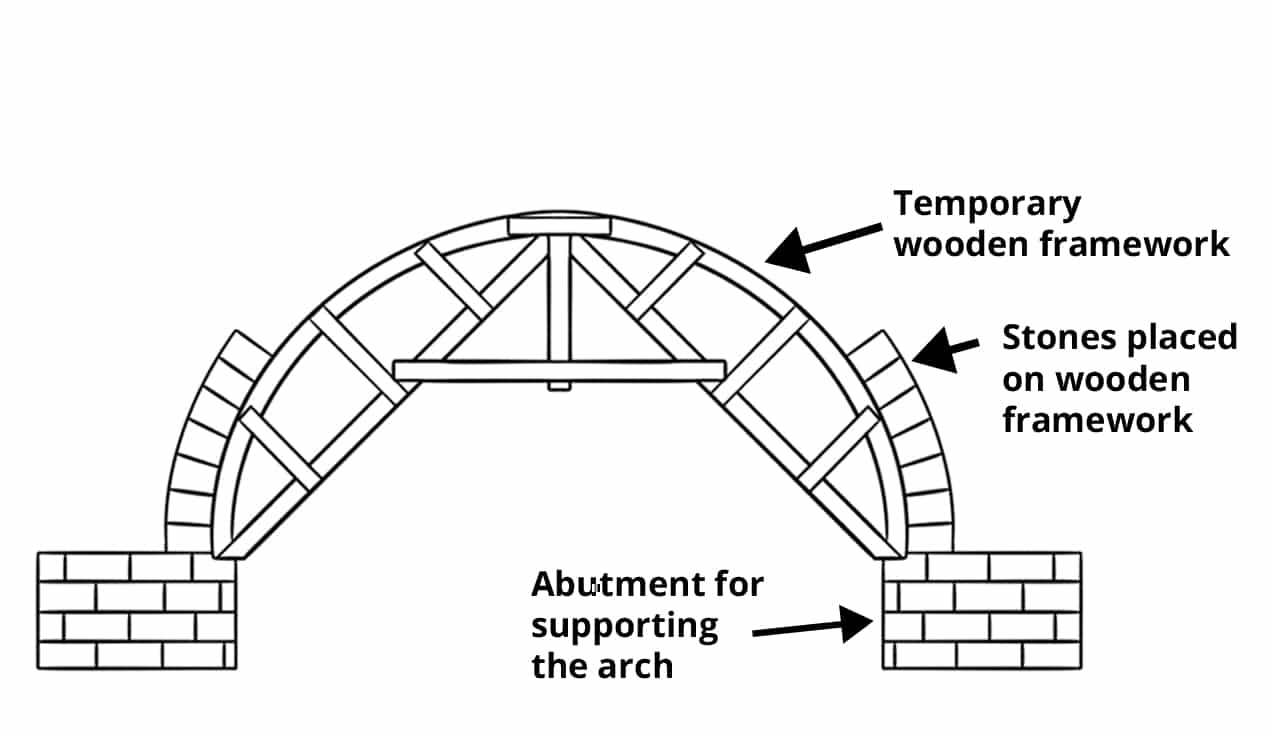
In engineering, it is well known that a Roman arch is irreducibly complex, because the arch only functions when the assembly is complete. Notice in Figure 1.10 below how a wooden jig is used to hold up the arch during construction. The jig must be in place during the entire construction because the arch cannot support itself until it is complete. In the same way, all the bones of the feet must be in place to function as arches. You cannot have a quarter of an arched foot or half an arched foot. Therefore, the arches of the feet could never evolve in a gradual, step-by-step process.
In Figure 1.9a notice the keystone at the top of the Roman arch. This stone locks the whole arch. The human foot also has a keystone for each of the three arches. The talus bone is the keystone for the medial arch. The cuboid bone is the keystone for the lateral arch. And the middle cuneiform bone of the midfoot is the keystone for the transverse arch.
An Irrelevant Objection
One might object that sandstone arches have evolved through the gradual removal of material from the center, eventually leaving behind solid arched structures (as at Arches National Park in Utah), structures that clearly came about through purely blind natural processes. Yes, but those are not strong Roman arches, each made up of several separate stones brought together to form a stable arch. Although striking in appearance, these natural arches are much weaker because they transfer loads through bending rather than compression. The human foot instead employs an advanced version of the Roman arch, one that, like the Roman arches made by human engineers, is irreducibly complex. Therefore, the solid sandstone arches are irrelevant to the engineering challenge faced by an evolutionary process “attempting” to build a simultaneously stiff and flexible foot arch.
The arches of the foot, it should be emphasized, are not the only irreducibly complex structures in the lower body. The linkage mechanism of the fibula and tibia bones, for instance, is also irreducibly complex, because the linkage system must be complete to have a useful function.
Absence of Fossil Evidence for Foot Evolution
A famous fossil claimed as a transitional between an ape-like creature and humans is known as Lucy, identified as the species Australopithecus afarensis. Many museums and science books provide recreations of the once-living Lucy standing upright with human-like arched feet. However, while the fossil remains of Lucy include bone fragments from the arms, vertebrae, pelvis, leg, and skull, there are no bones from the hands and feet. So the anatomy of Lucy’s feet is speculation. In the case of other Australopithecus afarensis fossils, there is no good evidence for arched feet.
Some have asserted fossil evidence for ape-to-human foot evolution, but such claims have not held up to scrutiny. For example, evolutionist Carol Ward and her fellow researchers claim that a single foot bone (fourth metatarsal) of an Australopithecus afarensis fossil resembles the fourth metatarsal of a human biped. “A complete fourth metatarsal of A. afarensis was recently discovered at Hadar, Ethiopia,” they write, and add that “it exhibits torsion of the head relative to the base…. These features… support the hypothesis that this species was a committed terrestrial biped.” But the human foot, recall, contains twenty-six bones, so making such a claim based on the shape of one bone is a very dubious argument. It is like finding a single stone and confidently predicting that it used to be part of a Roman arch. Such a prediction would be totally unjustified because the stone could have been used in many different non-arch applications, such as in a circular stone border around a tree.
The tenuous nature of the evidence did not prevent the popular science media from rushing in to celebrate. A Science Daily story announced, “Researchers have found proof that arches existed in a predecessor to the human species that lived more than 3 million years ago.” Another in the same online magazine the next day informed readers, “A fossilized foot bone recovered from Hadar, Ethiopia, shows that by 3.2 million years ago human ancestors walked bipedally with a modern human-like foot.”
But fellow pro-evolution paleontologists who took the time to test and examine the argument advanced by Ward and her co-authors rejected their conclusion. In 2012, in the mainstream and peer-reviewed HOMO: Journal of Comparative Human Biology, P. J. Mitchell, E. E. Sarmiento, and D. J. Meldrum showed how the claims lacked credibility. “None of the correlations Ward et al. make to localized foot function were supported by this analysis,” they concluded. “The Hadar 4th MT [metatarsal] characters are common to catarrhines [old world monkeys] that have a midtarsal break and lack fixed transverse or longitudinal arches…. This study highlights evolutionary misconceptions underlying the practice of using localized anatomy and/or a single bony element to reconstruct overall locomotor behaviors.”
Interestingly, the popular media did not report on this refutation of Ward’s evidence for Lucy walking upright, so the public are still reading the popular articles claiming there is proof that Lucy walked upright, unaware that Ward’s evidence has been discredited.
Answering Claims of Bad Design
Experts in biomechanics view the human ankle-foot complex as a masterpiece of engineering. And yet there are evolutionists who insist it is a bad design, the substandard engineering product of that blind tinkerer, Darwinian evolution, only semi-successfully converting ape feet to the bipedal feet of Homo sapiens. Evolutionist Nathan Lents well represents this perspective. “Because many of the bones of the ankle do not move relative to one another,” he writes, “they would function better as a single, fused structure, their ligaments replaced with solid bone.”
It is hard to express the magnitude of the error of that statement.
It is very well known in the fields of medicine and biomechanics that ankle fusions lead to a significant degradation of ankle performance. One hospital report states, “Walking on rough ground is more difficult after an ankle fusion because the foot is stiffer. It is rare to be able to play vigorous sports such as squash or football after an ankle fusion.” Another medical report warns, “Because the fused ankle no longer moves, your body may shift more stress to the subtalar joint (below the ankle) or other nearby joints in the foot and knee. Over many years, this can sometimes lead to secondary arthritis in adjacent joints.”
There are some pathological conditions, such as tarsal coalitions, which fuse bones in the midfoot, and in such cases foot performance is always significantly degraded.
Lents claims another bad design for the lower leg, insisting that “there is no real reason to have paired bones” in the lower leg. Presumably he’s envisioning a revised design in which the fibula bone is dispensed with, and the remaining larger bone (the tibia) becomes still bigger, allowing it to single-handedly manage what previously required the two bones. But Lents’s one-bone strategy represents an engineering step backwards. The fibula is well known to be crucial in providing stability to the ankle joint. As one group of researchers explain in the journal Foot and Ankle International, “The whole fibula including the head is essential for the stability of the ankle joint complex, and the distal fibula is responsible for stabilizing the ankle mortise during external rotation and inversion.”
Another research team explains the importance of the fibula bone: “In recent years, there has been an increasing recognition of the importance of the fibula and the tibiofibular ligaments to the biomechanics of the lower limb as a whole and to the ankle joint in particular.”
Lents’s errors regarding the design of the ankle and lower leg show the dangers of following an evolutionary paradigm rather than well-established scientific knowledge.
All notes may be found in the published book.