






































Editor’s note: The late Italian geneticist Giuseppe Sermonti (1925-2018) is the author of the 2005 book Why Is a Fly Not a Horse? This year we observe the 100th anniversary of his birth. To mark the occasion, we are offering a FREE digital copy of his book if you sponsor Science and Culture Today at any level. Please do so now! The following is excerpted from his book’s Chapter 3.
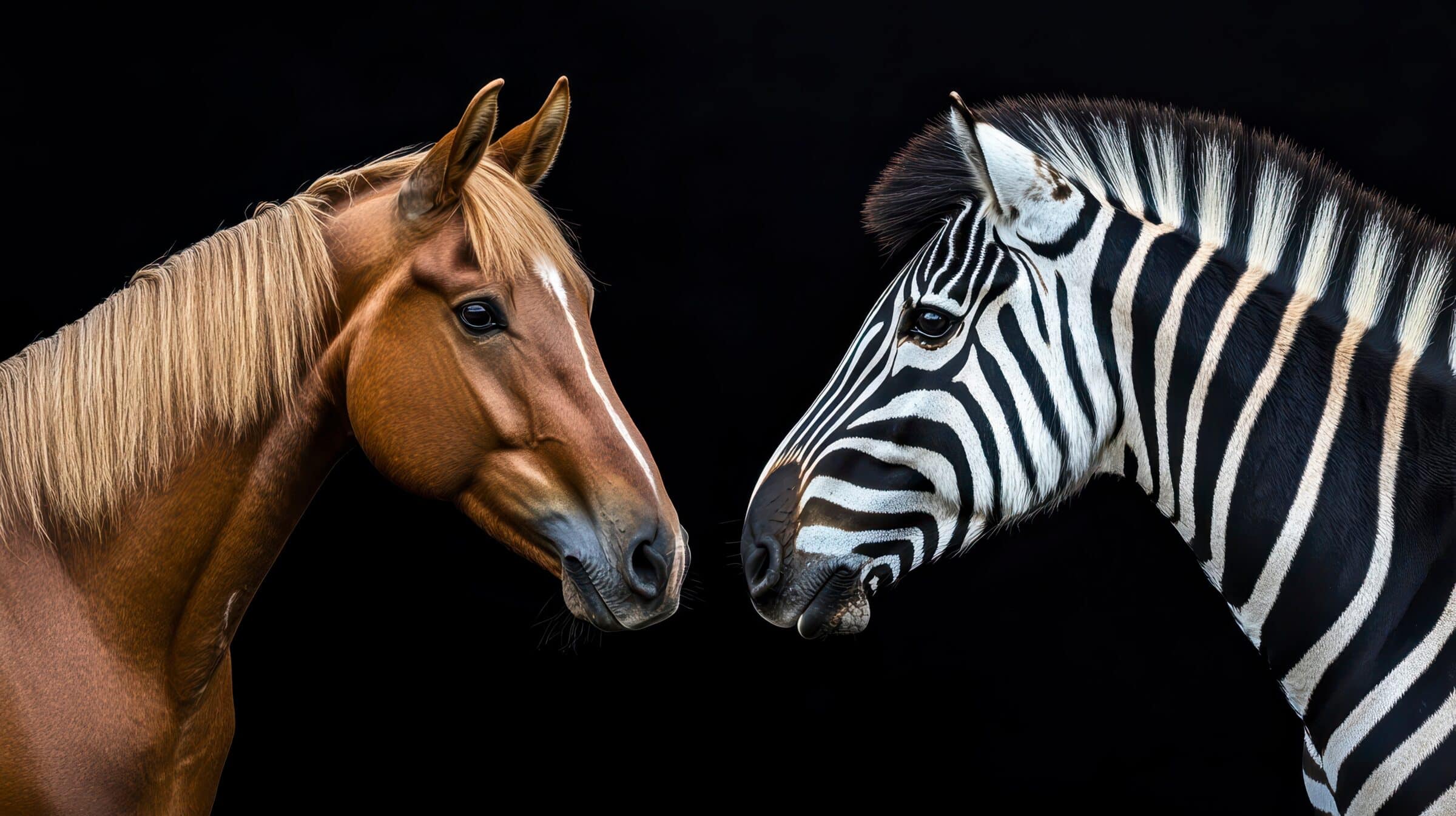
The final quarter of the 19th century witnessed a decisive turning point in the science of living things, when chromosomes (“colored bodies”) came on the scene and claimed center stage in biology. Chromosomes are tiny rod-like assemblages measuring a few microns in length, which become visible within the cell nucleus at the time of its division. They are found in plants and animals, and they occur in the same number and the same form (with minor exceptions) in all of an organism’s cells and in all organisms of the same species. Their diagrammatic representation (idiogram) was from the start taken as a specific identifying feature of the species, rather like the bar code a cashier scans at the supermarket. Within the cells of the body, or soma, they occur in pairs. Fruit flies (Drosophila) have 4 pairs, humans 23 pairs, and soft wheat 21 pairs. Closely related species have chromosomes that are similar in both number and form. Thus, humans have 23 and chimpanzees have 22; donkeys have 31 and horses have 32; zebras have 16 — making a horse the sum of two zebras. Soft wheat has 21 pairs, hard wheat has 14 pairs, and some wild wheat species have seven pairs.
The regularity of certain chromosome series, particularly in plants, seemed to suggest a relationship between chromosomes and form; but the series in question were limited to closely related groups with similar features, and thus provided no key to explain increasing complexity.
No Clear Relationship
Between chromosome number and the evolution of species it was immediately clear that no clear relationship exists. The number generally ranges between 16 and 25 pairs per cell nucleus; but a roundworm (Ascaris megalocephala) has only one pair, while a fern (Ophioglossum petiolatum) has 150 pairs.
Following the discovery of DNA (of which the genes in the chromosome are made), an attempt was made to establish a relationship between the amount of DNA in a cell and the “evolutionary” complexity of the organism. What was found, indeed, were two levels of DNA: the DNA of bacteria, with their millions of pairs of nucleotides, and the DNA of higher organisms, with their billions of pairs. The difference was not directly related to the amount of genetic information contained in the cell but to the organization of the chromosomes. Bacterial DNA is a string of genes; the DNA of higher organisms includes long non-coding sequences between and within genes. Since these sequences were non-coding they were dubbed “junk” DNA. The attempt to establish a relationship between amounts of DNA among different groups of animals proved disappointing. Mammals have around five billion pairs of nucleotides, reptiles around three, birds around two, and fishes between 0.3 and 3.0 billion pairs. So far so good. But what about amphibians, which have about ten billion pairs and in some cases 100 billion — a level one finds in several dipnoid fishes as well? The mollusks have levels of DNA like those of the vertebrates, and worms like those of the birds. Flowering plants waver between two and 500 billion pairs.
A Complete Failure
DNA, as we said, is the stuff genes are made of, and, since genes are directly involved in metabolism, it was thought that a gene count might offer a better index of organismal complexity. Anywhere from three to five thousand genes have been counted in bacteria, 6,000 in yeast and 25,500 in one of the Cruciferae, 13,600 in the midge and 26,000 in Drosophila. Man, in whose genome should have been found his entire civilization and his destiny — the Parthenon and the Ninth Symphony — has 20,000 to 25,000 (Stein, 2004), about the same as Cenorhabditis elegans, a small worm 1 mm long with only a thousand cells. And where did all this lead? To the conclusion that biochemical complexity has little to offer in explaining evolution.
The story of the evolution of organisms, told in terms of chromosome numbers, or numbers of genes, or amount of DNA, was a complete failure. The stance taken by biologists, therefore, was to discount differences and to concentrate on “universal” DNA. In the second half of the 20th century, DNA — its structure, its self-replication, its codes, its exchanges, and its decay and repair — became the central interest of biology, while organisms disappeared below the horizon. In many papers on DNA the organism is barely mentioned, for it no longer showed forth the glory of the Lord — or showed only His propensity to gamble — leading Salvador Dalì to exclaim: “And now, this announcement of Watson and Crick’s is the real proof of the existence of God” — a universal deity that presided over essential life but was uninterested in vain morphological variations.
Molecular Biology Is Born
This was how, halfway through the 1900s, molecular biology was born, pledged to study the DNA of genes and its primary products, the proteins. Beyond the proteins, between proteins and final forms — the wilderness.
Molecular biology took on such dimensions and gathered such momentum as to outclass the other biological disciplines, and even chemistry and physics.
The astonishing thing about molecular biology was not so much the knowledge that was emerging from the study of macromolecules but the fact that living nature showed itself to be so accessible, so ready to yield up its secrets without any modesty or reticence. It seemed as though life could be disassembled and reassembled like Lego blocks. Some people then placed their faith in the omnipotence of biology and in the prospect — it seemed only a matter of time — of being able to put life together and change it in a test tube. To be fair, nobody today expects to be able to construct a cell or a homunculus in vitro, and genetic engineering (as it has been called) does not erect biological edifices, but limits itself to simply adding a touch here and there.