





































As Durham University archaeology prof Paul Pettit reveals, it is a loaded question:
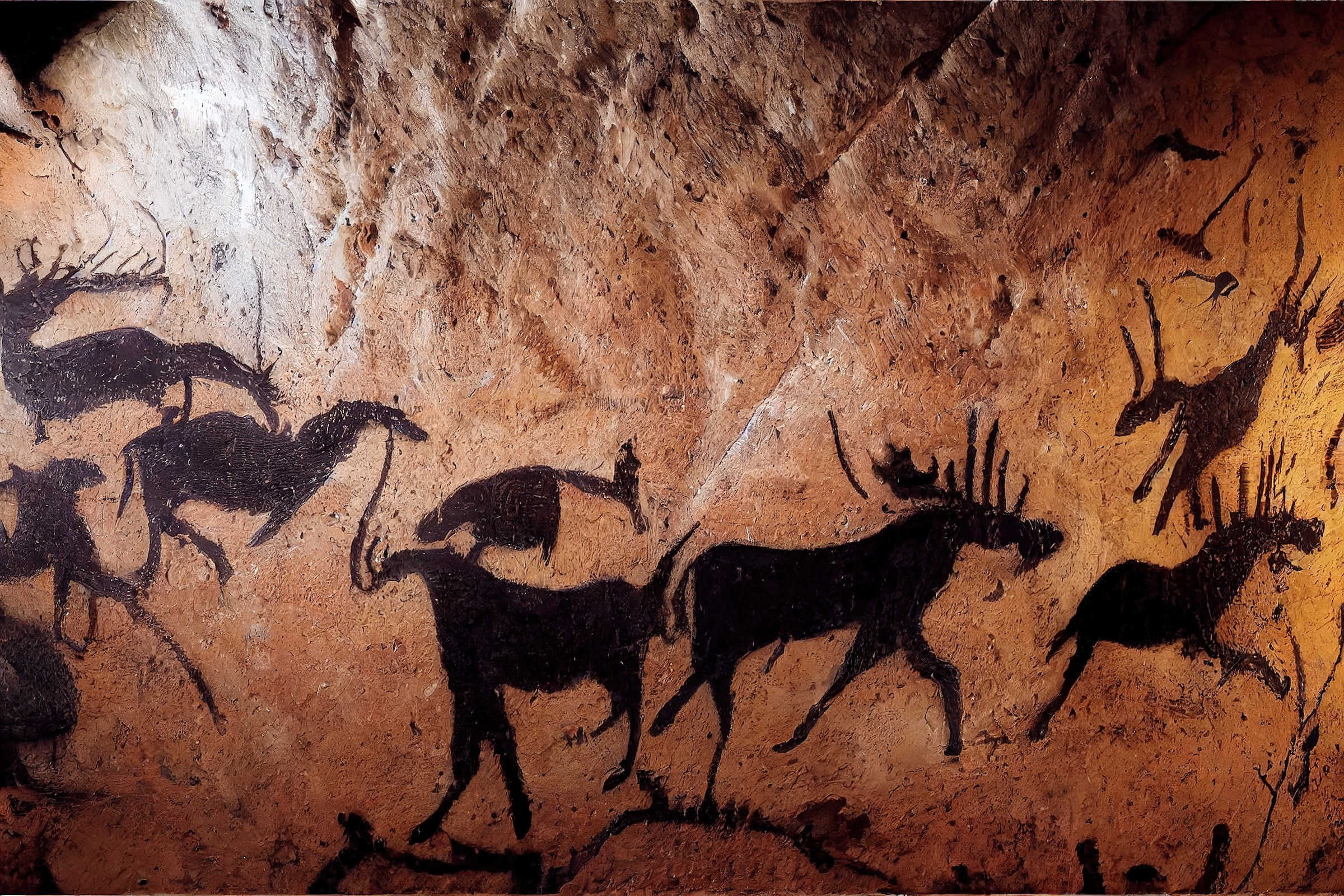
Despite the fact that we know that Neanderthals were capable of producing jewellery and using coloured pigments, there has been much objection to the notion that they explored deep caves and left art on the walls.
But recent work has confirmed beyond doubt that they did. In three Spanish caves — La Pasiega in Cantabria, Maltravieso in Extremadura and Ardales in Malaga, Neanderthals created linear signs, geometric shapes, hand stencils, and handprints using pigments. In La Roche Cotard, a cave in the Loire Valley, France, Neanderthals left a variety of lines and shapes in finger flutings (the lines that fingers leave on a soft surface).
And deep in the Bruniquel cave, southwest France, they broke off stalactites into sections of similar length and constructed a large oval wall of them, setting fires on top of it. This was not a shelter but something odder, and if it was constructed in a modern art gallery we’d no doubt assume it was installation art.
Now that we have well-established examples of Neanderthal art on cave walls in France and Spain, more discoveries are inevitable. However, the job is hard because of difficulties in establishing the age of Palaeolithic cave art. In fact, it is often the focus of intense debate among specialists.
“Were Neanderthals capable of making art?,” October 28, 2025
Pettit offers pencil drawings of the cave art here (on a “no reuse” basis).
Background to the Controversy
Some controversies make better sense if we understand the background. Materialists have long sought to show that Neanderthals were less mentally evolved than modern humans. That would fit their view that all brains evolved from primeval cells and the human mind is merely what the brain does. So the idea that some of us are more evolved than others and that Neanderthals could not produce art has been very convenient. But as more caves are searched, some of them do turn out to contain Neanderthal art. And that has been deeply shocking for some researchers.
The alternative proposition, that the human mind has no history, is not something many of them are prepared to entertain, whatever the state of the evidence turns out to be.
Cross-posted at Mind Matters News.