






































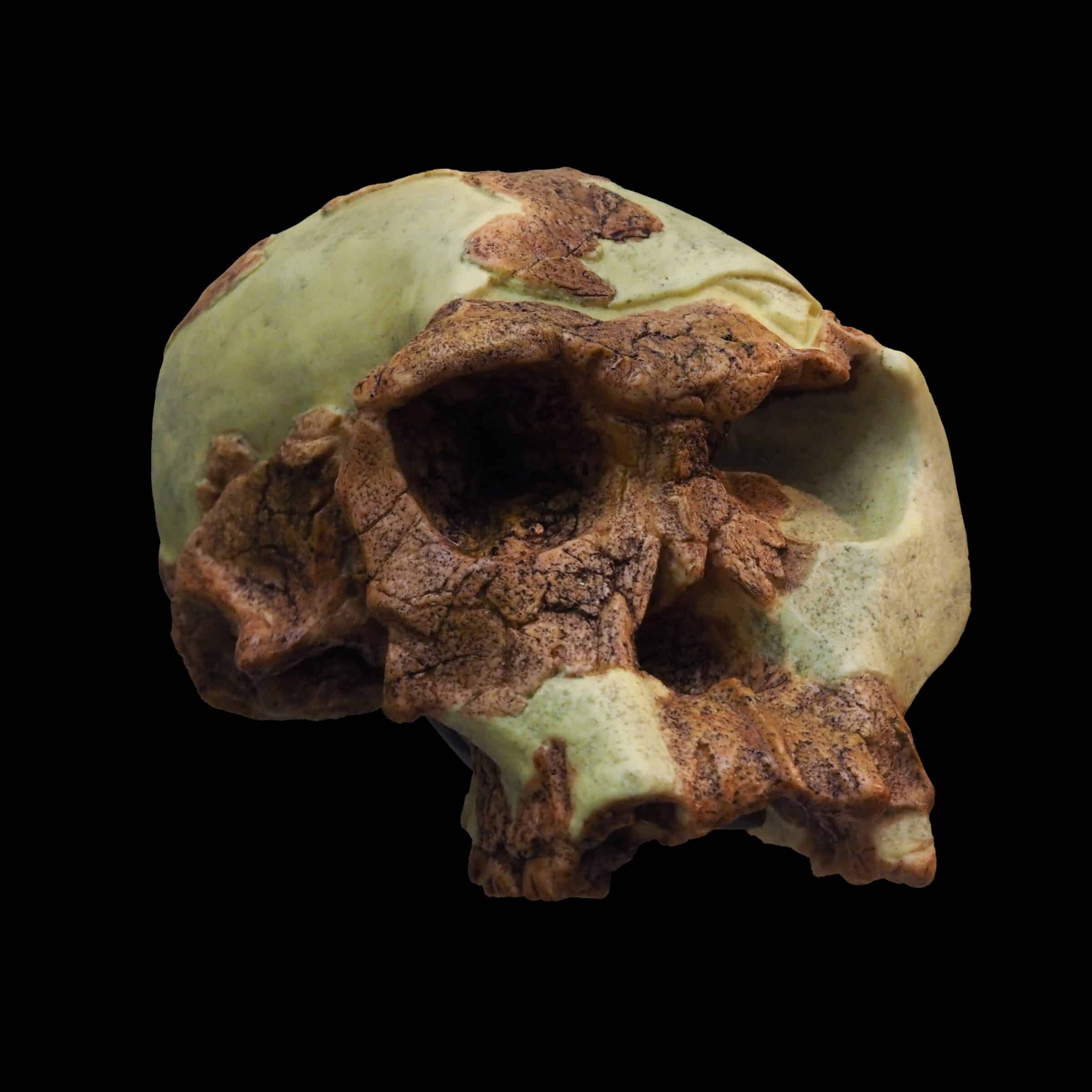
In the past, many evolutionary paleoanthropologists had hoped to cite Homo habilis as a potential transitional form between the australopithecines and other members our genus Homo, such as Homo erectus. We’ve previously discussed the fact that Homo habilis is morphologically more similar to the australopithecines, probably belongs within the genus Australopithecus rather than Homo, and does not have the right morphological traits to serve as such an intermediate or “link” (see for example here, here, here, here, and here). Now a new study in Annals of New York Academy of Sciences, “Early humans and the balance of power: Homo habilis as prey,” has found evidence that seems to further confirm this view.
Homo habilis “More of a Prey than a Predator”
According to the study, Homo habilis was hunted and eaten by leopards as prey, meaning they weren’t the first advanced “apex predators” that many evolutionary paleoanthropologists had wanted them to be. As the study states: “It has been argued that Homo habilis was responsible for the earliest episodes of stone-tool making, animal butchery, meat eating, and the reversal of the predator–prey relationship with carnivores,” but “the application of CV [computer vision] methods to the remains of the holotype and other specimens of H. habilis documents with unprecedented reliability that Olduvai Hominin (OH) 7 and OH 65 were consumed by leopards.” It’s true that they have a pretty limited dataset, but you have to go on the data that’s available. The technical paper thus concludes:
The implications of this are major, since it shows that H. habilis was still more of a prey than a predator. It also shows that the trophic position of some of the earliest representatives of the genus Homo was not different from those of other australopithecines.
News from Rice University frames the issue well:
For decades, researchers believed that Homo habilis — the earliest known species in our genus — marked the moment humans rose from prey to predators. They were thought to be the first stone tool users and among the earliest meat eaters and hunters based on evidence from early archaeological sites.
It concludes: “H. habilis may not have been the turning point researchers once believed.”
Of course, the comments here assumes that habilis belongs within Homo and not within Australopithecus — a view contradicted by much data. In fact, though the dataset in this paper is limited, it adds to and confirms a much larger body of data which shows that Homo habilis was more similar to Australopithecus and not a link between that ape-like genus and our genus Homo.
Not an “Apex Predator”
A headline over at IFL Science further describes the finding — “The First Humans Were Hunted By Leopards And Weren’t The Apex Predators We Thought They Were,” noting that “Homo habilis has been ‘dethroned’” and cannot serve as the intermediate they want it to be:
Around 2 million years ago, prehistoric humans in East Africa turned the tables on the carnivores that had previously terrorized them, learning not only to fend off these predators but also steal their kills, thus replacing them at the very top of the food chain. Generally, the ancient species Homo habilis is credited with making this trophic leap, yet new research suggests that this extinct hominin was actually hunted by leopards and may therefore have been more prey than predator.
[…]
“The implications of this are major, since it shows that H. habilis was still more of a prey than a predator,” they continue.
Speaking to IFL Science, study author Manuel Domínguez-Rodrigo explained that “for some time we have been depicting Homo habilis as the first conqueror of the trophic pyramid, as the scavenger-hunter, fending carnivores off from their kills.”
“But we have identified that these Homo habilis [specimens] actually were eaten by leopards in the same fashion as the previous Australopithecines,” he adds. “So it’s actually kind of dethroning Homo habilis and putting him at the same scale as other Australopithecines.”
Yet if H. habilis wasn’t able to muscle in on the prey of big cats, then which human species was the first to ascend this throne? According to the researchers, the most probable candidate is Homo erectus, which existed around the same time as H. habilis and was more adapted to life on the ground rather than in trees.
In other words, “Homo habilis” was not the first hominid king of the food web, as many would have preferred it to be if it was part of a transition between Australopithecus and Homo.
No “Transitional Phase” of Hominin Hunting
Evolutionary models of hominid hunting behavior predict that somehow hominids transitioned from being prey (as was the case with australopithecines) to being predator (as was the case with species like Homo erectus). The evolution of tool use is said to have been crucial in fostering this transition. The technical paper notes that some evolutionary theorists have proposed a “transitional phase” in this evolutionary scheme, where stone tools were being used to butcher animal carcasses, but this was being done by scavengers as humans had not yet developed a hunting ability. But the technical paper notes that much evidence for this “transitional phase” is highly controversial and it “might as well have not existed”:
A transitional phase has been argued by some to have existed during the initial stage of hominins as carnivorans, coinciding with the emergence of stone tool use and taphonomic evidence of animal carcass butchery, which can be framed as the scavenging phase of human evolution, mostly focused on within bone marrow and brain exploitation. However, it should be emphasized that no uncontroversial evidence of stone tool use or carcass butchery and/or exploitation exists prior to 2.6-million-year-old (Ma). Current taphonomic evidence from anthropogenic sites also underscore that such a transitional phase might as well have not existed, since by 2 Ma hominins had regular/frequent primary access to small and medium-sized animals.
It’s often been hoped that Homo habilis would fulfill their desired transitional stages between Australopithecusand Homo erectus, but the technical paper further notes that its findings situate habilis similarly to the australopithecines:
[W]e confirm the predatory role of leopards on H. habilis, assuming a primary role of these felids in the consumption of this hominin taxon, and the lack of taphonomic evidence of durophagous carnivores implied by the modification of the individuals analyzed. Both hypotheses could potentially indicate that H. habilis was still in a similar position as some australopithecines regarding their relationship with large mammal carnivorans. This would explain their primitive body, which included substantial adaptations to tree climbing. An arboreal component in their adaptive behavior would probably have been needed to buffer predation hazards.
It’s also often hoped that Homo habilis could be responsible for some early evidence of intelligence in the archaeological record, but the study concludes that Homo erectus is most likely the species responsible for the archaeological / anthropogenic record, NOT Homo habilis:
This leaves us with the issue of what role (if any) H. habilis played in the formation of the archeological record. The information obtained after the taphonomic analysis of the Olduvai Gorge Bed I anthropogenic sites suggests that some hominins were already inserted within the carnivoran guild, with a predatory component. This shows that around 2 Ma ago, some hominins were capable of coping with predation risks. At the time that this is documented taphonomically, there is evidence of more modern hominins with complete terrestrial adaptation (i.e., H. erectus) who are contemporaneous and very likely sympatrically adapted to the same environments as H. habilis, even at Olduvai Bed I. The most parsimonious interpretation is that this larger and more anatomically modern hominin is responsible for the anthropogenic record.
The proposals of this study are very consistent with what we have long argued here: It was species like Homo erectus that were the first really human-like hominids in the fossil record, not “Homo habilis,” which may not even be a real species, and probably does not even belong within the genus Homo.