






































Jonathan McLatchie has posted a nice discussion of a peer-reviewed scientific paper critiquing a strictly natural chemical origin of life. The paper, authored by Olen Brown, Professor Emeritus of Biomedical Sciences at the University of Missouri, and David Hullender, Professor of Mechanical and Aerospace Engineering at the University of Texas at Arlington, was published in November 2024 in an Elsevier journal, Progress in Biophysics and Molecular Biology. (According to the University of California, Elsevier is “the world’s largest scientific publisher” and thoroughly mainstream.) We had the authors on ID the Future (see here and here) to discuss some of their other scientific papers a few months before this paper came out.
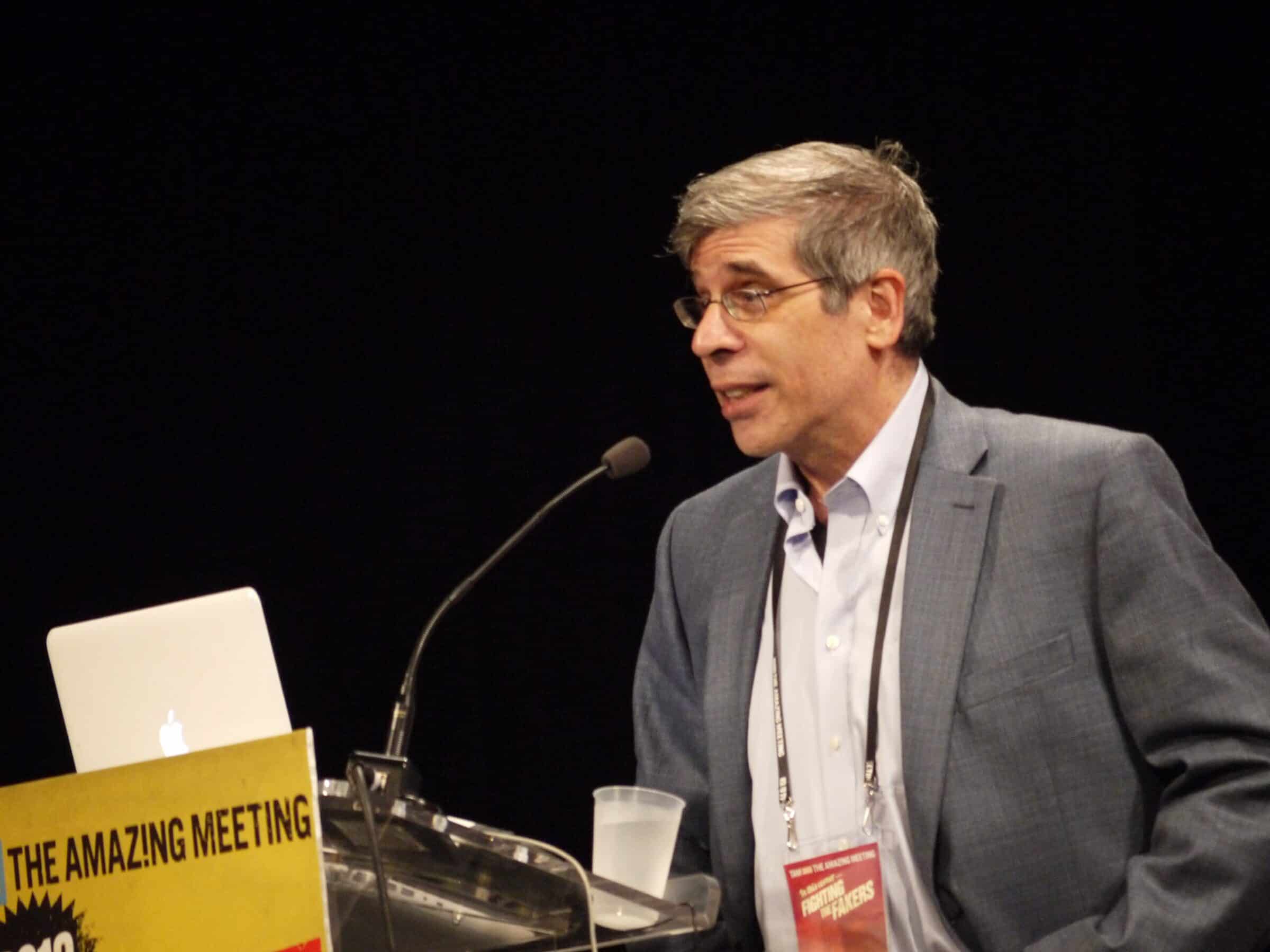
Last month, Jerry Coyne, a prominent evolutionary biologist and professor emeritus at the University of Chicago, wrote a critique of this paper at his blog, Why Evolution Is True. I want to say at the outset that I fully support the academic freedom of folks to write critiques of intelligent design, and I’m happy to see prominent scientists like Coyne engaging with the work of pro-ID scientists! Thank you, Jerry, for taking the time to examine this paper.
Coyne’s rebuttal, though, turns out to be quite weak, and Dr. McLatchie has already easily refuted Coyne’s main scientific points. If you look at Jonathan’s post it focuses strictly on the science, and offered no personal attacks whatsoever. This is the norm for Jonathan, and pretty much all of us here at Science and Culture Today.
Here, I want to highlight a different but nonetheless important aspect of this conversation: the rhetoric. Coyne’s post has brought out of the woodwork quite a bit of classic intolerance against intelligent design (ID) from critics who are keen to attack the authors personally and who implicitly or explicitly oppose academic freedom for scientists who critique evolution.
Ignorant, Insane, or Wicked: Take Your Pick
I fully recognize that reasonable people can disagree on things in good faith, and I very strongly believe that people who disagree with ID are generally reasonable folks who are trying to grapple with the scientific issues just like I am. Unfortunately, many ID critics don’t feel that way towards us. They have great difficulty comprehending that a person who is informed, intelligent, and acting in good faith could possibly think differently than they do. Richard Dawkins famously encapsulated this view of Darwin-skeptics when he wrote:
It is absolutely safe to say that if you meet somebody who claims not to believe in evolution, that person is ignorant, stupid or insane (or wicked, but I’d rather not consider that).
Dawkins once tried to defend this quote. In trying to explain what he meant, he basically doubled down on his claim about Darwin critics. He said they are “ignorant,” insane — or “tormented, bullied, or brainwashed,” presumably by religion. He then added the possibility of their being “stupid” while attacking “creationists who tell lies” and use “duplicity.” And in highlighting the “wicked” faction among Darwin doubters, Dawkins added what he apparently thought was the kindly disclaimer that “such minor examples of wickedness can be excused on the grounds that ignorance and stupidity trump wickedness.”
Huh? What is Dawkins even talking about? And why is he having a debate inside his head about precisely which form of evil best characterizes his interlocutors?
Whatever the disturbing answer might be, it’s clear that Dawkins cannot fathom the possibility that an informed person could disagree with him in good faith. His view of ID proponents is tragically epidemic among ID critics on the internet. This precise form of intolerance was on display from Coyne himself, and from subsequent commenters on his post, attacking Olen Brown and David Hullender.
Personal Attacks on the Authors
Coyne and his commenters used all the classic personal attacks listed by Dawkins. They attacked the authors’ competence and knowledge (“ignorant”), their religion (essentially what Dawkins labels as “insane” or “brainwashed” or “stupid”), and their intellectual integrity (the “wicked,” obviously).
Regarding the authors’ alleged ignorance, one commenter charged: “It is a cliché that one of the authors is an engineer. The other presumably had an evolution course or two as an undergrad.” Another wrote: “I am an MD and it is embarrassing that of all people with college degrees the ones most likely to be taken in by pseudosciences like creationism are engineers and medical doctors.” Never mind that engineers are very good at doing calculations and have a keen ability to recognize design because they practice it every day! Interestingly, one commenter implicitly recognized this point:
As a first-year undergraduate student in physics 40 years ago, I was surprised by how many of the engineering students in my dorm were religious creationists. To an engineer everything is engineered, I guess.
Or maybe it’s simply that engineers are trained to recognize engineered systems.
Other commenters attacked the authors’ religious motives, commenting that one author “seems to be totally tied with his Baptist church…which may explain some anti-Darwin predisposition.” Some folks just posted juvenile parodies or rants about religion, with things like:
- “And lo, when Jesus looked down upon the lifeless Earth, and seeing that His Plan of Life was improbably and irreducibly complex, and with all the angels and cherubim and seraphim of the heavenly host, didst breathe the complex specified information into the dust of the rudimentary poly-peptides of the Earth, and said in a loud voice, ‘Go ye hither to multiply and fitly survive.’ And it was so. Of Pandas and People, pp. 89-90” (Needless to say, the quote is fake.)
- “…and with all the angels and cherubim and seraphim of the heavenly host, didst say, ‘Let there be M. genitalium.’ And there was M. genitalium. And God saw that it was a pest.”
- “I can’t stand theists who challenge abiogenesis because they lack sufficient imagination, knowledge, and long for a merely 3,000 year old skydaddy who was obviously, demonstrably manmade.”
- “Ok, so it’s all down to magic then……!”
Many ID critics operate under the mindset that if you critique evolution then you must be deficient in some way — probably immoral and wicked. This view is on full display in the comments.
One commenter quoted Jerry Coyne’s statement that the authors are “a pair of creationists, with decent academic credentials” and then responded, “Or in common parlance, liars.” Another chimed in that the authors are “orthogonal to truth.” Others says that the fact that one author has written for Discovery Institute is “Very embarrassing for the journal and publisher.” Another wrote: “It shows the intellectual dishonesty of the journal, its edtors [sic], and the authors.”
Other commenters claimed the authors used “sleight of hand” or “snuck” the paper “past reviewers.” Coyne himself even said “the journal was played by creationists.” I’ve heard this charge before and what I’d like to know is: How does one sneak anything past reviewers? One submits a paper, and if the reviewers think it has merit, then they accept it; if they don’t, they reject it, or they require changes until it becomes acceptable. For a major academic publisher like Elsevier, there’s no “sneaking” anything past reviewers. In submitting your work to reviewers for rejection, critique, or acceptance, you are doing the opposite of sneaking.
There’s an implicit assumption that if you are an ID proponent then you should be disqualified from being allowed to publish scientific papers. According to the extreme prejudice of Coyne’s commenters, anytime an ID proponent writes a paper, he or she must disclose their ID-friendly views from the beginning, alerting the reviewers to the alleged inferiority of the author so they can reject the paper. By implication, ID proponents are necessarily second-class scientists, deserving of mistreatment.
This view — which would reject a paper based upon prejudice against the author rather than the merits of its content — stands fundamentally against academic freedom. ID proponents are legitimate scientists with credentials just as good as non-ID scientists, and they have every right to submit papers to scientific journals that can be judged on their own merits. If the paper has merit, then may the reviewers accept it. If the paper doesn’t, then by all means let them reject it or require changes. In this case, the reviewers accepted the paper. That’s a fact. Of course, we ID proponents have had papers rejected due to prejudice not related to the merits, but you can rest assured that if a mainstream science journal accepts an ID-friendly paper, then it must have had merit. Feel free to disagree with the paper, but don’t accuse anyone of wickedness simply because they submitted a paper to a journal and the journal accepted the manuscript.
Another commenter noted that after Jerry Coyne wrote an article on the Scopes trial at Quillette, “the comments were polluted with ‘reasons’ why Evolution simply cannot be true. I’m sure it disheartened [founder] Claire Lehmann to see who her subscribers actually are.” So when someone challenges Darwin, that constitutes “polluting” the discourse? These are ominous words, and their demands for intellectual purity “unpolluted” by critics only highlights their intolerance.
Trying to Gin Up Harassment of the Journal
At the end of his post, it became clear that Coyne’s whole point was to gin up harassment of the journal so they won’t publish critiques of evolution in the future. After writing, “Sadly, the journal was played by creationists, and should be really embarrassed,” he provides a link to the editorial board, falsely caricaturing their argument, calling on people to pressure the journal:
You can see the editorial board (two editors-in-chief and six editors) here. Someone should write them and let them know what they published. And that, in science, ignorance does not equal God.
So what have we seen here? We’ve seen two credible scientists who submitted a paper to a mainstream scientific journal critiquing a naturalistic origin of life. That paper was accepted and published. Then we see ID critics on the internet attacking the authors personally. This follows a call by a leading influential evolutionary biologist for his blog commenters to press the journal to make sure that it never publishes anything critiquing Darwin again. Theirs is not a movement committed to academic freedom or open scientific debate. It’s committed to personal attacks and trying to silence the intellectual voices of people they disagree with.
An Incoherent Position of ID Critics
Over the years I’ve often heard ID critics propose an incoherent position: (a) First, they deny that ID faces any form of intellectual intolerance, all the while (b) arguing that ID should be rejected and denied academic freedom. This little episode shows that (a) is patently false because of all the intolerance on display at Coyne’s blog, and thus provides some very nice examples of (b) that should be bookmarked and saved for the next time someone tries to pretend that ID does not face intolerance from critics.