






































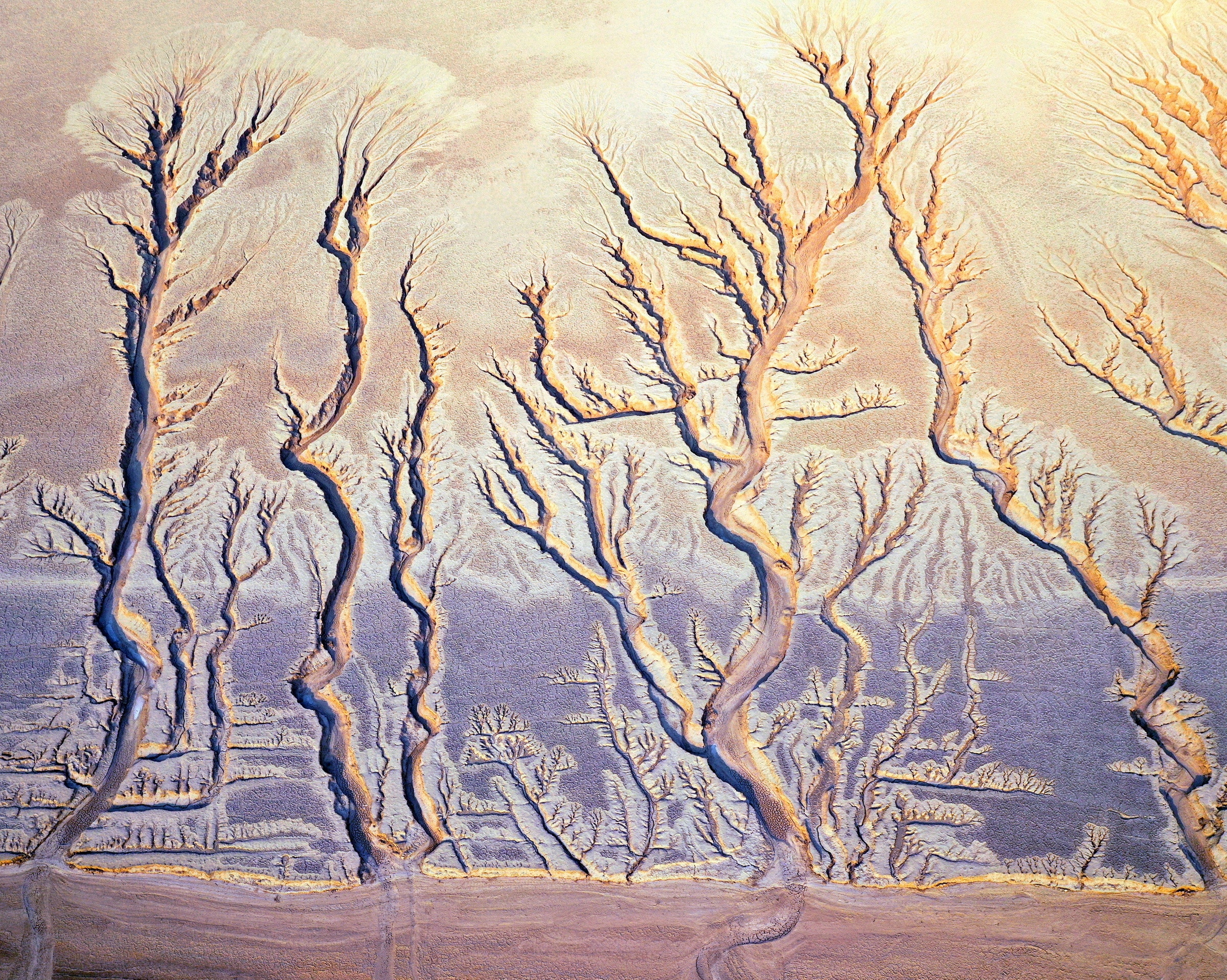
An article at Science News1 last month on the 50th anniversary of the word “fractal” brought back to mind things I had learned about the father of fractal geometry, Benoît B. Mandelbrot, after his death in 2010. Mandelbrot’s story can encourage outsiders to stick to their principles if their evidence is sound even when they must stand alone against the world’s consensus.
The experts that had shunned him now universally acclaim his brilliance and influence. “See how fractals forever changed math and science,” Stephen Ornes wrote in his Science News article; “Described by Benoit B. Mandelbrot in 1975, these shapes are everywhere.” Have not ID advocates argued similarly that design evidence is hiding in plain sight everywhere? Fractals and design evidences are not hiding, of course; they are evident throughout nature. Only those desiring acceptance by the crowd, or who are committed to wrong paradigms, fail to see them.
If you have not yet been mesmerized by some of the numerous video renditions of the Mandelbrot set, take a moment to look in awe at this colorful example, “Trip to Infinity”:
The essence of fractal geometry is self-similarity. As shown in the rendition, the same pattern reappears at all scales. Mandelbrot recognized that nature is like this: rough, not describable by polygons and curves in traditional geometry. Astrophysicist Jason Lisle helped me understand how these patterns emerge when plotting points from a simple-looking equation:
zn2 + c = zn+1
Today, artists and mathematicians are astonished at the intricacy of the patterns in the Mandelbrot set that repeat forever. It’s like looking into infinity. The infinity is not physical, of course; the new points are calculated going forward based on prior inputs, and physical representations of the set grind to a halt because of the limitations of atoms. Once self-similarity is visualized, though, it becomes apparent everywhere: in branching trees, clouds, mountains, and seashores. I myself have found and photographed stunning flow channels in a dry lakebed that look like trees (see the photo at the top). The self-similar patterns extend from largest channels to the tips.
Mandelbrot’s Life and Vision
Colleague Ralph Gomory describes Mandelbrot’s mission:
At a time when mathematics focused on lines, planes and spheres, Mandelbrot wrote: “Clouds are not spheres, mountains are not cones, coastlines are not circles, and bark is not smooth, nor does lightning travel in a straight line.” His life’s work was the creation of ways to describe these objects more accurately. He was able to see and describe the true roughness of the world. [Emphasis added.]
Mandelbrot, born into a Jewish family in Poland, moved to France under the threat of Nazi occupation when he was 12. Having to move often to escape detection, he later reflected that “his irregular life with its limited schooling had given him the time and the freedom to develop intellectually in his own way.”
His gift for visualizing geometric objects launched him into elite universities in France after the war, including École Polytechnique in Paris. Gomory describes his individualistic career path in the Nature obituary.2
When Mandelbrot graduated from the Polytechnique, the dominant mathematics in France was pure and abstract. Mandelbrot’s goal, like his background, was different. He wanted to find order where everyone else saw a lawless mess. He wanted to learn about real, concrete complex problems.
Around this time, he received a scholarship at Caltech where he was “exposed to the molecular biology being developed by Max Delbrück’s group.” This must have given him insight into patterns of iteration and self-similarity in the biological world. In 1952 he was back in Paris, then returned to the United States in 1958 with his wife, his “devoted companion throughout his life.” He continued studies at Princeton, Harvard, and Yale.
Working for IBM in New York, Mandelbrot was quickly recognized for his abilities, and he developed his new geometry mostly by himself. He began to see self-similarity everywhere: on coastlines, the branching of lungs, heartbeats, and even the stock market. Dissatisfied with geometry that had been reduced to abstract equations, he “gave the eye a central role again.”
In 1975 he coined the term fractal to describe the rough but structured forms he saw all around him. This ever-expanding work appeared in various forms, culminating in his book The Fractal Geometry of Nature (1982).
Out of the Mainstream
With fractal geometry, Benoit Mandelbrot could describe rough phenomena more accurately. Did the scientific community praise him for these unique and original contributions to our understanding of the world? Gomory continues,
Mandelbrot’s remarkable conclusions often directly contradicted the accepted view. Inevitably, this slowed their acceptance, but he always persisted with an intellectual courage that I greatly admired. In 1974 he became an IBM Fellow, IBM’s highest technical distinction, but outside recognition came more slowly.
Peitgen in Science agrees:
Some describe Mandelbrot as one who chose the role of a maverick in the mainstream sciences. Quite to the contrary, his uncompromising devotion to analyze and understand the “rough” reality of nature isolated him from the mainstream.
Recognition did come at a high level — but not till he was in his 60s. Gomory writes,
One fractal, suitably named the Mandelbrot set, became globally recognized, and questions about its properties sparked the interest of many mathematicians. Finally in 1985 he received the Barnard Medal, awarded by the U.S. National Academy of Sciences, and after that came a flood of recognition, honorary degrees, elections to prestigious academies, prizes and the Legion of Honour.
Today, fractal geometry is a mainstay in multiple disciplines. Heinz-Otto Peitgen wrote in the obituary in Science,3
He fundamentally and irrevocably changed our view of the world and left us a tool that will continue to unveil nature’s most peculiar commonalities that might otherwise be left aside as insignificant.
Mandelbrot’s revolution in geometry reminds me of Leeuwenhoek’s first look through a crude microscope at a hitherto unseen world of natural phenomena. Peitgen lists some of the fields that have benefited from fractal geometry:
Mandelbrot made us aware of a mathematical universe yet to be harvested — the world of iterative processes. Within this framework, he developed the tools that appear ideally suited for the rough nature of the world. And “world” is meant literally, because his footprints are left in the theory of finance, linguistics, biology, medicine, chemistry, physics, earth science, cosmology, computer science, astronomy, many of the engineering disciplines, and of course, mathematics.
Not every maverick is fortunate to receive recognition in his lifetime. We remember Ignaz Semmelweis, who died in frustration and obscurity after resistance by the consensus. There have been great scientists who were only vindicated after their deaths, like Galileo, William Harvey, Gregor Mendel, and others.
Lessons for Today’s Outsiders
Intelligent design is making inroads but it is still dismissed as a “fringe” view by the strict materialists and Darwinians who dominate the global conversation. Stories about mavericks like Mandelbrot and others remind us that truth is more important and powerful than consensus. Those who are convinced that the evidence supports their view can take heart at Mandelbrot’s courage to stand his ground till recognition came. Even if it never comes, truth is more honorable than reputation.
Are fractals an indication of intelligent design? One paper in Science tried to describe the origin of fractals in Romanescu cauliflower,4 because “How such a fractal, self-similar organization emerges from developmental mechanisms has remained elusive.” The scientists describe details of the genes and curds that give rise to fractal shapes, but leave unanswered why genes should obey self-similar laws that give rise to phyllotaxis in the first place.
The remarkable and unexpected numerical patterns in the Mandelbrot set only become apparent when zooming further in. These patterns are both fascinating and beautiful, and they always return to the starting cardiod shape. The Mandelbrot set reminds me of the Fibonacci series that, in a similar way, gives rise to aesthetically pleasing patterns in a wide variety of natural phenomena. Regardless of viewpoint, any reasonable observer must stand in awe of the patterns that emerge from a simple equation — another indication of what Eugene Wigner called “The Unreasonable Effectiveness of Mathematics in the Natural Sciences.”5
Notes
- Stephen Ornes, “See how fractals forever changed math and science,” Science News, Aug 19, 2025.
- Ralph Gomory, obituary to Mandelbrot, Nature, November 17, 2010.
- Heinz-Otto Peitgen, obituary to Mandelbrot, Science, November 12, 2010.
- Aspeitia et al., “Cauliflower fractal forms arise from perturbations of floral gene networks,” Science, July 9, 2021.
- Wigner, “The Unreasonable Effectiveness of Mathematics in the Natural Sciences,” Dartmouth reprint.