





































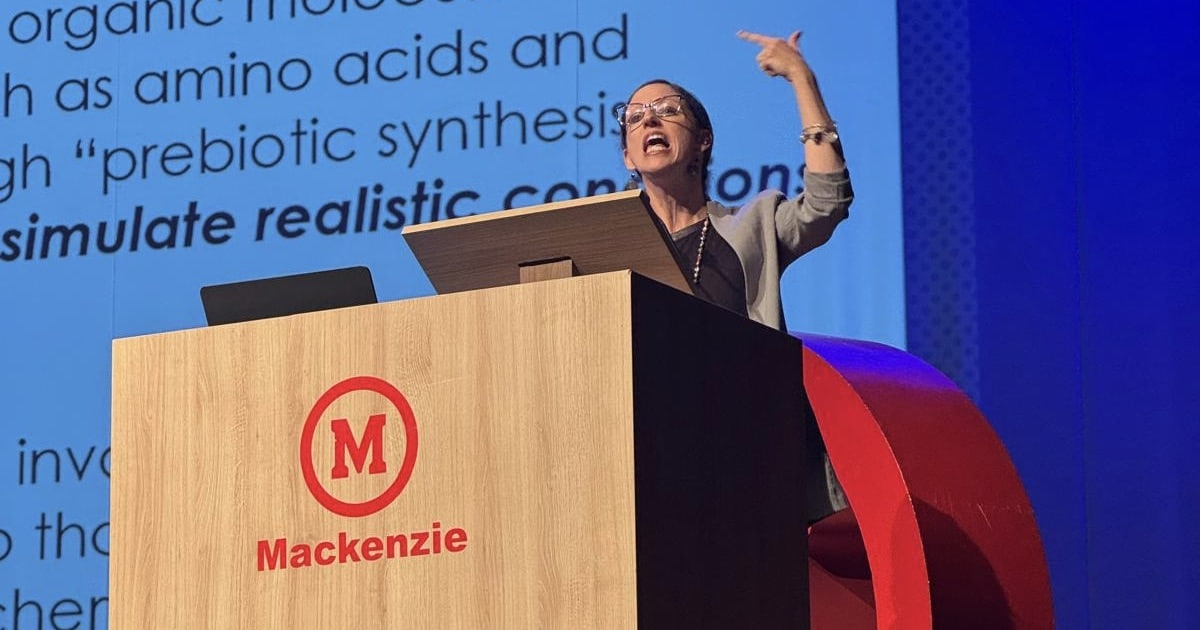
Kristin Marais (my wife) teaches chemistry for Discovery Institute Academy. We just returned from São Paulo, Brazil, for the TDI (Teoria do Design Inteligente) Brasil conference, where we both gave talks. My talk was on “O que é a Teoria do Design Inteligente” (“What Is Intelligent Design Theory?”), based upon my Dallas Conference presentation from earlier this year. I had lots of great conversations with scientists in the audience, from Brazil and other South American countries. It was wonderful as always to spend time with Marcos Eberlin. But here I want to highlight Kristin’s talk, which was exceptionally well received.
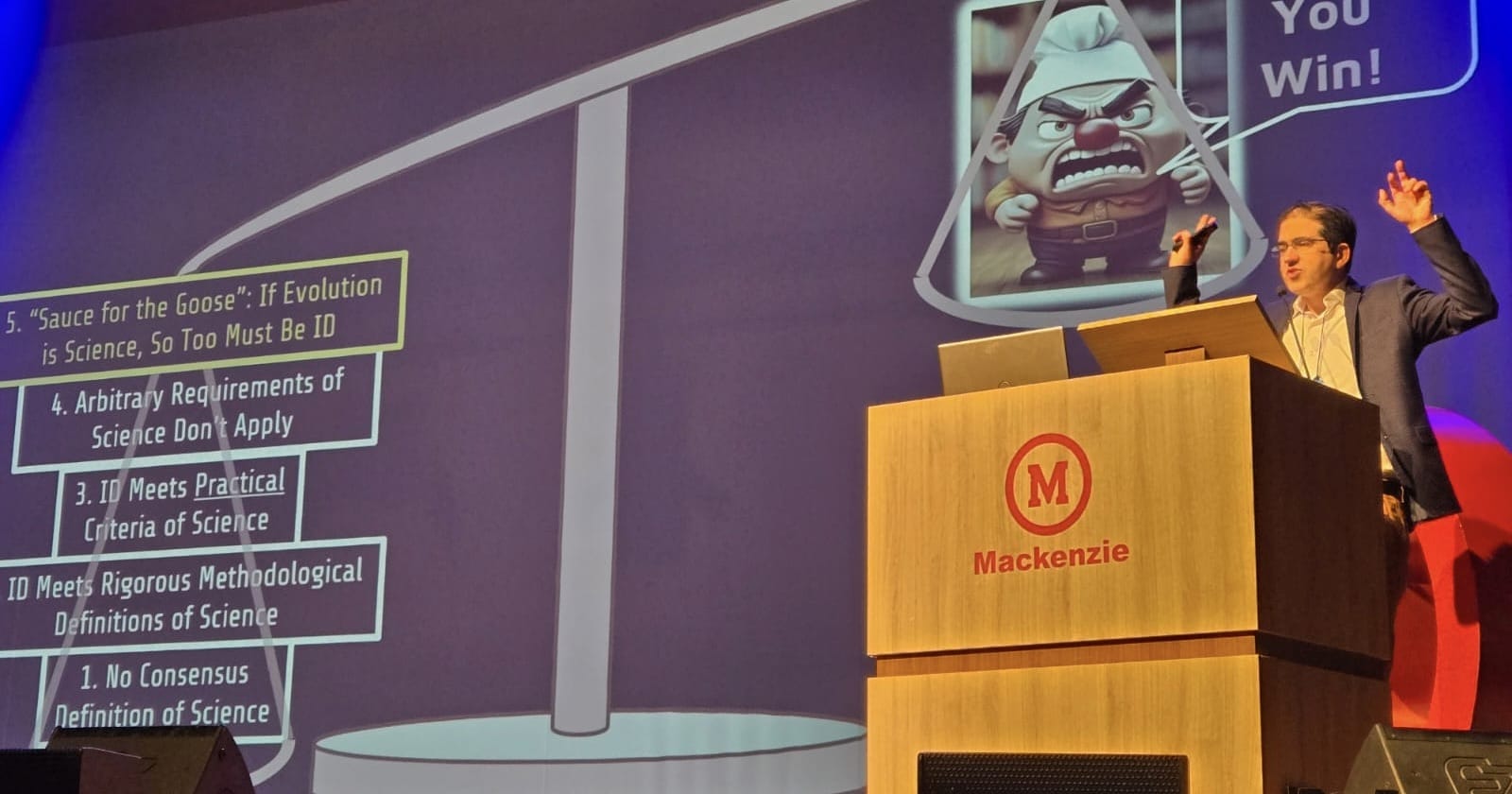 Photo source: Casey Luskin.
She spoke about “Como Tornar a Química Divertida Ensinando sobre Design Inteligente e a Origem da Vida” (“How to Make Chemistry Fun by Teaching Intelligent Design and the Origin of Life”).
Three Main Takeaways
The audience loved her talk, which was about 35 minutes long. She gave three main takeaways from her chemistry class about how basic chemistry helps high school students see what’s wrong with materialist explanations of the origin of life:
- Her students directly experience that chemistry experiments often produce only very minute amounts of the desired products. Origin-of-life (OOL) prebiotic synthesis experiments face the same “mass transfer” problem where there is very little material from reaction A to use when you need to perform the next step, reaction B. OOL researchers then cheat by using “relay synthesis.” Kristin did a superb job of explaining how her kids’ chemistry experiments show why prebiotic synthesis experiments face major problems.
- Le Chatelier’s principle holds that reactions won’t go forward in the presence of their products. This is a basic principle that her students learn, like all high school chem students. This principle shows exactly why you can’t form polymers like proteins, RNA, or DNA in the primordial soup. Polymerization reactions produce water, and this reaction therefore does not want to go forward in water. So you can’t do polymerization in the primordial soup.
- High school chem students also learn basic concepts like diffusion and osmosis. These principles suggest that the “coacervates” that are proposed as primitive cell membranes could never protect “protocells” from harmful substances. Modern cells have complex molecular machines and carbohydrates embedded in their membranes that make them “smart” membranes that can actively discriminate between harmful and helpful substances. But protocells would not have had these features, and harmful substances would just diffuse right into the “protocells,” leaving them dead in the water.
The Need for Design
Kristin then noted that each problem with explaining the origin of life points to the need for intelligent design:
- Origin-of-life chemistry experiments only work because skilled chemists are there to perform them. The chemists would not be present on the early earth, which shows the need for intelligent design to make the origin of life happen.
- In living cells, Le Chatelier’s principle can be overcome through enzymes that can force polymerization to occur even in a water-based aqueous environment. These enzymes would not be present on the early earth — showing the need for information and molecular machines to allow life to overcome the natural tendencies of chemical laws. This information requires intelligent design.
- The molecular machines and carbohydrates in cell membranes similarly point to the need for information to create the “smart barriers” that keep harmful substances out of cells, and let helpful ones in. Again, intelligent design is needed to overcome basic chemical laws.
Of course I’m highly biased, but Kristin’s talk knocked it out of the park! For more on the Discovery Institute Academy high school science courses (chemistry and biology!), and the urgent needs they serve, please see Brian Westad’s recent Evolution News article here.
 Image source: Discovery institute Academy.