







































There is no general agreement about what “science” is, but according to one of the most popular definitions, science is the field of knowledge that is concerned with uniform and predictable patterns in nature. If we adopt this definition, it does not follow that everything in nature operates according to uniform, predictable pattern, but it does mean that science cannot concern itself with those things that don’t. Thus, there can be a science of gravity, because gravity is uniform and predictable. But there can be no science of defenestration, because humans are fickle defenestrators and push people out of windows according to no predictable pattern.
This limitation is often used to disqualify the intelligent design hypothesis as unscientific. If the proposed intelligent designer is a being with free will, he/she/it does whatever he/she/it pleases, and therefore cannot be predicted and analyzed scientifically. This objection is especially pertinent if the proposed designer is God, and therefore literally omnipotent.
More Subtle than an Alternative
This argument is more subtle than the crude (but also common) claim that science has disproven the supernatural. Someone can admit that science hasn’t literally disproven the reality of “unscientific” causes such as gods, fairies, magic, and so forth, and yet maintain that it simply can’t investigate those things — just as a physicist whose experiment was ruined by data-tampering is helpless to investigate the saboteur with physics. This leads to the doctrine of non-overlapping magisteria, as the evolutionary biologist Stephen Jay Gould’s called it: that idea that science has its zone, and religion has its own, and ne’er the twain shall meet.
On the surface, this argument may seem convincing. But it falls apart if you consider how it would sound if applied to any other field of knowledge.
Consider a Narrower Field
As an example, let’s consider a narrower field. Geology, as everyone knows, is concerned with the natural processes that act upon the earth. It is not concerned with biology, much less sociology or psychology.
So imagine you are a geologist. One of your fellow geologists wants you to look at a particularly interesting geological site. But when you arrive, you find that the site has been ruined. Most of the ground has been torn up by some sort of tractor, and there are wheel tracks everywhere.
“That’s disappointing,” you say. “Someone has gotten here first.”
“Well, I don’t know about that,” says your colleague. “I’m no sociologist. I just want you to look at this geological site. Have you ever seen formations like these?”
“But those aren’t geological formations!” you reply. “They’re obviously manmade.”
“Now, now,” your colleague responds. “We’re geologists, aren’t we? Let’s stick to geological explanations.”
How would you reply to that?
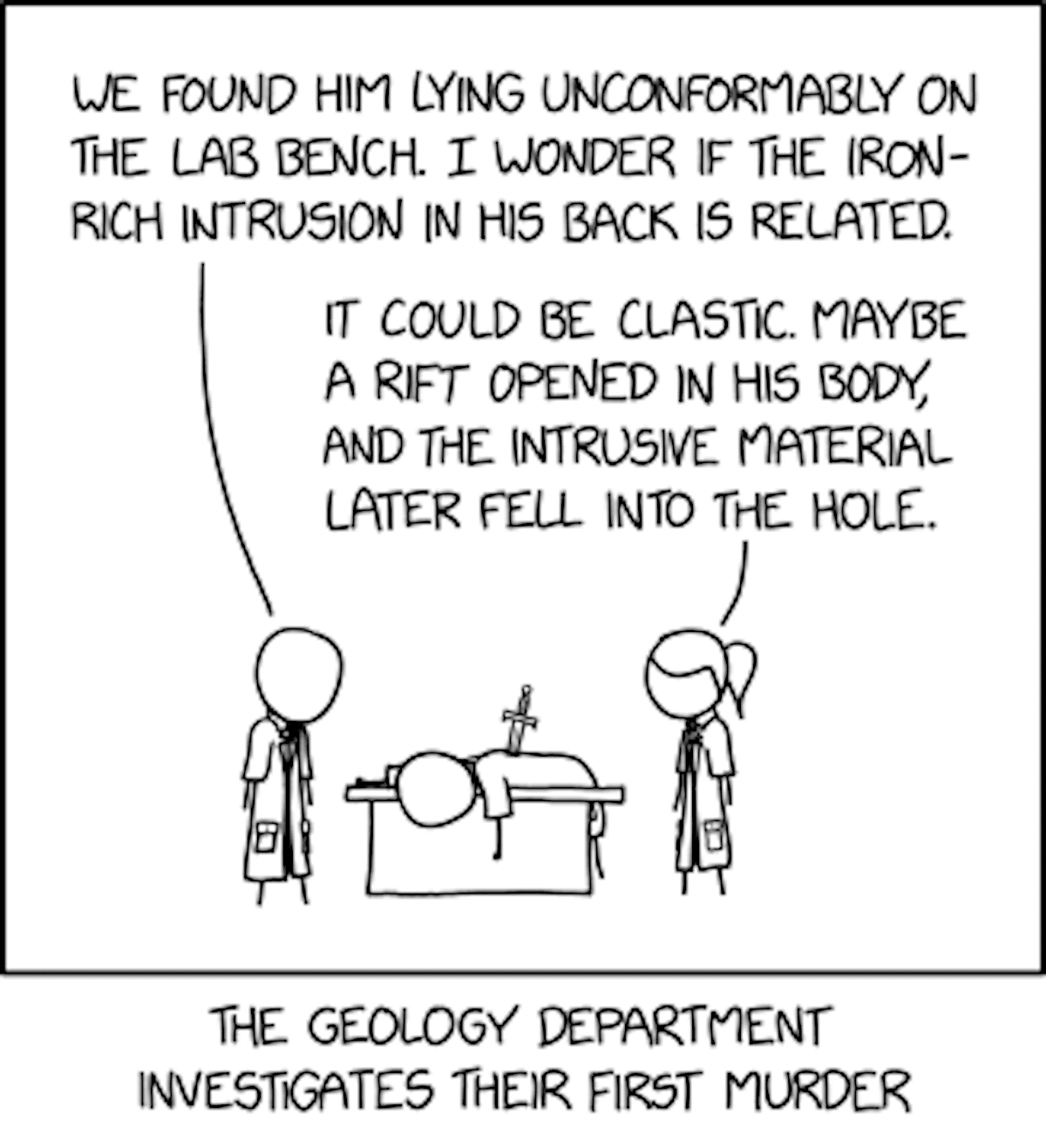
Most likely, you would think he was joking. Of course no geologist would behave like your colleague. The fact is, scientists and scholars of all sorts are always willing to consider explanations from outside their field. This is necessary, because the world and its contents are not divided into neat little Tupperware containers labelled “geology,” “biology,” “science,” “philosophy,” “religion,” and so on. There are no nonoverlapping magesteria in the real world. If science is defined as the study of uniform patterns in nature, scientists should still be able to notice when a natural phenomenon does not seem to follow uniform patterns.
A Flaw in My Analogy?
Someone might argue that there is a flaw in my analogy. Most geologists know something about tractors, and have even seen them, and that is why they are able to infer “tractor” from evidence at hand. But we know nothing about the supposed intelligent designer — so how can we infer him/her/it from the evidence?
If you think about it, though, the geologists could still probably infer non-geological interference even if they lived in a primitive society and had not yet encountered tractors. All they would need, at minimum, to detect interference would be an awareness of the fact that intelligent choice can produce results that the do not emerge from chance and natural laws alone, along with a geologist’s understanding of which things chance and natural laws are capable of producing.
That is roughly were we stand regarding intelligent design. We can analyze natural phenomena and determine if they are likely to have occurred by chance and known natural laws. And we know something about the designer — namely, the universal characteristics that define “designer.” We know about designers as a general class, because we are designers ourselves. One can imagine a world full of intelligent creatures that only observe, and do not design anything or affect the physical world in any way at all — like ghosts. It would be very difficult for these passive observers to recognize evidence of design, because they would have no first-hand knowledge of it. But we in the real world do have firsthand knowledge of it, and thus are capable of recognizing the work of our fellow designers.
That doesn’t mean we know much else about the designer in any given instance. Just as the geologists in the scenario could say very little about the people who dug up the geological site, there is not much a scientist qua scientist can say with certainty about whoever designed the first life or the initial conditions of the Big Bang. If the geologists started to talk about the motives or characteristics of the diggers, they would be speaking as psychologists or anthropologists, not geologists; and if a scientist starts to talk about the motives or characteristics of the designer, he is speaking as a theologian or a philosopher, not a scientist.
This is the reason that ID theorists refrain from declaring the designer “God” in technical works. Contrary to popular opinion, we aren’t just being coy or disingenuous. Of course, many of us believe that the designer is God. But we are trying to not go beyond the actual scientific evidence. What science can show is which things were produced by uniform natural laws — chance and necessity — and which things weren’t. Science can show where science ends; to go further, you do need to bring in something other than science.
The Dilemma
At the end of the day, you have a choice. Scientists can either consider “unscientific” explanations — or they can’t. But if they cannot, then they cannot discount the possibility of unscientific causes, either. If you as a science cannot even consider whether a cause was unscientific, how can you conclude that it wasn’t? If a geologist is not allowed to consider the possibility that vandals have tampered with his site, then he cannot declare that vandals did not tamper with the site. So if you follow the self-imposed rule “no unscientific explanations may be thought of” then you must make all scientific statements with a caveat — you must say “assuming a natural cause, this or that is the best explanation.”
I have no problem with scientists playing this game of hypotheticals if they want. But most people are concerned with the truth, and would rather not assume the answers to the most important questions. A strictly naturalistic methodology is ultimately unproductive for assessing any phenomenon that doesn’t have a strictly naturalistic explanation, and it has no way of determining what those phenomena are, or whether they exist. So if we want to move forward in cases that might not have naturalistic explanations, or even decide what those cases are, we need to adopt a broader investigative methodology. Doing so will not ruin science, any more than considering tractors ruins geology.