baby Type post Author Michael Egnor Date June 4, 2025 CategoriesAnatomyFaith & ScienceIntelligent DesignNeuroscience & Mind Tagged , brain, brain hemispheres, cerebral cortex, Christof Koch, consciousness, doctors, family, Global Workspace Theory, Integrated information theory, laughter, materialism, meat machines, mind, neuroscientists, nurses, René Descartes, soul, subjective experience, The Immortal Mind, Wilder Penfield The Boy Who Proved Most Theories of Consciousness Wrong Michael Egnor June 4, 2025 Anatomy, Faith & Science, Intelligent Design, Neuroscience & Mind 5 He was unequivocally conscious — without a cerebral cortex and even without brain hemispheres. Read More ›
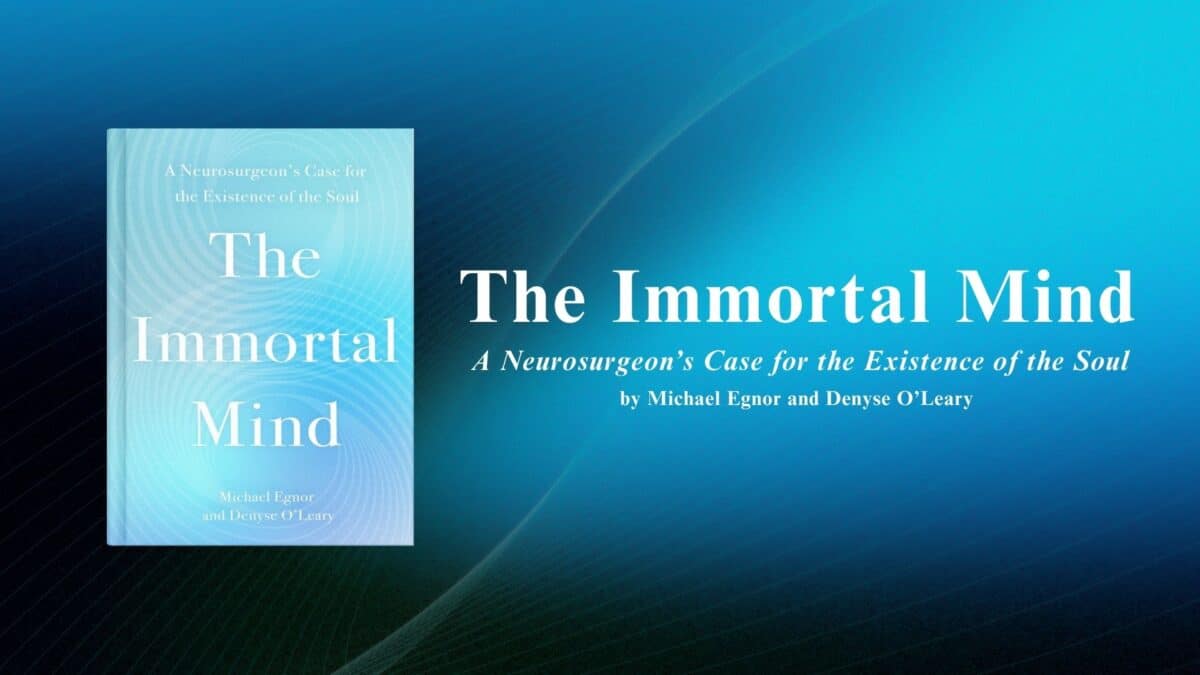
Immortal-Mind-Social-Media-Graphics-1920x1080px-No-Button Type post Author Michael Egnor Date June 3, 2025 CategoriesAnatomyMedicineNeuroscience & Mind Tagged , bone, brain, consciousness, corpus callosotomy, Denyse O'Leary, epilepsy, legs, Michael Egnor, mind, neuroscience, neurosurgery, seizures, skull, split-brain surgery, surgery New Book, The Immortal Mind, Out Today — The Brain Can Be Split, but Not the Mind Michael Egnor and Denyse O’Leary June 3, 2025 Anatomy, Medicine, Neuroscience & Mind 4 Even when the brain is split in half, many important aspects of the mind remain unified. Thus, the mind is something that the brain isn’t. Read More ›
soldier-grasshopper-nymphs Type post Author Granville Sewell Date June 2, 2025 CategoriesEvolutionIntelligent DesignScientific Reasoning Tagged , children, College Physics, common science, computer simulation, computers, David Klinghoffer, evolution, fundamental forces, humans, intelligent design, James Tour, materialistic science, Mathematical Intelligencer, mathematicians, Michael Kent, natural phenomena, Peter Urone, physics, Plato's Revenge, quantum mechanics, Rice University, Richard Sternberg, scientific evidence, smart phones, spaceships, supernatural Evolution and Common-Sense Reasoning Granville Sewell June 2, 2025 Evolution, Intelligent Design, Scientific Reasoning 5 The equations of quantum mechanics do not describe exactly — even in theory — the effects of the fundamental forces on the fundamental particles of physics. Read More ›