






































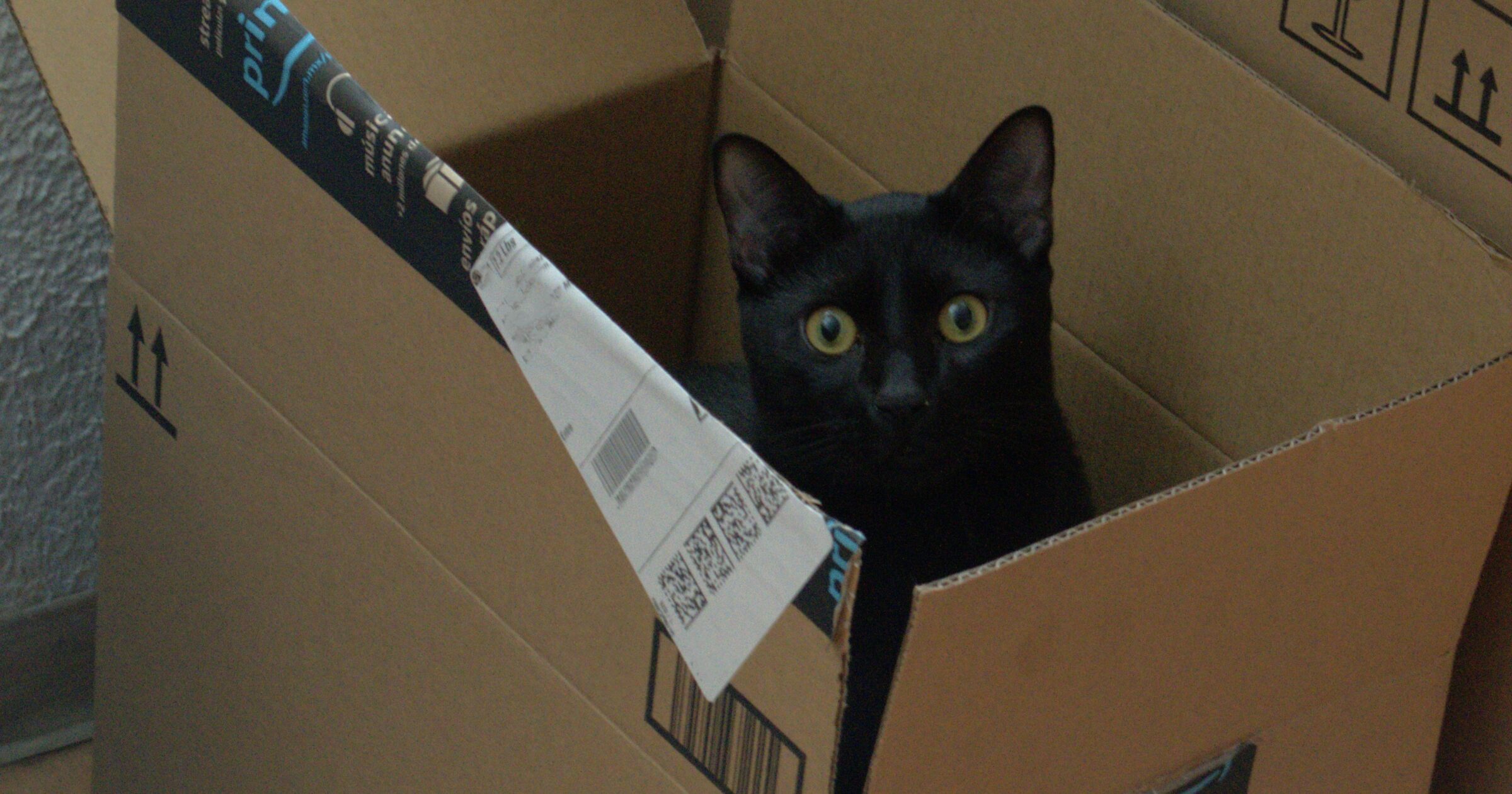
Schrödinger’s cat has got to be the most famous cat in science. He’s really a thought experiment designed by physicist Erwin Schrödinger (1887–1961) as an objection to the weirdness of quantum mechanics:
Schrödinger felt that while quantum mechanics was valid in describing the blurriness of the subatomic world, applying quantum mechanics indiscriminately led to strange consequences, writing in his paper “The Present Situation in Quantum Mechanics” (1935):
“One can even set up quite ridiculous cases. A cat is penned up in a steel chamber, along with the following device (which must be secured against direct interference by the cat): in a Geiger counter there is a tiny bit of radioactive substance, so small, that perhaps in the course of the hour one of the atoms decays, but also, with equal probability, perhaps none; if it happens, the counter tube discharges and through a relay releases a hammer which shatters a small flask of hydrocyanic acid. If one has left this entire system to itself for an hour, one would say that the cat still lives if meanwhile no atom has decayed. The psi-function of the entire system would express this by having in it the living and dead cat (pardon the expression) mixed or smeared out in equal parts.”
Britannica
Physicists have in fact been able to place ions and photons in such superposed states so we know the state really exists.
A Cat and a Controversy
Here’s science writer Jim Baggott’s recent contribution at Aeon to the unending controversy over how all this alive-and-dead at the same time stuff is possible in a supposedly straightforward world:
We are faced with a choice. We can recognise that quantum mechanics — with all its weirdness — is a purely symbolic framework for predicting the probabilistic outcomes of our experiments. It is indeed a calculational trick, not to be taken literally, which allows us some ability to get a handle on an otherwise unfathomable atomic and subatomic world.
Or we can recognise (with Einstein and Schrödinger) that quantum theory is at the very least incomplete, and deeply unsatisfactory. A theory capable of fathoming the atomic and subatomic world ought to be possible, if only we have the will to look for it, and the wit to find it.
“The cat that wouldn’t die,” April 28, 2025
Or — there is a third way — the world is simply more complex than classical physics assumes.
Cross-posted at Mind Matters News.