






































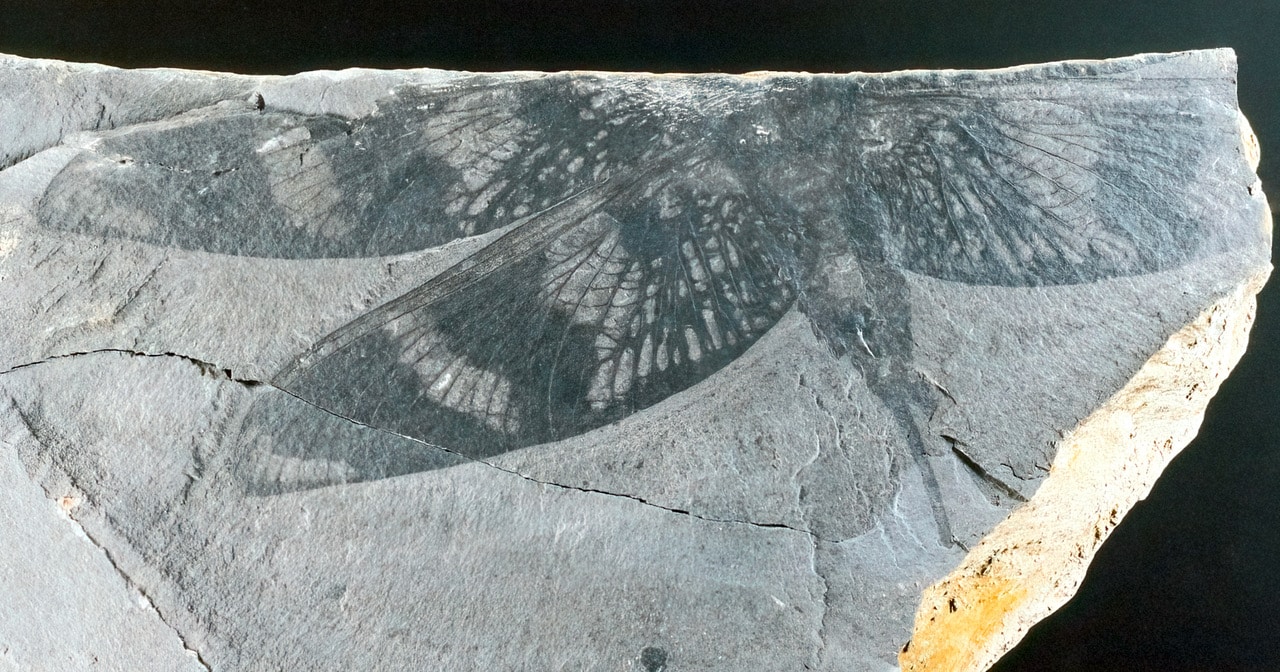
This Fossil Friday features Lithomantis varius, a large fossil insect from the Carboniferous (Namurian) brickwork quarry of Hagen-Vorhalle in Germany, which is one of the most ancient fossil localities for winged insects and dates to about 318 million years ago. Lithomantis belongs to the winged insect order Palaeodictyoptera, which only existed in the Palaeozoic era.
Insect wings are extremely complex structures that are highly adapted to their function as flight organs. They have a fan-like plicated structure to give the wing surface stability; additionally they are enforced by a complex wing venation; the wing is also supplied with sensory hairs; and the wing base has a highly complex arrangement of articulatory plates to allow for sophisticated movement, enabled by an associated muscular and neural system.
According to Darwinism, the evolution of such a system would certainly have required a plethora of intermediate stages that brought this wonderful locomotory apparatus into being by an accumulation of many small changes over a long period of time. Since paleontologists have discovered thousands of fossil insects from the Paleozoic, we have certainly also found at least some of these transitional forms in the evolution of insect wings!? At least one? Nope, not a single one.
The oldest fossil winged insects belong the orders Palaeodictoptera (e.g., Delitzschala) and to the giant dragonfly order Meganisoptera, thus they were already equipped with the complete wing apparatus. There is not a single transitional form, so that the leading textbook on insect evolution, by Grimaldi & Engel (2005: 160), admitted: “An insect equivalent of an Archaeopteryx remains elusive but certainly existed.” Apparently, the engineering marvel of insect wings came into being abruptly rather than gradually, which is inexplicable with unguided evolution but quite expected with intelligent design.