






































In the past we’ve covered proposals from evolutionists that monkeys rafted across oceans. Why would anyone make such an outlandish proposal? To save common descent from falsification, of course. Now they’re at it again — this time with terrestrial dinosaurs.
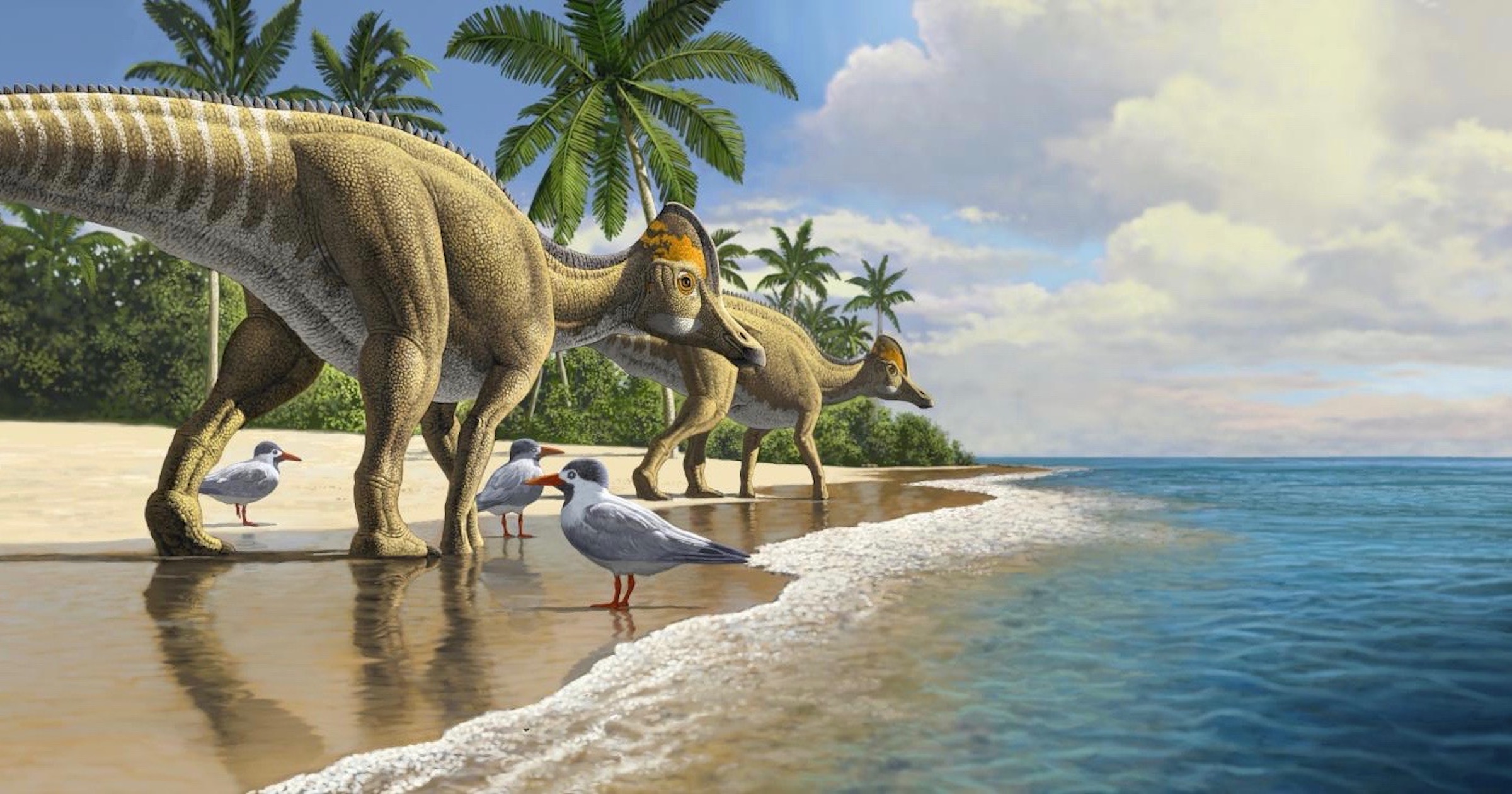
According to a story at SciTechDaily, “Dinosaurs Once Crossed Oceans: First Duckbill Dinosaur Fossil Discovered in Africa,” duckbilled dinosaurs rafted across ancient oceans to make their way to Africa:
Reconstructing duckbill evolution, they found the lambeosaurs evolved in North America, then spread over a land bridge to Asia. From there, they colonized Europe, and finally Africa.
Because Africa was isolated by deep oceans at the time, duckbills must have crossed hundreds of kilometers of open water-rafting on debris, floating, or swimming — to colonize the continent. Duckbills were probably powerful swimmers — they had large tails and powerful legs, and are often found in river deposits and marine rocks, so they may have simply swum the distance.
Expect the Unexpected
Of course, this is not what they expected. According to the story, finding a duckbilled dinosaur in Africa was “about the last thing in the world you would expect”:
Duckbills evolved in North America and eventually spread to South America, Asia, and Europe. Because Africa was an island continent in the Late Cretaceous, isolated by deep seaways, it seemed impossible for duckbills to get there.
The discovery of the new fossil in a mine a few hours from Casablanca was “about the last thing in the world you would expect,” said Dr. Nicholas Longrich, of the Milner Centre for Evolution at the University of Bath, who led the study. Dr. Longrich said: “It was completely out of place, like finding a kangaroo in Scotland. Africa was completely isolated by water — so how did they get there?”
The article lays out the logic by which they inferred that duckbilled dinosaurs must have rafted to Africa:
“Sherlock Holmes said, once you eliminate the impossible, whatever remains, no matter how improbable, must be the truth,” said Longrich. “It was impossible to walk to Africa. These dinosaurs evolved long after continental drift split the continents, and we have no evidence of land bridges. The geology tells us Africa was isolated by oceans. If so, the only way to get there is by water.”
Or in other words:
- We know that universal common ancestry is true; this is an inviolable fact.
- Duckbilled dinosaurs are known from North America, South America, and Europe — regions connected by a land bridge in the Cretaceous.
- This fossil of a type of duckbilled dinosaur was found in Africa.
- But Africa was a continent isolated by oceans at this time.
- How can we explain this? It’s impossible that universal common ancestry is false. Therefore, duckbilled dinosaurs must have rafted or swam across oceans to arrive in Africa.
Ride the Wild Waves, Dinos
The technical article in Cretaceous Research uses much the same reasoning:
Swimming, drifting, or rafting therefore could explain oceanic dispersal in dinosaurs. Dinosaur reproductive biology may improve the odds of a dispersal events leading to successful colonization. Large mammals have low reproductive rates, meaning a herd must disperse to establish a viable population. Dinosaurs’ large clutch size (Horner, 1999) likely improved the odds of a dispersal event becoming established, because a single gravid female could establish a population.
The odds of dinosaurs crossing ocean barriers are low, but improbable is different from impossible. If vicariance and land bridges cannot explain biogeographic patterns, then oceanic dispersal, no matter how improbable, becomes the only viable hypothesis. Importantly, over millions of years, highly improbable, once-in-million-years events become likely, even probable.
And there you have it, spelled out clearly: for evolutionists, it’s more reasonable to accept the “improbable” event that dinosaurs rafted across oceans than to accept what they feel is “impossible” — that common descent is false.