






































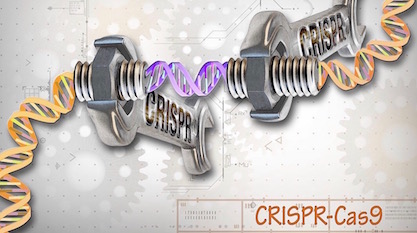
 Image credit: Ernesto del Aguila III, NHGRI [Public domain], via Wikimedia Commons.
Some of the most powerful technologies ever invented — which can change human life at the DNA level — are moving forward with very little societal discussion or sufficient regulatory oversight. MIT Technology Review is now reporting an attempt in the U.S. to use CRISPR to genetically modify a human embryo:
The first known attempt at creating genetically modified human embryos in the United States has been carried out by a team of researchers in Portland, Oregon, MIT Technology Review has learned.
The effort, led by Shoukhrat Mitalipov of Oregon Health and Science University, involved changing the DNA of a large number of one-cell embryos with the gene-editing technique CRISPR, according to people familiar with the scientific results…
Now Mitalipov is believed to have broken new ground both in the number of embryos experimented upon and by demonstrating that it is possible to safely and efficiently correct defective genes that cause inherited diseases.
Although none of the embryos were allowed to develop for more than a few days — and there was never any intention of implanting them into a womb — the experiments are a milestone on what may prove to be an inevitable journey toward the birth of the first genetically modified humans.
It may start with curing disease. But it won’t stay there. Many are drooling to engage in eugenic genetic enhancements.
So, are we going to just watch, slack-jawed, the double-time march to Brave New World unfold before our eyes? Or are we going to engage democratic deliberation to determine if this should be done, and if so, what the parameters are?
Considering recent history, I fear I know the answer. And no: I don’t trust “The Scientists” to regulate themselves.
Image credit: Ernesto del Aguila III, NHGRI [Public domain], via Wikimedia Commons.

Cross-posted at The Corner.