






































Science and Culture Today Discovering Design in Nature
Trilobite
Latest

Falsify Intelligent Design? Try Simulating the Cambrian Explosion Digitally

Categories
Intelligent Design
Share
Facebook
Twitter/X
LinkedIn
Flipboard
Print
Email

Want to falsify the theory of intelligent design? Here’s one way.

Show with a convincing computer simulation – no cheating allowed — that the infusion of biological information in the Cambrian explosion could occur absent the intervention of a guiding intelligence: artificial life in a variety as we see in the Cambrian event, but without design.

Researchers have tried, in multiple cases, as Introduction to Evolutionary Informatics author Winston Ewert tells biologist Ray Bohlin on a new episode of ID the Future. But each time, the simulations hit a “complexity barrier,” as the scientists themselves concede, and fail. It’s a fascinating conversation. Listen to it here, or download it here.

Ewert calls it “the mystery of the missing digital Cambrian explosion,” observing that “something is missing from all of the different artificial life simulations.” There’s a secret ingredient, and guess what that is? Intelligent design.

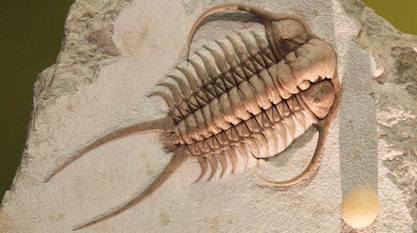
Image: Trilobite, Smithsonian Museum of Natural History, by Tim Evanson [CC BY-SA 2.0], via Wikimedia Commons.

David Klinghoffer

Senior Fellow and Editor, Science and Culture Today
David Klinghoffer is a Senior Fellow with Discovery Institute’s Center for Science and Culture. He is the author of seven books including Plato’s Revenge: The New Science of the Immaterial Genome and The Lord Will Gather Me In: My Journey to Jewish Orthodoxy. A former senior editor at National Review, he has contributed to the New York Times, Wall Street Journal, and other publications. He received an A.B. magna cum laude from Brown University in 1987. Born in Santa Monica, CA, he lives on Mercer Island, WA.
Benefiting from Science & Culture Today?
Support the Center for Science and Culture and ensure that we can continue to publish counter-cultural commentary and original reporting and analysis on scientific research, evolution, neuroscience, bioethics, and intelligent design.

© Discovery Institute